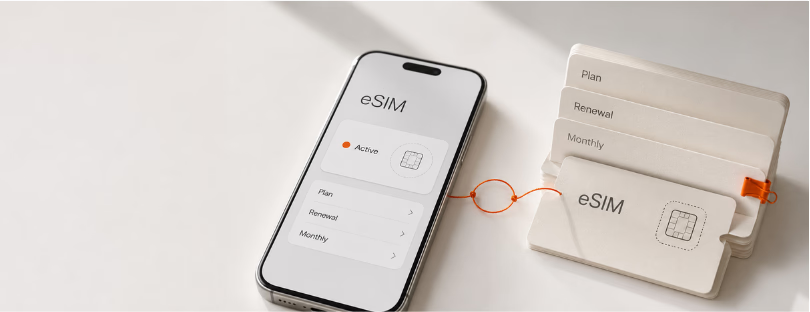
Telna places a $100 million bet on the future of travel eSIMs
The travel eSIM market has reached a moment where experimentation is giving way to scale. What started as a niche solution for frequent travelers has quietly evolved into one of the fastest-moving layers in global telecom. Against that backdrop, Telna has announced something the industry has not seen before: a dedicated $100 million investment fund focused exclusively on digital-first, direct-to-consumer eSIM brands, MVNOs, and Super App integrations.
This is not a generic telecom venture fund with a broad mandate. It is tightly scoped, purpose-built, and designed around a single thesis: travel eSIMs are becoming the default connectivity layer for international users, and the next wave of winners will be app-driven, regional, and deeply consumer-focused.
For an industry that has historically moved slowly and relied on heavyweight incumbents, that shift is hard to overstate.
Why this fund matters now
Over the last few years, travel eSIM adoption has followed a familiar pattern seen in other digital infrastructure markets. First came awareness, then utility, and now acceleration. New eSIM-native brands are launching at a pace traditional telecom models could never support, reaching global distribution in months rather than years.
What makes this moment different is not just growth, but structure. Travel eSIM providers are no longer just resellers of roamingdata. Many are evolving into full-stack MVNOs or app-based platforms that combine connectivity with payments, travel services, loyalty, and local offers. In short, they are becoming the application layer that sits on top of telecom infrastructure.
Telna has had a front-row seat to this evolution. As the connectivity enabler behind a large share of global travel eSIM providers, the company has visibility into usage patterns, regional adoption curves, and which business models actually scale in the real world. That insight is now being formalized into capital, partnerships, and acquisitions.
The goal of the fund is straightforward: accelerate global eSIM adoption by backing companies that understand how travelers actually buy, activate, and use connectivity in 2026 and beyond.
From infrastructure provider to ecosystem catalyst
Telna’s role in the eSIM ecosystem has traditionally been clear. It provides the underlying telecom infrastructure, APIs, and global reach that allow travel eSIM brands and MVNOs to operate across borders. What changes with this fund is not that role, but how strategically it is applied.
Rather than sitting behind the scenes as a neutral enabler, Telna is now actively shaping which models reach scale. The fund offers growth capital, structured partnership programs, and acquisition opportunities to travel connectivity providers, regional MVNOs, and Super Apps that are ready to move faster.
This includes support for brands that want to own a specific geographic niche, develop co-branded offers with local partners, or embed connectivity directly into consumer-facing apps. Several funding initiatives are already underway, signaling that this is not a theoretical announcement but an operational strategy with real traction.
The underlying logic is simple. As the number of eSIM brands increases, differentiation becomes harder. Infrastructure alone is no longer enough. The winners will be those who combine reliable global coverage with sharp positioning, strong UX, and direct consumer relationships.
Travel eSIM MVNOs as the new application layer
One of the most interesting implications of the fund is how it frames travel eSIM MVNOs. Rather than seeing them as lightweight telecom players, Telna positions them as regional application layers capable of anchoring broader digital ecosystems.
In many markets, prepaid roaming services are becoming the first touchpoint between users and digital connectivity. Travelers trust these apps, store payment details, and interact with them repeatedly. That makes them natural launchpads for additional services, from local data plans to financial tools and travel perks.
This mirrors what has already happened in parts of Asia, where Super Apps grew out of specific utility use cases before expanding horizontally. The difference is that travel eSIMs are global by default. They are borderless, instant, and increasingly expected by consumers.
By backing MVNOs and travel eSIM apps early, Telna is effectively investing in the scaffolding for future Super Apps in multiple regions.
What the fund actually provides
While the headline number is $100 million, the more important detail is how that capital is deployed. The fund is designed to do more than write checks. It combines financial investment with operational leverage.
Portfolio companies gain access to Telna’s global telecom infrastructure, mature API stack, and data platforms. This reduces time to market, simplifies technical integration, and allows founders to focus on product, marketing, and user acquisition rather than negotiating with dozens of operators.
The first phase of the fund focuses squarely on MVNOs and travel eSIM applications offering instant, borderless roaming without physical SIM cards. Joint ventures with Super Apps are also a priority, particularly those that enable co-branded campaigns, loyalty programs, and deeply integrated app experiences.
This is where the strategy moves beyond telecom and into consumer tech. Distribution, branding, and engagement matter just as much as coverage maps.
Executive perspective from inside Telna
Gregory Gundelfinger, Founder and Chief Executive Officer, Telna
Beyond providing growth capital, this investment allows MVNOs to become more strategically aligned with Telna, enabling deeper technical and commercial integration with our platform. By working more closely together, these partners can build more differentiated products, accelerate innovation, and deliver unique, high-value connectivity experiences that stand out in an increasingly competitive market.
Michael Neuman, Chairman, Telna
The market for prepaid roaming is growing rapidly, and digital travel connectivity is becoming the global standard. This fund is a catalyst for the next wave of growth, empowering MVNOs, operators, and Super Apps to innovate while Telna continues to provide the infrastructure that makes global eSIM adoption possible.
These statements underline a key theme: alignment. The fund is not about passive returns. It is about creating a tighter feedback loop between infrastructure and innovation.
How does this compare to other players in the market?
Telna is not the only company betting on travel eSIM growth, but it is taking a structurally different approach. Consumer-facing brands like Airalo, Nomad, and GigSky have focused on scaling distribution and marketing. Operators and groups such as Vodafone, Orange, and Deutsche Telekom are embedding eSIMs into broader roaming and digital strategies.
What is missing from most of these approaches is a dedicated capital vehicle designed specifically for the travel eSIM layer. Traditional telecom venture arms tend to be broad and conservative. Startup VCs often lack deep telecom expertise.
By contrast, Telna’s fund sits at the intersection of infrastructure, data, and consumer behavior. It resembles moves seen in cloud computing a decade ago, when hyperscalers quietly backed SaaS companies that would drive demand for their platforms.
In that sense, the comparison is less with other eSIM providers and more with ecosystem builders like AWS or Stripe in their early expansion phases.
Market trends support the strategy
Independent data support the timing of this move. GSMA reports consistently show rising eSIM-compatible device penetration, while analyst firms such as Juniper Research and Kaleido Intelligence highlight prepaid roaming and travel connectivity as high-growth segments through the end of the decade.
At the same time, regulatory pressure on roaming transparency and consumer demand for predictable pricing are accelerating the shift away from traditional roaming bundles. Travelers increasingly expect connectivity to be as simple as booking a flight or hotel.
The travel eSIM model fits that expectation almost perfectly.
What this means for founders and the ecosystem
For startups and regional MVNOs, the fund lowers one of the biggest barriers to scale: capital combined with credible infrastructure. For Super Apps, it creates a pathway to embed global connectivity without building telecom capabilities from scratch.
For the broader ecosystem, it signals maturation. Travel eSIMs are no longer a workaround. They are becoming a core layer of digital travel.
Most importantly, it suggests that the next phase of competition will not be about who can sell the cheapest gigabyte, but who can build the most trusted, integrated, and regionally relevant connectivity experience.
Conclusion: a structural shift, not a headline
This fund should be read less as a bold announcement and more as a structural signal. Telna is effectively formalizing what the market has already been showing for two years: travel eSIMs are moving from product to platform.
Compared to consumer-first players chasing volume or operators cautiously experimenting at the edges, Telna is placing an infrastructure-backed, long-term bet on the application layer itself. If the strategy succeeds, the winners will not just be individual eSIM brands, but a new class of regional connectivity platforms that sit at the center of travel, payments, and digital services.
In hindsight, this may look like the moment when travel eSIMs stopped being a niche and started behaving like real telecom businesses, just built for a very different era.
Driven by wanderlust and a passion for tech, Sandra is the creative force behind Alertify. Love for exploration and discovery is what sparked the idea for Alertify, a product that likely combines Sandra’s technological expertise with the desire to simplify or enhance travel experiences in some way.