Lumia 2 Smart Earrings: The Next Step in Health Tracking
Wearables have been getting smaller, smarter, and more precise for years. But they have also been getting… a bit predictable. Wrist, finger, repeat. That is why Lumia Health’s latest launch feels different. Not just another iteration, but a shift in where health tracking actually happens.
The company’s new Lumia 2 smart earrings are quietly gaining serious traction. In less than a week, the Kickstarter campaign pulled in over $1.3 million. For a category that barely existed until recently, that is not just early hype. It is a signal.
Why the ear suddenly matters
Most wearables today live on your wrist or finger. It is convenient, yes. But according to Lumia Health, it is not ideal.
As Daniel Lee, co-founder and CEO of Lumia Health, explains, traditional wearables are placed there because it is easy, not because it is optimal.
“But there are significant limitations regarding what can be measured in these areas,” he says, noting that constant movement can interfere with sensor accuracy.
That is where the ear comes in. Specifically, behind the ear.
It is a part of the body that stays relatively stable, is close to major blood vessels, and is less exposed to the kind of motion noise that affects wrist-based tracking. In simple terms, it might just be a better place to measure what actually matters.
What Lumia 2 is actually doing
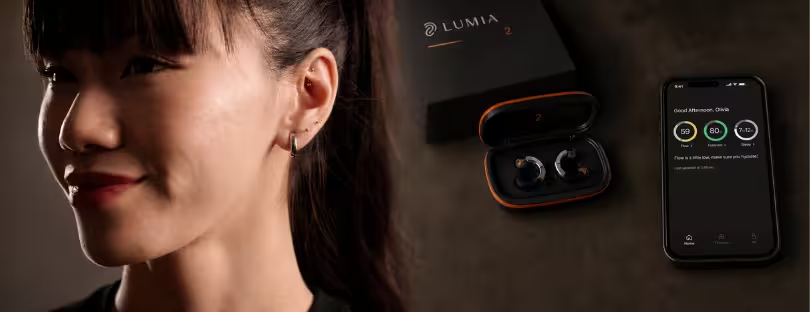
The Lumia 2 earrings are tiny. Less than a gram in weight and about five times smaller than AirPods. But inside that form factor, Lumia Health has packed miniature biosensors capable of tracking more than 20 health indicators.
We are talking about the usual suspects like heart rate, sleep, temperature, and blood oxygen. But also something more ambitious: blood flow.
That last one is not just a technical flex. It is personal.
Lee shares that the idea came after his father suffered a serious incident linked to insufficient blood flow to the brain. “We should be able to measure blood flow in real time to prevent some of these catastrophic injuries,” he says.
That is a bold claim. And if it works as intended, it moves this device out of the “wellness gadget” category and closer to something with real preventative health potential.
Design that actually fits daily life
One of the biggest friction points with wearables is not functionality. It is consistency. People stop wearing devices that are bulky, uncomfortable, or simply don’t fit their lifestyle.
Lumia seems to understand that.
The Lumia 2 comes in three different form factors, including options for people without pierced ears. Regardless of the version, the sensors sit behind the ear, maintaining measurement accuracy while keeping the visible design minimal.
Battery strategy is also worth noting. Instead of daily charging, the device uses replaceable batteries that last up to seven days. That might sound like a small detail, but in wearables, charging friction kills engagement. Removing that daily habit could make a real difference in long-term usage.
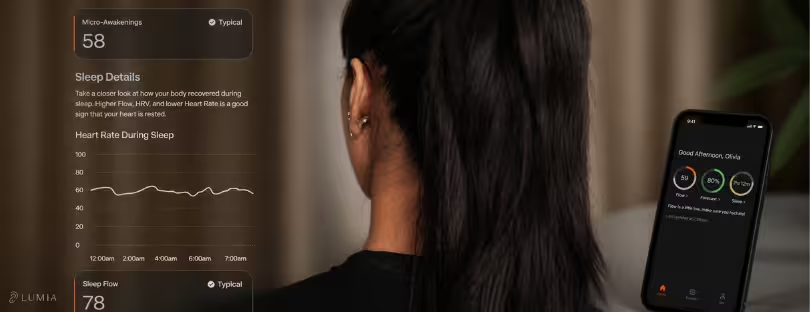
All collected data syncs with a mobile app on Android and iOS, which is standard. The real question will be how actionable and meaningful that data actually is.
The business model question
Here is where things get a bit more familiar.
The Lumia 2 starts at $249, but it comes with a mandatory subscription, available monthly or annually. That puts it in the same strategic lane as players like Oura or Whoop, where hardware is just the entry point and recurring revenue comes from insights and analytics.
This model works. But it also raises expectations.
If users are paying ongoing fees, the value cannot just be data collection. It has to be interpretation, recommendations, and ideally some level of predictive insight. Otherwise, it becomes another dashboard that people stop checking after two weeks.
Is this a real shift or just a niche?
It is tempting to dismiss smart earrings as a niche experiment. But the broader trend says otherwise.
According to reports from IDC and Statista, the global wearables market is still growing, but maturity is setting in. Smartwatch growth is slowing, and categories like smart rings have already proven there is demand for more discreet, specialized devices.
Oura showed that people are willing to move away from the wrist. Apple has explored ear-based biometrics in patents for years. Even companies like Bose and Sony have experimented with sensor-equipped earbuds.
So Lumia is not inventing the idea of ear-based sensing. It is productizing it in a new form factor.
And that is the interesting part.
Where this fits in the bigger picture
If you zoom out, this is not just about earrings. It is about where wearables are heading next.
We are moving from visible, multi-purpose devices to invisible, specialized ones. Less screen, more sensing. Less interaction, more passive data collection.
That aligns with a broader shift in consumer tech. The best products are the ones you forget you are wearing.
In that sense, Lumia 2 feels less like a competitor to smartwatches and more like part of a new layer of health infrastructure. Something that runs quietly in the background.
The real test starts after Kickstarter
Raising $1.3 million in a week is impressive. But crowdfunding success does not guarantee product-market fit.
The real test will come after launch.
Can Lumia deliver consistent, clinically meaningful data? Can it justify the subscription over time? And perhaps most importantly, can it build trust in a category that sits uncomfortably close to medical territory without being a certified medical device?
Those are not easy challenges.
Conclusion
Smart earrings might sound like a gimmick at first glance. But Lumia 2 taps into something real. A growing demand for health tracking that is less intrusive, more continuous, and better integrated into everyday life.
Compared to established players like Oura or Whoop, Lumia is taking a risk by betting on a new form factor instead of refining an existing one. That is harder. But it is also where breakthroughs tend to happen.
If the technology behind ear-based sensing proves more accurate, especially for metrics like blood flow, this could open an entirely new category of wearables. Not a replacement for smartwatches, but a parallel track that focuses on deeper health insights rather than surface-level tracking.
For now, it is an ambitious product with a strong early signal. Not a guaranteed success, but definitely not something to ignore.
And in a market that has started to feel a bit repetitive, that alone makes it worth watching.