The plane door opens. Everyone stands too early. Phones come out. Messages start loading. Then nothing happens.
No map. No Uber. No hotel address. No WhatsApp call. No boarding-pass screenshot for the connecting flight. Just that small, brutal reminder that international travel now depends on mobile data almost as much as it depends on a passport.
And here is the real business question: when millions of travelers land without data, who takes the money?
Right now, too often, the answer is: someone else.
Not the airline that carried the passenger. Not the hotel that will welcome them. Not the booking platform that owns the customer relationship. Not the travel app that helped plan the trip. The value leaks away at the exact moment the traveler is most ready to buy.
That is why travel connectivity is no longer a telecom side topic. It is becoming one of the most underused ancillary revenue opportunities in travel.
Connectivity is now part of the trip
Travel businesses already understand ancillaries. Airlines sell seats, bags, lounge access, priority boarding, insurance, car rental and hotels. According to IdeaWorksCompany, airline ancillary revenue now represents 15.7% of total airline revenue, up from 9.1% in 2016. That tells us something important: travelers are willing to buy useful add-ons when the timing makes sense.
Mobile data fits that logic perfectly.
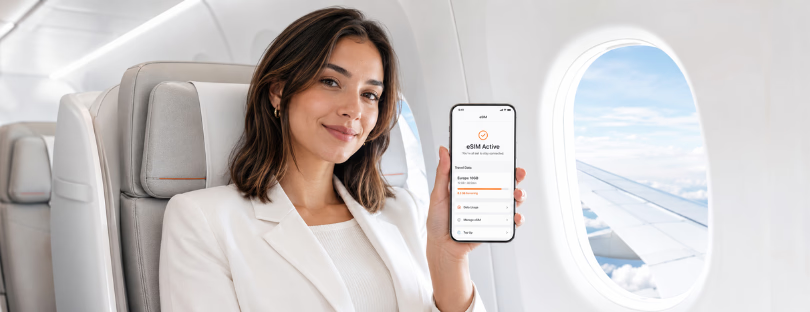
The traveler does not need an eSIM six months before departure. They need it when the trip becomes real: after booking, before flying, during online check-in, inside the airline app, in the hotel pre-arrival email, or when they scan the destination guide.
The problem is that many travel brands still treat connectivity as “not our category.” That made sense when roaming was controlled almost entirely by mobile operators. It makes much less sense now.
eSIM has turned connectivity into a digital product. It can be embedded, bundled, recommended, white-labeled or sold through APIs. GSMA Intelligence has noted that mobile operators are increasingly launching travel eSIM offers themselves, while consumer eSIM use is expanding into temporary and on-demand connectivity models. In simple terms, everyone can see the same opportunity now.
More on Alertify
Follow the latest eSIM news
Market moves, provider updates, roaming trends and travel connectivity stories in one place.
Explore eSIM news →
The money is moving
This is not a tiny market hiding in a corner of telecom. Juniper Research has forecast strong growth for travel eSIMs, with reports in 2025 pointing to revenue growth of around 85% for travel eSIM packages.
That growth is happening because the customer pain is obvious. Roaming remains confusing. Local SIM cards are inconvenient. Airport SIM counters feel outdated. Free Wi-Fi is patchy and often insecure. And younger travelers, business travelers and digital nomads have very little patience for being offline. monetize travel connectivity
So the travel eSIM market has grown fast because it solved a practical problem. But the next phase will be different. It will not only be about eSIM providers selling directly to travelers through search ads and comparison sites. It will be about distribution.
Airlines have the boarding pass. Hotels have the pre-arrival flow. OTAs have the itinerary. Fintech apps have the travel-spend signal. Travel insurance companies know the destination and dates. Airports know the arrival anxiety better than anyone.
The companies closest to that moment should not be watching telecom brands capture all the margin.
Airlines are the obvious first movers
Airlines are especially well-positioned because they already sell trip add-ons and control multiple touchpoints before departure. A travel eSIM offer can sit naturally inside booking confirmation, check-in, app notifications or destination content.
This is not about turning airlines into telecom companies. That would be the wrong lesson. It is about using eSIM infrastructure partners, APIs or reseller models to turn connectivity into a travel service.
The best version feels invisible: “You are flying to Japan next week. Add 10GB data before you land.” That is far more relevant than another generic credit card pop-up or car rental banner.
It also fits the market direction. IATA reported that full-year international passenger demand rose 7.1% in 2025 versus 2024, with an international load factor of 83.5%. More international movement means more cross-border connectivity friction.
Every passenger landing abroad is a potential connectivity customer. The only question is whether the travel brand makes the offer first or leaves the traveler to Google it later.
Hotels, banks and travel platforms should pay attention
Hotels often talk about guest experience, but many still ignore the first digital pain point after arrival: getting online before reaching the property. A hotel chain offering guests a simple destination data plan is not selling “telecom.” It is reducing friction before check-in.
Banks and fintechs have another angle. They already see travel behavior through card spending, FX usage and premium travel benefits. Connectivity can become part of a smarter travel bundle, especially for high-value customers.
OTAs and travel platforms may have the widest opportunity. They already package flights, stays, transfers, insurance and activities. Connectivity belongs in that basket. Not as a loud upsell, but as a useful trip layer.
The winners will not be the brands that throw a random eSIM banner onto a confirmation page. The winners will understand timing, context and trust. They will offer the right plan for the destination, explain validity clearly, avoid fake “unlimited” promises, and make support simple.
That is where many travel brands still need help. The product is easy to plug in. The positioning is harder.
Your customers will buy connectivity. The question is: from you, or from someone else?
We help airlines, banks, and travel platforms turn that demand into a built-in product — not a missed opportunity.
Final thoughts about monetizing travel connectivity
The travel industry has spent years monetizing bags, seats and breakfast. Connectivity may be the next obvious add-on, but it needs to be handled with more care. A bad eSIM experience damages trust quickly because travelers feel it immediately. No data means no map, no ride, no message, no confidence.
Compared with classic airline ancillaries, travel connectivity is more useful and less annoying when it is offered well. Compared with roaming, it can feel more transparent. Compared with standalone eSIM marketplaces, embedded travel brands have one major advantage: they already know where the customer is going and when.
So the money is there. The demand is there. The moment is there.
The only uncomfortable question for travel brands is this: if your customer lands without data and buys connectivity from someone else, how many times are you willing to let that happen?
For airlines, hotels, fintechs, travel agencies and booking platforms, this is the moment to stop wasting a high-intent revenue opportunity. Alertify helps travel and tech businesses shape the right connectivity offer, narrative and go-to-market approach before someone else owns that customer moment.
Driven by wanderlust and a passion for tech, Sandra is the creative force behind Alertify. Love for exploration and discovery is what sparked the idea for Alertify, a product that likely combines Sandra’s technological expertise with the desire to simplify or enhance travel experiences in some way.