KOLET eSIM and the Shift Toward App-First Roaming
KOLET is one of those eSIM brands that says something important about where the travel connectivity market is going. Not because it is the loudest name in the category. It is not. Airalo, Holafly, Ubigi, Nomad eSIM, Saily and GigSky still dominate a lot of the traveller conversation. But KOLET is interesting because it is trying to make the eSIM feel less like a telecom product and more like a travel companion.
That matters.
For years, travel eSIMs were sold around one very simple promise: avoid roaming charges. That promise still works, of course. Nobody enjoys landing in another country and receiving a message that their operator will generously charge them €9.99 per day to check WhatsApp and Google Maps. But the market is moving past the first wave. Travellers now expect more than “cheap data abroad.” They expect easy installation, clear pricing, fast top-ups, real-time usage tracking, and support that does not disappear the moment something goes wrong.
KOLET’s positioning sits right in that shift.
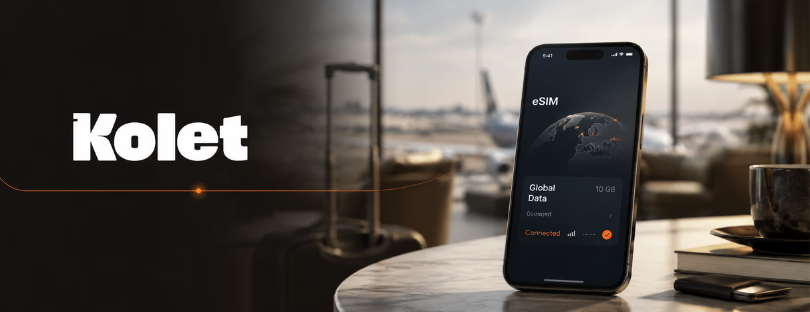
The app-first eSIM
KOLET describes itself as a next-gen eSIM service for travellers, with mobile internet available in more than 190 countries. Its app listings highlight plans starting from €3.99, installation in under two minutes, no commitment, no hidden costs, real-time usage tracking and easy recharging. The brand also says more than 500,000 travellers use the service, and its App Store listing shows a 4.9 rating from 838 ratings at the time checked.
The most interesting part is not only the coverage claim. Many eSIM providers now say they cover 150, 180 or 200-plus destinations. The more interesting part is KOLET’s “install once, use forever” idea. On its own site, KOLET explains that users can install one eSIM and then keep recharging it for future trips instead of installing a fresh eSIM profile every time.
That is a small product detail, but a meaningful one. eSIM installation is much easier than it was a few years ago, but it is still where many mainstream users get nervous. QR code? Data roaming toggle? Primary SIM? Travel line? Suddenly, the supposedly simple product starts to feel technical. KOLET is clearly trying to remove that repeated friction.
Kolet eSIM for the World Cup
One travel eSIM for the tournament across the United States, Canada, and Mexico, with simple 30-day data options.
Canada
Mexico
3 countries included
Where KOLET fits
KOLET is not trying to look like a traditional mobile operator. It openly says it is not a network provider, but works with networks to deliver connectivity wherever users travel. That is important because it places KOLET in the same broad category as most travel eSIM brands: customer-facing app, partner network access, prepaid data bundles, digital onboarding.
The difference is in the travel distribution angle. TechCrunch reported in 2024 that KOLET had revenue-sharing agreements with travel partners, including professional travel agency Resaneo and booking platform Ulysse, with plans starting at €3.99 for 1GB in Europe at the time. Then KLM announced a partnership with KOLET in November 2024, offering travellers an eSIM solution for destinations in more than 190 countries through a dedicated website or the KOLET app.
This is where KOLET becomes more than “another eSIM app.” The eSIM market is increasingly becoming a distribution game. The winning moment is not always when a traveller searches “best eSIM for Japan” on Google. It may be when they book a flight, check in, receive a travel confirmation, open an airline app, or prepare their itinerary.
That is exactly why airline and travel-platform partnerships matter.
The real product is confidence
The best eSIM brands are no longer selling data only. They are selling confidence before a trip.
KOLET’s pitch leans heavily into that: no roaming fees, no hidden costs, easy setup, top-ups, support, and a money-back satisfaction message on its website. Its app descriptions also emphasize tracking usage in real time, which is underrated. Travellers do not only want cheap data. They want to know whether their 3GB will survive a weekend in Lisbon, a work trip in Dubai, or a family holiday where someone inevitably turns on cloud photo backup at the worst possible moment.
This is also where KOLET has to compete with more established players. Airalo has scale and brand recognition. Holafly has pushed hard into unlimited-style travel data. Ubigi benefits from a deeper Transatel telecom background. GigSky has long-standing travel connectivity credibility. Saily has Nord Security’s consumer trust engine behind it. KOLET’s advantage, if it keeps sharpening it, is simplicity plus travel-channel distribution.
But that also creates pressure. When every provider claims easy activation, global coverage and no roaming fees, differentiation becomes harder. KOLET will need to keep proving what its experience does better: fewer installation headaches, clearer plan logic, stronger partner journeys, better handling of unused data, or more responsive support.
Get your Kolet eSIM for Europe
Stay connected across the European Union and UK, including France, the Netherlands and Germany, with one simple travel eSIM.
France
Netherlands
Germany
The market is moving fast
The timing is good. GSMA Intelligence recently framed consumer eSIM as moving from forecast to fact, putting global eSIM smartphone penetration at 5% at the end of 2025, with expectations of 10% by the end of 2026. That may sound modest, but in travel it is already enough to change behaviour. More travellers have eSIM-compatible phones. More operators are responding. More airlines and travel brands are testing connectivity as an ancillary product.
That last point is crucial. Travel eSIMs are not just competing with roaming anymore. They are competing for the best place in the travel journey. The provider that appears at the right moment, with the least friction, may win even if it is not the cheapest option on a comparison table.
Conclusion
KOLET is not yet the default name in travel eSIM, but it represents a very relevant direction: eSIM as a travel service, not a telecom purchase. That distinction matters.
The first generation of travel eSIM brands won attention by being cheaper than roaming. The next generation will win by being easier to trust, easier to install, and easier to discover exactly when the traveller needs them. KOLET’s airline and travel-platform partnerships point in that direction. Its “one eSIM for all trips” idea also addresses one of the market’s quiet pain points: setup fatigue.
The challenge is that the category is becoming crowded fast. Airalo, Holafly, Nomad eSIM, Ubigi, GigSky and others are all fighting for the same traveller habit. KOLET’s opportunity is not to shout louder, but to make the experience feel calmer. Less telecom. More travel. Less “buy a data bundle.” More “you land, it works, you move on.”
And honestly, that may be where the whole market is heading.
Sandra Dragosavac
Driven by wanderlust and a passion for tech, Sandra is the creative force behind Alertify. Love for exploration and discovery is what sparked the idea for Alertify, a product that likely combines Sandra’s technological expertise with the desire to simplify or enhance travel experiences in some way.