IoT eSIM Management: Telecom26 & Trasna Launch eIM
As industries from maritime to smart infrastructure scale their IoT deployments, a quiet but serious problem is surfacing. Physical SIM logistics and manual provisioning are becoming bottlenecks. Shipping plastic SIM cards across continents, scheduling technician visits for swaps, and locking devices into single-network contracts create cost, delay, and operational risk.
Against that backdrop, Telecom26 and Trasna have partnered to launch a new eSIM IoT Manager platform, known as eIM. The aim is straightforward but powerful: give enterprises centralised, remote control over large-scale IoT fleets.
This is not just another product launch. It reflects a structural shift in how connected infrastructure is managed.
The Hidden Cost of Physical SIMs
When organisations deploy thousands or millions of devices across ships, ports, energy grids, smart cities or transport systems, connectivity becomes mission-critical. But many IoT deployments still rely on traditional SIM distribution models.
That means warehouses, inventory tracking, region-specific SKUs and on-site installation. If a device changes geography or requires a new network agreement, someone often has to physically intervene. In remote or industrial environments, that intervention can be expensive and slow.
As IoT expands, this model simply does not scale.
Enter eSIM.
But embedded SIM technology alone is not enough. What matters is orchestration. Who controls the profiles? How are they switched? How quickly can enterprises react if coverage fails or commercial terms change?
That is where the eIM platform comes in.
What the eIM Platform Enables
The new solution combines Telecom26’s global connectivity reach with Trasna’s expertise in eSIM and eUICC architecture. Built in alignment with the GSMA SGP.32 IoT eSIM framework, the platform enables secure over-the-air provisioning, profile updates and lifecycle management of eSIM profiles embedded in devices that may never be physically accessed again.
In practical terms, enterprises gain:
Remote profile provisioning
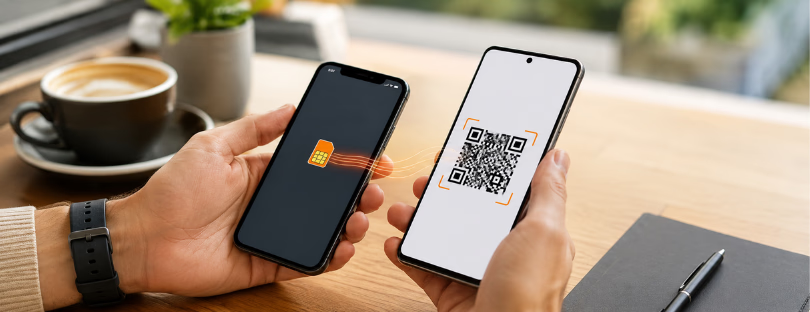
Connectivity profiles can be activated, switched or updated over the air without physical SIM swaps.
Multi-network flexibility
Devices can connect across multiple networks, with fallback options that enhance resilience.
Automated onboarding
New devices can be enrolled and configured remotely, reducing deployment time.
Real-time visibility
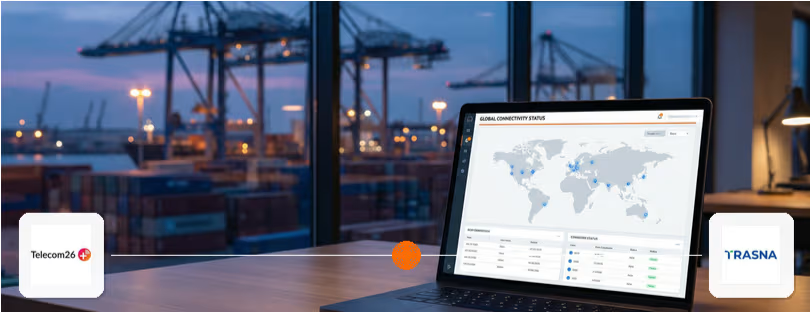
Enterprises can monitor connectivity status across thousands or millions of endpoints from a central interface.
The key shift here is from static connectivity to programmable connectivity. Instead of being locked to a single operator or contract, enterprises gain agility.


Why SGP.32 Matters
The alignment with SGP.32 is not a minor detail. Earlier M2M eSIM frameworks provided remote provisioning, but often with complexity and limitations that slowed adoption.
SGP.32 was developed to simplify IoT eSIM architecture and better support large-scale, unattended deployments. It introduces a more streamlined approach to profile management, enabling easier integration and broader interoperability.
With global IoT connections forecast by GSMA to exceed 30 billion in the coming years, remote lifecycle management is becoming essential. Enterprises cannot manage that scale with manual processes.
By building around SGP.32, Telecom26, and Trasna are positioning their platform in line with where industry standards are moving.
A Necessity, Not a Convenience
David McCanny, VP commercial operations at Telecom26, captured the urgency of this shift:
“Bringing the agility of eSIM to the M2M market is a massive step forward for enterprise connectivity,” said David McCanny, VP commercial operations at Telecom26. “Managing devices remotely isn’t just a convenience — it’s a necessity. This solution ensures even the most inaccessible devices benefit from enhanced security and seamless fallback capabilities. “
In sectors such as maritime or utilities, a connectivity failure is not an inconvenience. It can disrupt operations, delay data flows or create safety risks. The ability to switch profiles remotely or activate fallback networks becomes operationally critical.
Remote control is becoming baseline infrastructure.
Competitive Landscape
Telecom26 and Trasna are not alone in recognising this shift. IoT connectivity management platforms are expanding rapidly. Companies such as Pelion and Amdocs have also invested in advanced IoT management layers that include eSIM orchestration and multi-network control.
The broader trend is clear. Connectivity is evolving into a software-defined asset. Enterprises increasingly expect flexibility, transparency and contract independence. Static roaming agreements and long-term single-carrier lock-ins are becoming harder to justify in a world of dynamic deployments.
What differentiates platforms in this space is not just coverage. It is the intelligence and control layer sitting on top of that coverage.

Security and Lifecycle Control
Security is central to industrial IoT deployments. Over-the-air provisioning must be secure, encrypted and compliant with industry standards. Profile switching must not introduce vulnerabilities.
By leveraging established GSMA standards and combining connectivity supply with eUICC expertise, the Telecom26 and Trasna collaboration aims to address those concerns. The ability to update or replace connectivity profiles remotely can even strengthen resilience. Instead of recalling devices, enterprises can adapt configurations digitally.
Lifecycle management also becomes more transparent. Enterprises gain insight into activation status, usage patterns and network performance across their fleets.
That visibility can inform both operational decisions and commercial negotiations.
The Bigger Picture
This launch reflects a broader transformation in connectivity economics.
For years, connectivity was treated as a commodity line item. Today, it is increasingly seen as strategic infrastructure. As IoT becomes embedded in critical services, enterprises demand sovereignty over how their devices connect and switch networks.
Remote eSIM orchestration aligns with wider digital transformation trends. Just as cloud computing replaced physical servers with virtualised environments, eSIM is replacing plastic SIM distribution with digital control.
The centre of gravity is shifting from hardware logistics to software management.
Conclusion about the IoT eSIM management platform
The Telecom26 and Trasna eIM platform arrives at a moment when IoT deployments are scaling beyond what traditional SIM models can sustain. By aligning with SGP.32 and focusing on centralised remote control, the partnership reflects where enterprise connectivity is heading.
Similar moves by players like Pelion and Amdocs show that the control layer is becoming the competitive battleground. Coverage alone is no longer enough. Enterprises want programmable, resilient and multi-network connectivity that adapts as their deployments evolve.
The bigger picture is clear. As IoT fleets grow into the millions, the question is not whether to adopt eSIM. It is who controls the orchestration layer and how flexible that control can be.
In the next phase of IoT expansion, the leaders will be those who provide not just connectivity, but infrastructure-level command over it.