New Coral eSIM Donates Per GB to Protect Reefs
Did you know? Corals could vanish by 2050. Coral reefs are declining faster than ever, driven by warming seas from climate change and marine pollution. Around 50% of the world’s corals are already gone, and some forecasts warn that up to 90% could disappear by 2050. We need action now—before ocean ecosystems lose their balance.
Your daily data can help coral grow.
Your phone data use becomes direct support. With this eSIM, ¥1 per 1GB is automatically donated to coral conservation groups. It’s simple, but it adds up—easily and sustainably. Turn your everyday data into help for a healthier, more beautiful ocean.
Coral eSIM arrives with a blue mission
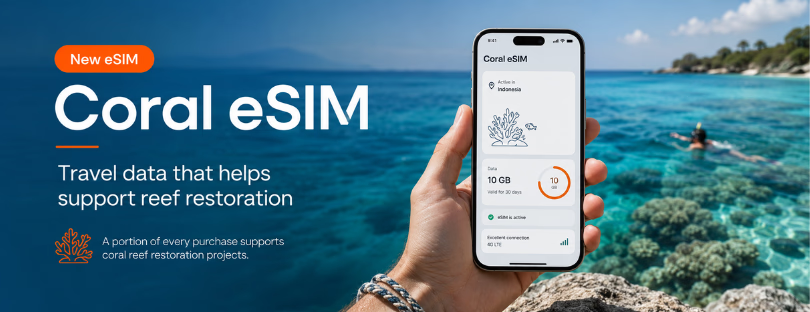
Boring Inc. has launched Coral eSIM, a global travel eSIM service that combines low-cost mobile data with a built-in donation model for coral reef conservation. The product is available across more than 180 countries and regions, positioning it in the same broad travel connectivity category as other global eSIM services, but with one clear difference: every 1GB of data used triggers a $0.01 donation, approximately ¥1, to coral reef restoration partners.
The company describes the idea as “Data for Blue,” with the simple message: “Vote 1GB for the ocean.” It is a neat line, and more importantly, it explains the product quickly. Travelers do not need to make a separate donation, activate a special setting, or change their behavior. They buy data, use the eSIM, and the donation accumulates automatically through their account.
That simplicity matters. Sustainability add-ons often fail because they ask users to do one more thing. Coral eSIM’s pitch is that the impact is designed into the product itself.
Why coral matters
The environmental context is not marketing decoration. Coral reefs are among the most threatened ecosystems on the planet. NOAA notes that the world has already lost roughly 30% to 50% of coral reefs, with climate change, ocean acidification, pollution, storms, invasive species and direct physical damage all contributing to reef decline.
The IPCC has also warned that coral reefs are projected to decline by a further 70% to 90% with global warming of 1.5°C, while losses exceed 99% at 2°C. That is the uncomfortable backdrop behind Coral eSIM’s launch. The company is entering a crowded travel eSIM market, but it is tying the product to one of the clearest environmental pressure points in global travel.
READ MORE: CORaiL will use artificial intelligence to save coral reefs
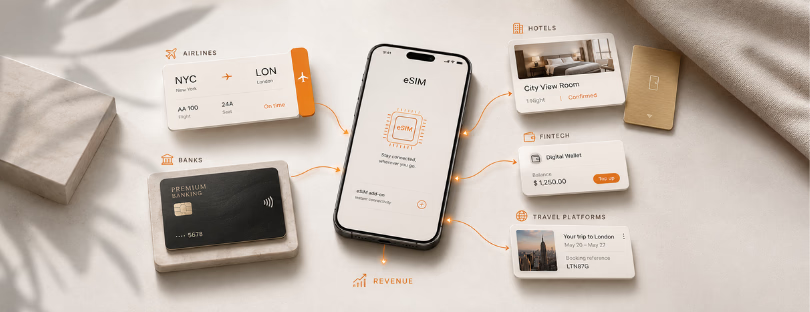
There is also a timing issue. Travel connectivity is now a normal part of the travel purchase journey. People compare flights, hotels, insurance, airport transfers and increasingly, mobile data. If eSIMs are becoming part of everyday travel planning, then the question becomes: can they carry a social or environmental function too?
The product promise
Coral eSIM’s three core product values are straightforward: “GOOD TO SEA,” low price and stable coverage. The first is the mission layer. Every gigabyte used contributes to coral reef restoration. The second is commercial: affordable plans designed to keep travel data costs down. The third is practical: stable coverage across more than 180 countries and regions.
That balance is important because travelers rarely buy an eSIM for charity alone. They buy it because roaming is expensive, airport SIM cards are inconvenient, and public Wi-Fi is unreliable. The conservation angle may help Coral eSIM stand out, but the product still has to perform as a travel eSIM first.
This is where the model gets interesting. Coral eSIM is not asking users to pay a premium donation product, at least based on the launch description. It is trying to attach environmental contribution to ordinary data usage. That makes the idea more scalable, but also raises fair questions: which conservation partners receive the funds, how often donations are transferred, and how transparently users can verify impact over time.
For this type of positioning to work long term, transparency will matter as much as pricing.
Restorative consumption
Boring Inc. frames the model as “Restorative Consumption,” meaning the act of consumption includes a built-in function of restoration. In plain English, you use something and a small part of that usage helps repair something else.
That is a smart concept, especially in travel. The travel sector has spent years talking about carbon offsets, sustainable tourism and responsible choices. But many of those models are still separate from the actual purchase experience. Coral eSIM’s approach is more embedded. The donation is not a side campaign. It is part of the product logic.
READ MORE: Cheap eSIMs Are Booming. But Are They Sustainable?
Still, this should be treated with healthy realism. One cent per gigabyte will not solve coral reef decline. The primary threat remains warming oceans, and major scientific bodies continue to stress the need for emissions reductions and broader marine protection. NOAA, Reuters and AP have all reported on mass coral bleaching events linked to unusually warm ocean temperatures, with scientists emphasizing climate change as the central driver.
So the fair reading is this: Coral eSIM is not a climate solution by itself. It is a consumer product that turns a routine travel purchase into a small recurring conservation signal.
Where it fits in the eSIM market
Most travel eSIM providers compete on familiar ground: price per GB, destination coverage, app experience, local network quality, unlimited plans, hotspot support and refund policies. Coral eSIM adds a cause-led layer to that equation.
That could be useful, especially for younger travelers, eco-conscious tourists and brands looking for more responsible travel services. It also follows a wider trend in consumer technology: products are no longer judged only by utility. They are increasingly judged by what they say about the user’s values. coral esim sustainable travel data
The risk is that purpose-led eSIMs can easily sound soft if the operational details are unclear. Serious travelers still want to know: does it work, is it affordable, which networks does it use, can I top up easily, and what happens when support is needed abroad?
Coral eSIM’s environmental story may win attention. Its reliability, pricing and proof of donation will decide whether it earns trust.
Bottom line about Coral eSIM & sustainable travel data
Coral eSIM is a small but interesting signal for the travel connectivity market. It shows that eSIM differentiation does not have to be only about cheaper data or more countries on a coverage map. It can also be about attaching meaning to a product that travelers already need.
But the strongest version of this idea will depend on proof. If Coral eSIM clearly shows donation totals, names credible conservation partners and reports impact transparently, it could become more than a nice campaign. It could define a useful niche: affordable travel data with built-in environmental contribution.
That will not replace serious reef protection, climate action or marine policy. But in a market full of nearly identical eSIM offers, “Stay connected. Protect the ocean.” is at least a direction travelers can understand. And sometimes, in travel tech, clarity is the first real advantage.