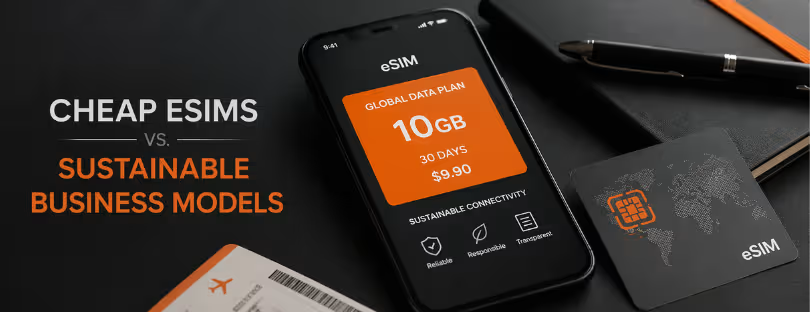
And over the past two years, the travel connectivity market has been full of them. Open almost any comparison site or travel forum and you will see it immediately: €5 eSlM plans, €10 global packages, and “unlimited data” offers that look almost suspiciously cheap.
For travelers, this feels like a revolution.
Not long ago, using mobile data abroad meant risking a roaming bill that could easily reach hundreds of euros. Now you can land in another country, scan a QR code, and get connected in seconds for the price of a coffee.
But if you spend time inside the telecom industry, another conversation is quietly happening behind the scenes.
A much less comfortable question.
How can these prices possibly support a sustainable business?
Because mobile connectivity may look digital, but it still relies on very physical infrastructure. Towers, spectrum licenses, roaming agreements, and global network partnerships all cost real money.
And someone in the value chain eventually has to pay for them.
How the market became so cheap
The reason traveleSIM pricing dropped so quickly is not a mystery. It is the result of a new distribution model.
Most travel eSIM providers are not traditional telecom operators. They function more like digital mobile virtual network operators (MVNOs). Instead of building their own networks, they buy data capacity wholesale from global connectivity providers and resell it through apps and online platforms.
Companies like BICS, Tata Communications, and other global aggregators make it possible for a small startup to offer data coverage across dozens or even hundreds of countries.
This dramatically lowered the barrier to entry.
At the same time, international travel started recovering strongly after the pandemic. Investors saw an opportunity, startups entered the market quickly, and competition intensified.
The result was predictable.
Prices started falling.
And falling.
And falling again.
Industry analysts at Juniper Research estimate that travel eSIM revenue will grow rapidly over the next five years, reaching several billion euros globally by the end of the decade. But they also warn that average revenue per gigabyte is declining as competition intensifies.
Which brings us to the uncomfortable reality behind the cheap plans.
The hidden economics of travel eSIM
When you see a €10 data plan online, it may look like a simple transaction. But behind that purchase sits a surprisingly complex cost structure.
A typical travel eSIM provider must cover several layers of expenses.
Network wholesale costs
Even though providers buy data in bulk, wholesale rates still apply. Global connectivity is cheaper than roaming used to be, but it is not free.
Payment and infrastructure
Running an eSIM platform requires:
provisioning systems
global SIM profiles
billing infrastructure
payment processing
Each transaction triggers multiple backend systems.
Customer acquisition
This is where the real pressure begins.
Search advertising, affiliate commissions, travel comparison sites, and influencer promotions can easily push customer acquisition costs well beyond the price of a single eSIM plan.
In other words, selling a €10 plan may cost significantly more than €10 to acquire the customer in the first place.
Not surprisingly, many companies are now realizing that cheap connectivity alone does not build a sustainable telecom business.
When connectivity becomes a commodity
Another structural challenge is that travel eSIM services are rapidly becoming a commodity market.
Many providers use the same wholesale connectivity partners. Coverage maps often look identical. Activation flows are nearly identical across apps.
Which means differentiation often collapses to a single factor: price.
Economists call this commoditisation. When products become interchangeable, competition shifts almost entirely to price reductions.
The telecom industry has seen this pattern before. Similar dynamics occurred during the early MVNO boom in the 2010s, when dozens of low-cost mobile brands launched across Europe and North America. Many disappeared or were acquired once margins collapsed.
Some analysts believe travel eSIM could be entering a similar phase.
The strategies that may actually work
Despite the price pressure, several providers are still scaling successfully. The difference is that they are not relying purely on cheap gigabytes.
Instead, they are building broader connectivity ecosystems.
Distribution partnerships
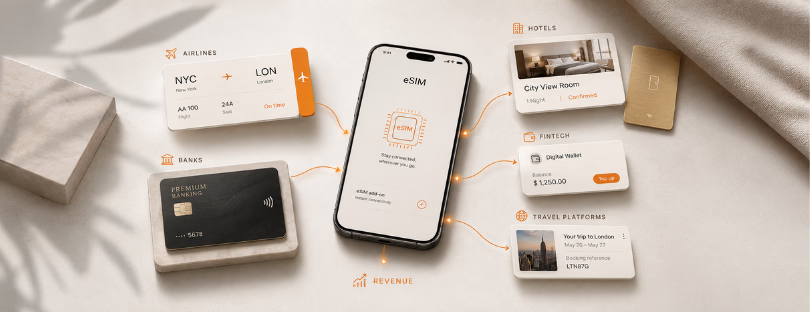
One of the most powerful strategies is embedding eSIM directly into travel platforms.
Airlines, fintech apps, travel booking sites, and digital banks already have millions of active users. Offering connectivity at the moment someone books a flight or activates a travel card dramatically reduces marketing costs.
Distribution often matters more than pricing.
App retention
Another key metric in the industry is app retention.
If a traveler installs an eSIM app and deletes it immediately after the trip, the provider must acquire that customer again the next time they travel.
But if the app remains installed, the second purchase becomes far cheaper. Over time, retention can turn low-margin transactions into profitable long-term relationships.
Subscription and membership models
Some companies are also experimenting with connectivity subscriptions or annual plans that behave more like traditional telecom services.
Instead of selling data only for individual trips, providers create ongoing connectivity layers for frequent travelers or remote workers.
This approach stabilizes revenue and reduces the volatility associated with seasonal travel demand.
A changing competitive landscape
Another important factor is the growing interest of large telecom operators in the travel eSIM market.
For years, the space was dominated by digital startups. But as travel eSIM adoption increases, mobile network operators have started launching their own products or partnerships to protect roaming revenue streams.
Large operators have several advantages.
They already own infrastructure. They control network capacity. And they have direct billing relationships with millions of customers.
That scale can make price competition much easier to absorb.
At the same time, agile startups still have advantages in product design, app experience, and international distribution partnerships.
The result is a market that is still evolving rapidly.
What travelers should really look for
For travelers, cheaper connectivity is undeniably good news. Many travel eSIM plans are significantly cheaper than traditional roaming tariffs.
But price alone rarely tells the full story.
Other factors increasingly shape the user experience.
Network quality
Coverage may be similar across providers, but actual network prioritization and speed can vary depending on local operator agreements.
Support availability
Connectivity problems rarely happen at convenient times. Reliable customer support can matter more than a few euros in price difference.
Transparency of plans
Some “unlimited” plans include speed throttling or fair-use policies that affect real-world performance.
In short, the cheapest plan is not always the best connectivity experience.
Conclusion cheap esim pricing
The travel eSIM market is still in its early stages, and like many technology sectors, it is currently experiencing an aggressive pricing phase.
Cheap plans attract attention and accelerate adoption, but they also place enormous pressure on providers trying to build sustainable businesses.
Industry data suggests that wholesale data prices are stabilizing rather than continuing to fall, which means the economics of ultra-cheap plans may become increasingly difficult to maintain.
When we compare the current landscape to earlier telecom cycles such as the MVNO expansion of the 2010s, the pattern looks familiar. Early price wars eventually give way to consolidation, differentiation, and a renewed focus on quality.
The long-term winners in travel connectivity are unlikely to be the companies offering the cheapest gigabytes.
They will be the ones building strong distribution networks, reliable infrastructure partnerships, and services that travelers actually trust when they land in a new country and need their phone to work immediately.
Cheap data may win the first click.
But sustainable connectivity will decide who is still in the market five years from now.
Driven by wanderlust and a passion for tech, Sandra is the creative force behind Alertify. Love for exploration and discovery is what sparked the idea for Alertify, a product that likely combines Sandra’s technological expertise with the desire to simplify or enhance travel experiences in some way.