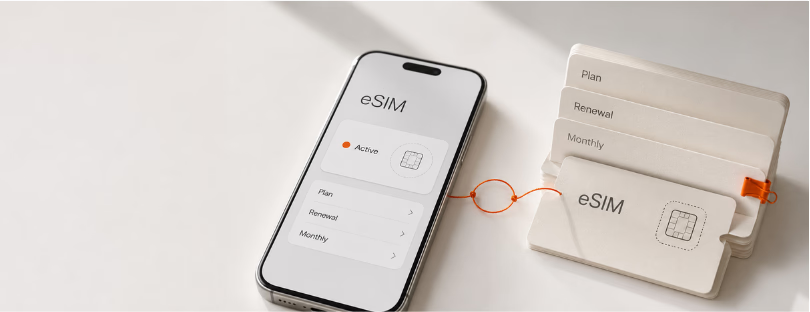
floLIVE Launches SGP.32 IoT eSIM Operations
If you have been following the IoT connectivity space closely, you already know that SGP.32 has been “coming” for a while.
Now it is starting to feel real.
floLIVE has announced operational support for GSMA SGP.32 across its global IoT infrastructure, enabled through a deep integration with Kigen. On paper, that sounds like another standards update. In reality, it is something more important: a shift in how IoT connectivity is provisioned, controlled, and scaled.
For years, IoT eSIM conversations focused on the promise of remote provisioning. But anyone deploying devices at scale knows the hard part was never just the SIM. It was the operations layer behind it.
SGP.32 is designed to address exactly that.
What SGP.32 Changes
SGP.32 is the GSMA’s specification for IoT remote SIM provisioning. Unlike earlier consumer-focused standards, it is purpose-built for large-scale, headless, and industrial deployments.
In simple terms, it introduces a cleaner operational framework for:
- Remote profile lifecycle management
- Zero-profile provisioning
- Secure, standardized profile downloads
- Enterprise-level control over connectivity decisions
Instead of locking connectivity decisions into the factory or the first operator selected, SGP.32 allows enterprises to defer those decisions. Connectivity becomes dynamic.
And that matters.
As fleets scale across borders and regulatory regimes, enterprises want flexibility without operational chaos. They want to switch operators, manage compliance, and optimize costs without physically touching devices.
That is the theory.
The real question has always been: who can make it work in production?
floLIVE’s Hybrid Approach
“Delivering immediate access to SGP.32 capabilities, as well as hybrid connectivity, allows us to support a broad range of deployment demands from enterprises, IoT Service Providers, and Mobile Network Operators (MNO),” said Nadav Doron, vice president of product management at floLIVE.
“These models allow businesses to take advantage of critical operational benefits such as remote zero-profile provisioning that places connectivity decisions in the hands of the enterprise. Our partnership and deep technology integration with Kigen provides us with a strong framework for delivering secured connectivity options that can be customized to satisfy the specific needs of customers around the world.”
What stands out in floLIVE’s positioning is not just “SGP.32 compliance.” It is optionality.
The company is not forcing customers into a pure SGP.32 model overnight. Instead, it supports a hybrid approach that combines SGP.32 operations with proven multi-IMSI connectivity using eSIM and other SIM formats.
That is pragmatic.
Broad SGP.32 adoption is expected to accelerate throughout 2026, but most enterprises will not flip a switch all at once. They will run pilots. They will measure ROI. They will test operational impact. During that transition, hybrid models matter.


Factory-to-Field, Without the Chaos
Through its collaboration with Kigen, floLIVE leverages Kigen’s SGP.32-compliant eSIM IoT Remote Manager (eIM) and secure eSIM OS to create what both companies describe as a seamless “factory-to-field” experience.
The integration includes In-Factory Profile Provisioning (IFPP), meaning eUICCs can be pre-configured at the factory with an initial connectivity profile based on floLIVE’s Multi-IMSI SIM.
Devices connect immediately upon activation, anywhere in the world.
Then, using SGP.32 standards, they can download local profiles without complex manual intervention.
That seemingly small detail solves one of the most error-prone moments in IoT: first connect.
“SGP.32 provides the missing operations layer for connectivity state, so market expansions and fleet transitions can be delivered at scale with confidence,” said Jean-Louis Carrara, Global Head of Sales at Kigen.
“Kigen’s SGP.32 eSIMs and our award-winning GSMA SGP.32 SAS-certified eIM are built for real-world IoT deployments, including secure indirect profile delivery for air-gapped environments and regulatory-driven cybersecurity requirements. Combined with Kigen’s In-Factory Profile Provisioning within floLIVE’s connectivity offering, this makes first-connect behavior deterministic and removes the most error-prone moments—so enterprises can go live faster with operational readiness built in.”
That word deterministic is key.
In massive IoT rollouts, unpredictability is expensive. Failed first connections, misaligned profiles, or regional compliance issues can stall entire projects. Deterministic first-connect behavior turns what used to be a risk into a predictable process.
Why This Matters in 2026
Industry analysts, including IDC and GSMA Intelligence, have consistently pointed to two bottlenecks in IoT expansion: operational complexity and regulatory fragmentation.
SGP.32 addresses the first by standardizing remote SIM operations. It does not magically eliminate regulatory diversity, but it creates a cleaner way to manage connectivity state across jurisdictions.
Cited benefits include:
- Reduced lock-in
- Future-proofing deployments
- Lower operational risk
- New managed service opportunities for MNOs
However, floLIVE’s leadership is realistic about the broader picture.
“While SGP.32 simplifies many important operational challenges, it is important to remember that issues in network complexity, back-end integration, compliance, cost control, and multi-operator management will still exist,” continued Doron.
“Using a platform such as floLIVE’s CMP Aggregator provides a holistic monitoring, deployment, and provisioning environment that maximizes value and achieves business objectives.”
This is an important nuance.
Standards are necessary, but they are not sufficient. Enterprises still need visibility, orchestration, billing control, and policy enforcement across multi-operator environments. SGP.32 provides the plumbing. Platforms like floLIVE’s CMP Aggregator aim to provide the control room.

Competitive Context
The broader IoT connectivity market is increasingly shaped by three models:
- Pure-play eSIM and iSIM technology providers
- Connectivity aggregators offering multi-IMSI and global cores
- Mobile network operators building enterprise-managed services
Kigen sits clearly in the first category, with a strong footprint in eSIM and iSIM security, backed by major investors and deeply embedded across chipset ecosystems.
floLIVE positions itself in the second category, with distributed core networks and more than 40 local points of presence, enabling localized compliance and low-latency routing.
Other major players in the market, including global MVNO aggregators and MNO-backed IoT platforms, are also moving toward SGP.32 readiness. But the differentiation will not come from simply ticking the compliance box.
It will come from integration depth.
Who controls the first-connect experience?
Who manages profile lifecycle seamlessly across regions?
Who combines compliance, performance, and operational tooling in one environment?
That is where the real competitive battle sits.
The Bigger Trend
Zooming out, this announcement fits into a larger shift across telecom and IoT.
Connectivity is no longer just a network problem. It is an orchestration problem.
Enterprises want:
- Control without friction
- Flexibility without fragmentation
- Scale without surprises
SGP.32 is part of the infrastructure answer. Hybrid deployment models are part of the transition strategy. Integrated platforms are part of the operational reality.
The market is moving from “can we connect this device?” to “can we manage 500,000 devices across 30 countries without losing control?”
That is a very different conversation.
Conclusion
The floLIVE and Kigen collaboration is not just another interoperability headline. It signals that SGP.32 is moving from specification to operational execution.
Compared with other connectivity players that are still framing SGP.32 as a future roadmap item, floLIVE’s hybrid model acknowledges the messy middle phase enterprises actually live in. Kigen’s emphasis on deterministic first-connect and secure indirect profile delivery addresses practical deployment pain points, not theoretical benefits.
If 2025 was about preparing for SGP.32, 2026 will be about proving it.
Enterprises will measure not just compliance, but measurable improvements in deployment speed, reduced truck rolls, fewer activation failures, and smoother regional expansions. According to recent GSMA Intelligence projections, IoT connections will continue double-digit growth through the decade. But growth at scale requires operational confidence.
That confidence will not come from the spec alone.
It will come from how well companies integrate that spec into real-world, multi-operator, multi-country deployments.
floLIVE and Kigen are positioning themselves squarely in that operational layer. The next twelve months will show whether the rest of the market can match that depth or whether SGP.32 readiness becomes the new dividing line in global IoT connectivity.