What If 5% of Your Users Bought Connectivity?
There’s a quiet shift happening across travel, fintech, and digital platforms. It doesn’t look dramatic on dashboards at first. No massive spike, no viral moment. Just a small number that starts to matter more than it should. connectivity monetization for travel platforms
Five percent.
That’s often all it takes. If just 5% of your users decide to buy connectivity through your platform, something interesting happens. Not just in revenue, but in how your entire product suddenly behaves.
Most companies underestimate this. They’re still thinking in terms of “add-on feature” or “nice-to-have upsell.” But connectivity isn’t behaving like that anymore. It’s starting to look more like embedded infrastructure. And the math, even at low adoption, proves it.
Small Conversion, Real Money
Let’s keep this simple and realistic.
Say you have 100,000 monthly active users. Not massive. Not small either. Just a healthy, mid-scale platform. Travel booking site, fintech app, airline loyalty program, whatever.
Now, assume 5% of them buy a connectivity package.
That’s 5,000 users.
If the average transaction sits somewhere between €10 and €25, you’re looking at €50,000 to €125,000 in monthly revenue. Not theoretical. Not inflated. Just basic behavior aligned with how people already travel and use their phones.
READ MORE: How to Launch Your Own eSIM Product?
And here’s the part that’s often missed: this isn’t replacing anything. It’s incremental.
You didn’t acquire new users. You didn’t launch a new core product. You simply monetized a moment that already exists. People traveling, landing, needing data, and making a decision in that exact window.
That’s why 5% matters. It’s not about scale first. It’s about timing.
Where That 5% Actually Comes From
It’s easy to assume that only “power users” will buy connectivity. Digital nomads, frequent flyers, business travelers.
In reality, that 5% is much more mixed.
It’s the person landing in Rome who realizes their roaming is off. The family trying to navigate from the airport without Wi-Fi. The fintech user whose card works globally but their data doesn’t. The airline passenger who suddenly understands that “stay connected” isn’t just a slogan.
These are not edge cases. These are everyday moments.
And importantly, they are moments of mild friction. Not emergencies, but just enough inconvenience to trigger a purchase if the option is right there.
That’s where most platforms fail. Not because users don’t want connectivity, but because the offer isn’t embedded at the right time.
The Missed Layer in Most Products
Here’s the uncomfortable truth: most digital platforms already own the customer relationship at the exact moment connectivity becomes relevant.
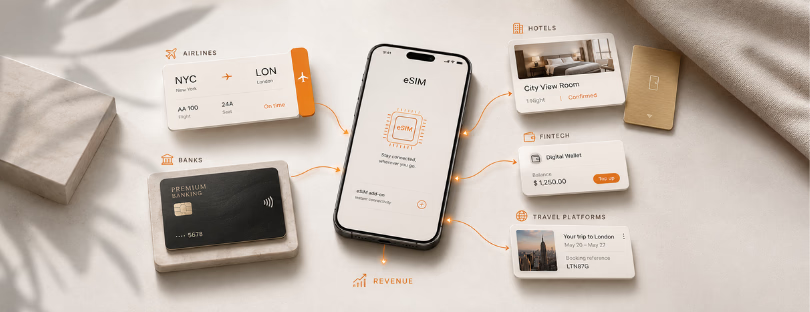
Airlines know when you land. Banks know where you transact. Travel apps know your itinerary. Hotels know your check-in time.
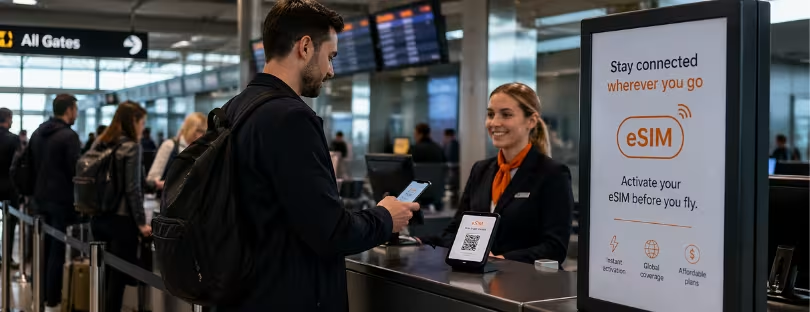
And yet, connectivity is still outsourced to Google searches and airport kiosks.
That gap is where the 5% lives.
It’s not a marketing problem. It’s a product decision. Do you surface connectivity as part of the experience, or do you let users solve it elsewhere?
Because they will solve it. The only question is whether you’re part of that transaction.
Why It Feels Bigger Than 5%
Once that initial layer is in place, something else starts to happen.
Users begin to associate your platform with reliability in a broader sense. Not just booking, not just payments, not just information. But actual support in real-world situations.
Connectivity quietly becomes a trust signal.
READ MORE: How to Choose an eSIM Provider for Your Platform
And that trust feeds back into usage. Higher retention. More frequent interactions. Slightly higher willingness to engage with other paid features.
This is where the revenue conversation becomes incomplete if you only look at direct sales. The real impact is cumulative.
That initial 5% starts influencing the other 95%.
The Operators Already Playing This Game
If you look closely, some players have already moved here. Not loudly, not as a headline feature, but as part of a broader strategy.
Fintech apps are integrating connectivity into their travel experience. Airlines experimenting with add-ons beyond baggage and seats. Even some travel platforms are bundling data options alongside bookings.
But most of them are still early. Fragmented. Testing.
What’s missing is a clear, consistent approach to positioning connectivity as part of the core product experience rather than an optional extra buried three clicks deep.
That’s why the opportunity is still open.
Why Most Companies Hesitate
There’s a pattern here. When companies think about adding connectivity, the conversation quickly shifts to complexity.
Integration. Support. Pricing models. Partnerships. Risk.
All valid concerns.
But they’re often overestimated compared to the actual barrier, which is strategic clarity.
Because once you decide that connectivity is part of your product, not just an experiment, the rest becomes execution.
And the execution is increasingly standardized. APIs, white-label solutions, managed platforms. The infrastructure is there. It’s not 2018 anymore.
What’s missing is the decision to move.
The Real Question Isn’t 5%
The 5% is just a starting point. A way to make the opportunity tangible.
The more interesting question is what happens after.
What happens when you optimize placement? When you tie connectivity to specific journeys? When you personalize offers based on destination, duration, behavior?
That 5% doesn’t stay at 5%.
It moves. Slowly at first. Then faster.
And suddenly, you’re not talking about a side revenue stream anymore. You’re talking about a new layer of your business.
The Market Direction Is Clear
If you zoom out, the trend is obvious.
Connectivity is becoming embedded. Less visible, more integrated. Less about standalone products, more about being part of something else.
We’ve seen this before. Payments did the same thing. So did insurance. So did logistics.
Connectivity is following.
READ MORE: eSIM White Label: Launch Your Own Telecom Product
The companies that win here won’t be the ones with the cheapest plans or the widest coverage. That’s already commoditized at the infrastructure level.
The winners will be the ones who control distribution. Who own the moment when the user needs it.
And that moment is already yours.
Your customers will buy connectivity. The question is: from you, or from someone else?
We help airlines, banks, and travel platforms turn that demand into a built-in product — not a missed opportunity.
What This Means for You
If you’re running a platform with users who travel, even occasionally, you’re already sitting on this opportunity.
Not in theory. In actual user behavior.
The question is whether you treat it as noise or as a signal.
Because the signal is pretty clear: a small percentage of your users are ready to buy connectivity if you make it easy, relevant, and immediate.
And once they do, the impact goes beyond that single transaction.
Connectivity monetization for travel platforms – final thoughts
The industry is moving toward embedded connectivity, whether companies actively choose it or not. Players like fintech apps and travel platforms are gradually integrating data services into their ecosystems, while telecom enablers and infrastructure providers are making deployment easier and faster. Reports from GSMA and multiple mobility studies consistently point to rising eSIM adoption and a shift toward digital-first connectivity models.
What’s interesting is that we’re not seeing a winner yet. The space is still fragmented. Some companies treat connectivity as a feature, others as a revenue stream, and a few are starting to see it as infrastructure.
That difference in perspective will define the next phase.
Because 5% is not the end goal. It’s just proof that the model works.
The real opportunity is building something where connectivity is not an afterthought, but part of how your product delivers value in the real world.
If you’re starting to see that layer in your own platform, it’s probably worth exploring properly. Not as a side project, but as a strategic move.
And if you want to understand what that could look like in your specific case, reach out to Alertify. We’ll show you where that 5% is hiding and what it could realistically become.