Wildix eSIM Brings AI to Business Mobile Calls
There has always been a quiet gap inside enterprise communications.
Not in the contact center. Not in the CRM. Not in the collaboration stack.
On the mobile phone.
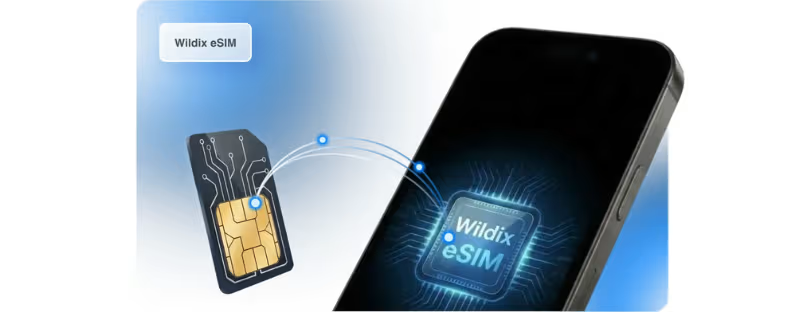
This week, Wildix announced the launch of Wildix eSIM, a new capability within its Mobility Cloud offering. On the surface, it sounds like another business eSIM. But if you look closely, it is actually something more structural: an attempt to eliminate one of the last blind spots in enterprise customer communication.
Mobile conversations have long lived outside the system of record. Sales calls made from personal devices. Field service updates are happening in transit. Healthcare coordination is done between appointments. Real estate negotiations are closing while someone is in a car. Legal consultations are happening at airports.
These conversations move business forward. But they rarely move through enterprise logic.
Wildix is trying to change that.
The Hidden Blind Spot
Mobile communication is now the default mode for entire categories of professionals. According to Gartner, distributed and hybrid work models have permanently shifted communication patterns toward mobile-first workflows. Yet most enterprises still treat mobile calls as peripheral.
They are not peripheral.
They are often the moment the deal closes.
The problem is that traditional enterprise telephony logic stops at the desk phone or softphone. Once a call happens on a personal SIM, visibility disappears. Routing logic is lost. Presence status breaks. CRM capture becomes manual. Context fragments.
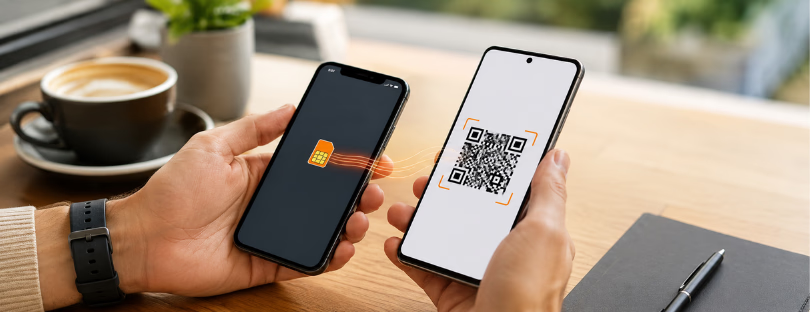
The Wildix eSIM brings business mobile calls back into the enterprise layer without forcing users to change behavior.
Employees use their phone’s native dialer. No app switching. No parallel identity. No awkward interface juggling.
But behind the scenes, the call is routed through enterprise infrastructure.
That is the shift.

Identity Instead of Interface
Most mobility solutions in UCaaS have relied on apps. Download an app. Log in. Use the soft dialer. Keep work and personal separate.
In theory, this works.
In practice, professionals revert to the native dialer. It is faster. It feels natural. It integrates with the device.
Wildix anchors mobility at the identity level instead of the interface level.
With Wildix eSIM, a single business identity extends across SIM, mobile, browser and desk endpoints. Presence, routing and policy controls remain synchronized as users move between devices. A call placed from the native dialer still follows enterprise routing logic. Availability rules apply. Escalation flows trigger if necessary.
This is more than convenience. It is governance without friction.
As Dimitri Osler, co-founder and CIO of Wildix, put it:
“Work is fluid, and conversations move with it,” said Dimitri Osler, co-founder and CIO, Wildix. “Mobility Cloud ensures that context moves too. We built it so conversations do not reset every time someone changes device, location or role, but instead continue with the business, intact and actionable.”
That word matters: context.
When AI Meets the Mobile Call
Wildix is positioning the eSIM not just as connectivity, but as an intelligence layer.
Calls routed through the Wildix eSIM can be captured, transcribed, summarized and analyzed using voice AI. Sentiment can be detected. Structured outcomes can be generated. Follow-ups can be triggered automatically. CRM records can be updated in real time.
This aligns with a broader shift we are seeing across enterprise communication. Zoom, Microsoft and RingCentral are all embedding AI into meetings and calls. But most of that AI activation still happens inside app environments.
Wildix is pushing that intelligence layer into the SIM itself.
For mobile-first teams, this is significant.
Sales teams do not need to remember to log notes. Field service engineers do not need to manually summarize updates. Healthcare professionals can keep a traceable, compliant communication record without switching systems.
The mobile call becomes structured data.

Enterprise Logic Outside the Contact Center
Traditionally, advanced routing logic and availability rules have lived inside contact centers.
Wildix is extending that logic to every mobile call placed through the eSIM.
If someone is unavailable, escalation can occur. If presence changes, routing adapts. If a team member walks away from one device, continuity persists on another.
This is particularly relevant for industries where mobile is the primary workplace.
Sales Teams
Real-time follow-ups, automatic CRM updates, preserved deal context.
Field Services
Escalation logic during incident response, full call traceability.
Healthcare
Compliance-ready records of mobile patient communication.
Real Estate and Legal
Protected business identity without exposing personal numbers.
It is subtle infrastructure work. But infrastructure is where enterprise resilience lives.
Mobility as Infrastructure
Wildix calls this the Mobility Cloud. The term is not accidental.
We are seeing a broader industry narrative where connectivity is moving from a utility layer to an infrastructure layer. In telecom, programmable APIs are replacing static roaming logic. In enterprise IT, identity is replacing device-based control. In UCaaS, AI is replacing manual note-taking.
Wildix eSIM sits at the intersection of these trends.
It unifies identity across endpoints. It ensures persistent context across calls and channels. It synchronizes presence. It supports walk-away continuity. It integrates RCS-enabled business messaging. And it feeds AI-driven insights directly into workflow systems.
This is not about cheaper mobile minutes.
It is about eliminating fragmentation.
The Competitive Landscape
Wildix operates in a competitive UCaaS environment. The company has been recognized for four consecutive years in Gartner Magic Quadrant for UCaaS, a signal of credibility in the enterprise communications space.
But the eSIM move pushes it into a more differentiated territory.
While providers like RingCentral and Zoom Phone extend softphone capabilities, they largely depend on application-level engagement. Meanwhile, telecom operators offer business SIM solutions, but rarely integrate them deeply into CRM and AI workflows.
Wildix is blending telco-grade SIM logic with cloud-native AI orchestration.
That is a structural play.
According to IDC, enterprise investment in AI-enhanced communications is accelerating as organizations seek productivity gains and measurable workflow impact. The missing piece has been mobile parity.
Wildix is attempting to close that gap.
Early Signals
The company says the eSIM is already live through its global partner ecosystem and early deployments show improved visibility into mobile interactions and stronger continuity across workflows.
That is consistent with what we see across digital transformation projects: visibility precedes optimization. Once mobile calls become measurable, they become improvable.
And once they are improvable, they become strategic.
The Bigger Picture
We often talk about digital transformation as if it is a software problem.
But in reality, it is an identity and infrastructure problem.
Work no longer happens at desks. It happens in motion. Conversations begin in cars, on factory floors, in hospital corridors, at construction sites, in hotel lobbies.
The enterprise stack followed work into the cloud. Now it must follow it into the SIM.
Wildix eSIM is not just a feature release. It is a signal that the boundary between telecom and enterprise workflow is dissolving.
If APIs are replacing roaming logic in telecom, identity-anchored eSIMs may replace app-based mobility in enterprise communications.
Conclusion enterprise eSIM for business communications wildix
Wildix’s eSIM strategy reflects a larger structural shift in enterprise communications: mobility is no longer an edge case. It is the core.
Compared to traditional UCaaS app extensions or operator-issued business SIMs, Wildix’s identity-level integration feels more aligned with where enterprise architecture is heading. AI is becoming table stakes. Context persistence is becoming expected. Governance without friction is becoming mandatory.
The real question is not whether mobile calls should be inside the enterprise system. It is why they were ever outside.
If competitors continue to treat mobile as an add-on, they risk leaving intelligence and compliance on the table. If they follow Wildix’s model, we may see a new category emerge: identity-native enterprise eSIM infrastructure.
In a world where conversations define customer experience, revenue flow and operational resilience, letting mobile calls drift outside enterprise logic is no longer sustainable.
Wildix is betting that the SIM is not just connectivity.
It is control.
And in the AI-driven enterprise era, control means context.
 >
>
 >
>