SimiGo’s eSIM-as-a-Service Goes Live at MWC 2026
At Mobile World Congress Barcelona 2026, the noise is always loud. Big booths. Bigger promises. Endless talk about 5G, AI, satellites, APIs.
But every year, a few companies quietly shift the narrative from theory to execution.
This year, SimiGo is doing exactly that.
On the exhibition floor at Fira Gran Via, Hall 6 — Stand 6F82, SimiGo is not presenting a slide deck about eSIM potential. They are letting people activate it live.
Not a sandbox.
Not a prototype.
A production-ready eSIM-as-a-Service platform running in real time across 190+ countries.
For an industry that often overpromises and under-delivers, that matters.
From Concept to Live Activation
Following the unveiling of Cerqle’s Connectivity Operating System, SimiGo is positioning itself as the commercial execution layer.
The pitch is simple, but strategically important: travel brands, airlines, OTAs, fintech platforms, and enterprise players can launch global eSIM services in minutes — without building or operating telecom infrastructure.
That line alone tells you where the market is heading.
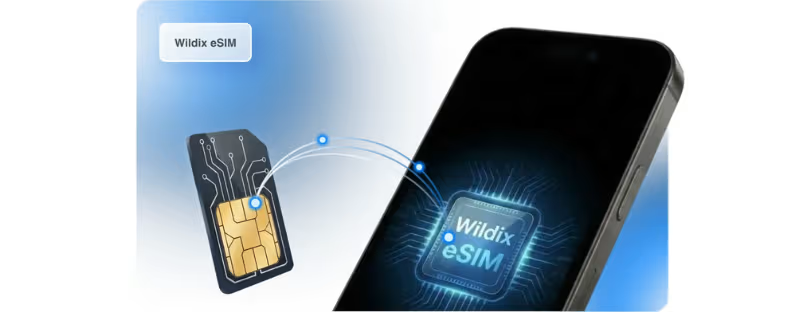
Telecom is no longer just about spectrum and SIM plastic. It is becoming programmable infrastructure.
And at MWC, attendees can test it themselves:
What happens on the stand
- Download the SimiGo mobile app
- Instantly activate global eSIM connectivity
- Access the live partner dashboard portal
- Watch real-time provisioning across 190+ countries
- Register directly for the B2B eSIM-as-a-Service platform
“Partners can experience the full onboarding flow, activation process, and monetization model directly from the show floor,” said the SimiGo Team.
This is not just product theater. It is a statement about maturity.
Too many “eSIM platforms” still rely on manual workflows, carrier-by-carrier integration, or fragmented backend logic. If SimiGo can provision live on the floor, that signals orchestration capability rather than simple resale.
MWC Exclusive: 100% Cashback
To add a bit of Barcelona energy to the mix, SimiGo is running an on-site campaign.
Anyone who downloads the SimiGo app and tops up their wallet will receive:
100% cashback credited back into their wallet balance.
The credit can be used for global data plans anytime they travel. No expiration. No gimmicks.
The flow is designed to be frictionless:
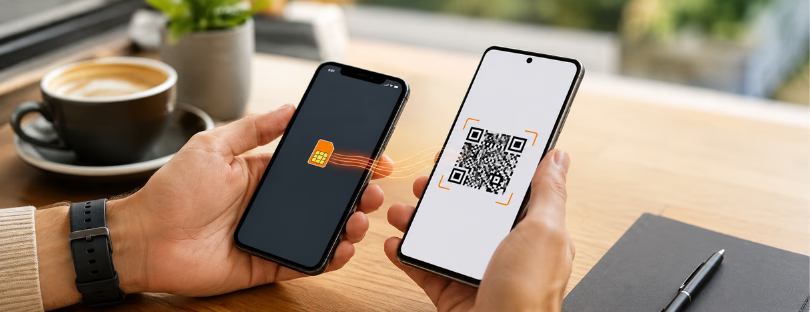
Scan → Download → Activate → Travel Connected
For attendees flying home days later, it becomes immediately relevant. And strategically, it does something smart: it converts booth traffic into actual activated users.
That is a metric many exhibitors at MWC quietly struggle to achieve.
Embedded Connectivity, Not Retail eSIM
The bigger story is not the cashback.
It is the shift from retail eSIM apps to embedded connectivity infrastructure.
SimiGo enables businesses to integrate:
Core capabilities
- Prepaid global data plans
- Instant QR activation
- Pay-as-you-go roaming alternatives
- White-label mobile connectivity
- API-first telecom integration
This is not positioned as another consumer eSIM brand competing with travel apps. It is a B2B layer for:
- Travel agencies
- Online travel platforms
- Airlines
- Corporate travel desks
- Fintech and card issuers
- Super apps
The logic is clear. Connectivity is becoming an embedded utility.
Just as payments became embedded into digital platforms over the past decade, mobile data is now following the same path.
And that trend is visible across the industry.
According to GSMA intelligence reports and increasing API-driven telecom strategies discussed at MWC panels in recent years, operators are opening up programmable interfaces. Meanwhile, travel platforms and fintech companies are looking for ancillary revenue streams and customer retention tools.
eSIM-as-a-Service sits precisely at that intersection.

Avoiding Carrier Complexity
One of the strongest parts of SimiGo’s positioning is the promise of carrier-agnostic infrastructure.
That means:
- No direct negotiations with multiple mobile operators
- No bilateral roaming agreements to manage
- No telecom licensing headaches
- No multi-country provisioning chaos
Instead, businesses can:
- Offer global eSIM under their own brand
- Control pricing and margins
- Launch within days
That is powerful for digital-first brands that do not want to become telecom operators, but do want to own the connectivity experience.
And this is where Telmobil Inc. enters the picture.
The Infrastructure Layer
Behind SimiGo sits Telmobil Inc., providing the carrier-agnostic eSIM infrastructure and orchestration backbone.
This distinction is important.
Many travel eSIM brands are front-end resellers sitting on top of one or two upstream aggregators. That creates margin compression and limited control.
True orchestration platforms, on the other hand, manage provisioning logic, routing intelligence, and multi-carrier abstraction layers.
If SimiGo is indeed operating at that level, it moves them closer to players like eSIM infrastructure providers seen across MWC in previous years, including companies such as eSIMGo and Pelion, who also operate in API-driven and enterprise-focused segments.
The difference will come down to orchestration depth, partner economics, and deployment simplicity.
The Bigger Picture
The real story here is not a booth activation.
It is the evolution of telecom distribution.
For decades, connectivity was vertically integrated. Operators owned networks, SIM distribution, billing, and retail.
Then MVNOs emerged.
Then digital eSIM apps.
Now we are entering the orchestration era.
Connectivity is becoming:
- API-accessible
- Wallet-based
- Embedded into travel ecosystems
- Controlled through dashboards rather than physical supply chains
As global travel rebounds and digital ecosystems merge, the expectation is no longer “buy a SIM at the airport.” It is “connect automatically.”
Airlines want bundled data.
Fintechs want travel data add-ons on premium cards.
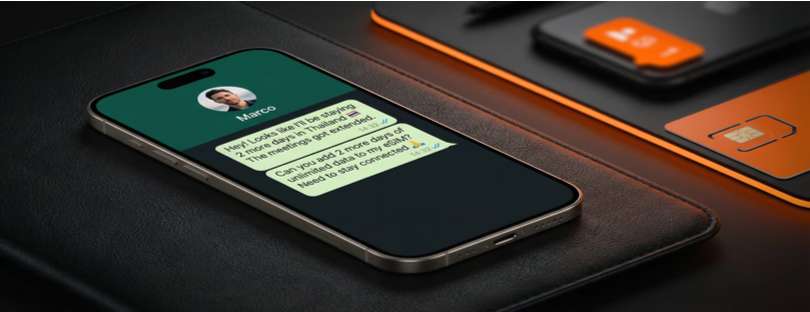
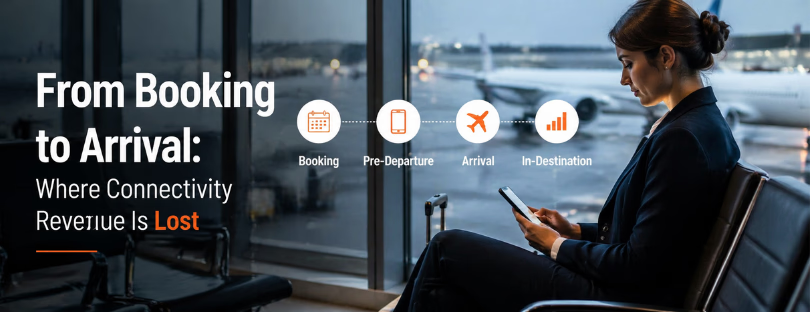
OTAs want post-booking upsells.
Corporate travel desks want centralized control.
The convergence is obvious.
And SimiGo’s live MWC demo is essentially saying: the infrastructure is ready.
Production-Ready vs. Slideware
At MWC, there is always a gap between conceptual innovation and operational deployment.
The key question for any eSIM orchestration platform is:
Can it scale?
Can it provision across 190+ countries reliably?
Can partners control margins?
Can it abstract away upstream complexity?
The fact that attendees can access the live partner dashboard and see real-time provisioning is a strong signal.
Still, execution at scale will be the real test.
Enterprise adoption cycles are longer than consumer app downloads. Travel brands demand SLAs. Fintechs demand compliance. Airlines demand integration into legacy systems.
If SimiGo can navigate those layers, it positions itself not as an eSIM seller, but as infrastructure.
And infrastructure is where durable value is created.
Conclusion: The Infrastructure Moment
The eSIM market is entering its second phase.
The first phase was retail hype. Hundreds of consumer apps promising cheaper roaming.
The second phase is orchestration.
Control layers. APIs. Embedded distribution. Carrier-agnostic routing. Wallet logic.
Players like eSIMGo and Pelion have been active in infrastructure conversations, while GSMA frameworks and industry panels at events like Mobile World Congress Barcelona 2026 continue to emphasize programmable networks and open ecosystems.
SimiGo’s MWC demonstration signals something important: eSIM-as-a-Service is no longer theoretical.
If travel and digital platforms truly want to treat connectivity as an embedded utility rather than a resale product, orchestration platforms will define the next cycle of growth.
The bigger picture is not about selling data plans.
It is about turning mobile connectivity into programmable infrastructure that any digital brand can deploy.
If SimiGo delivers on that promise beyond the show floor, it will not just be another exhibitor at MWC.
It will be part of the quiet reshaping of how global connectivity is distributed.