TextNow Launches Free eSIM Phone Plans
For years, the U.S. mobile market has sold one core idea: more data, bigger bundles, faster speeds. What it has not always sold is clarity.
Now, TextNow is trying to flip that script.
The original app-based mobile phone service has just announced its most flexible data plans to date, alongside the launch of eSIM. On paper, this looks like another plan refresh. In reality, it signals something deeper: connectivity is no longer just about coverage. It is about cost control, emotional stability, and financial breathing room.
And the timing is not accidental.
According to new survey data commissioned by TextNow, 92 percent of Americans say having a mobile phone number is essential in daily life. Yet mobile service now ranks among the top five monthly bills people struggle to keep up with, after food, utilities, and housing. That is not a lifestyle statistic. That is infrastructure under pressure.
TextNow’s response is simple but provocative: free unlimited talk and text across all plans, flexible data options that can scale up or down, and instant eSIM activation for lower friction.
This is not about selling gigabytes. It is about reframing what phone service should look like in 2026.
Built Around Real Usage
“Phone service isn’t optional for anyone; it’s critical infrastructure for modern life and should be just as accessible as having an email address,” said Derek Ting, CEO and founder of TextNow. “We built TextNow to allow people to take control. They decide what kind of plan they want and when they want it.”
That framing matters.
The company’s survey data highlights how embedded mobile connectivity has become in everyday survival:
- 36 percent use their phone to manage money
- 42 percent prioritize accessing healthcare
- 58 percent rely on it to contact family or caregivers
This is no longer about scrolling social feeds. It is about job applications, telehealth check-ins, banking alerts, childcare coordination, and emergency updates.
From an infrastructure perspective, the U.S. mobile ecosystem has long operated on a predictability gap. Consumers often face hidden fees, unclear throttling rules, and bundled features they do not need. TextNow appears to be leaning into the opposite logic: transparency first, usage flexibility second.
 The Flex Model
 The Flex Model
TextNow’s expanded portfolio is structured around simplicity rather than upsell pressure.
Flex Plan ($0)
Unlimited nationwide talk and text, plus free essential data for email, maps, rideshare, and finance apps.
Unlimited Data Add-Ons
Talk and text remain unlimited, with flexible data passes:
- Day Pass: $2.99
- Week Pass: $8.99
- Month Pass: $35.99
There are no contracts. No surprise bills. No automatic long-term commitments.
In an industry accustomed to locking users into 24-month upgrade cycles, that alone is disruptive.
For context, many budget MVNOs in the U.S. offer low monthly rates, but they still require structured monthly commitments. Even prepaid competitors typically operate within defined billing cycles. TextNow’s daily and weekly passes introduce something closer to “connectivity as needed” logic.
It mirrors what we are seeing globally in travel eSIM markets, where users activate data only for specific periods or destinations. The difference is that TextNow is applying that flexibility domestically, not just for roaming scenarios.
The Emotional Cost of a Phone Bill
Perhaps the most revealing statistic in the survey is not about coverage or usage. It is about stress.
Sixty-four percent of consumers say worrying about their phone bill affects their mental or emotional well-being. Among Gen Z, that rises to 77 percent.
That is staggering.
We often talk about digital connectivity as empowerment. But financial unpredictability can quickly turn it into anxiety.
When you combine essential dependence with rising living costs, even a $50 or $70 monthly bill can feel like risk exposure. TextNow is positioning itself as a pressure valve in that equation.
“Our goal is to remove barriers from phone service,” Ting added. “When people know exactly what they are paying for and know they can always stay connected, it creates confidence. That is what we want to deliver.”
Confidence, in this context, is as valuable as bandwidth.
 eSIM as Friction Killer
 eSIM as Friction Killer
The launch of eSIM is more than a technical upgrade. It is an activation strategy.
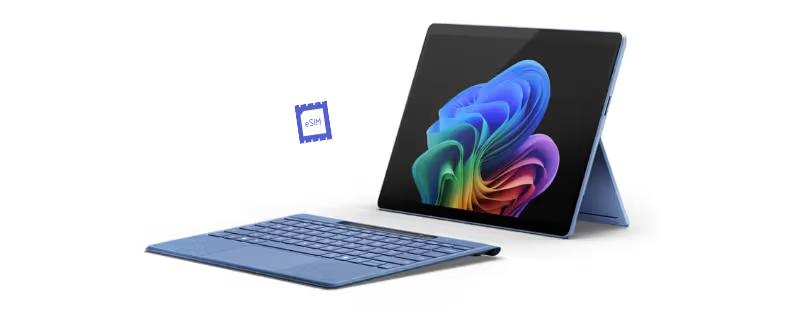
With eSIM now available on iOS at launch, users can download the app, activate service digitally, and gain instant access to wireless data. Android support is expected soon. Physical SIM cards remain available, but the company is clearly leaning into digital onboarding.
From an industry standpoint, this aligns with broader U.S. market shifts. Apple’s move toward eSIM-only iPhones has accelerated adoption, while carriers increasingly treat eSIM as the default rather than the premium.
The benefit is not just convenience. It reduces the cost of distribution, eliminates shipping delays, and lowers entry barriers for budget-conscious users who want immediate access.
Once activated, customers are automatically enrolled in the Free Essential Data plan, making connectivity functional from day one. No waiting. No in-store visits.
For an ad-supported carrier model like TextNow’s, eSIM also enhances scalability. Lower friction means higher conversion rates. And in a cost-sensitive market, simplicity converts.
Network Upgrade Meets Value Positioning
TextNow has also upgraded its nationwide 5G network, aiming to combine affordability with reliability.
While it does not operate as a facilities-based carrier like Verizon or AT&T, TextNow runs as an MVNO on major networks. The company’s emphasis is not on competing in raw speed benchmarks but on delivering dependable baseline connectivity.
In practical terms, that matters more to most consumers than marginal speed differences. According to reports from the Federal Communications Commission and independent analysts such as OpenSignal, coverage consistency and reliability are often stronger predictors of user satisfaction than peak download speeds.
TextNow appears to understand that its target audience is not chasing premium flagship performance. They are chasing stability without financial shock.
A Budget-Conscious Generation Is Shifting
The survey data shows that 52 percent of consumers plan to make financial changes in the New Year to manage their budgets better. Among Gen Z respondents, 26 percent plan to switch to a lower-cost mobile plan or provider.
This reflects a broader structural shift.
Younger consumers are subscription-aware, price-comparison fluent, and less loyal to legacy carriers. They treat telecom like any other recurring service. If it does not justify its cost, they move.
In that sense, TextNow’s model aligns with trends we see globally in both prepaid and app-based connectivity ecosystems. Transparency, modularity, and immediate activation are becoming table stakes.
The question is not whether flexibility is attractive. It is whether the ad-supported model can sustain scale without compromising user experience.
The Bigger Picture
Zooming out, TextNow’s announcement is part of a wider redefinition of connectivity economics.
Globally, operators are facing margin pressure. In the U.S., average revenue per user has plateaued in many segments. Meanwhile, consumer sensitivity to monthly bills has intensified amid inflation and rising housing costs, as reported by institutions like the U.S. Bureau of Labor Statistics.
At the same time, digital-first MVNOs are experimenting with hybrid revenue models: advertising support, app ecosystems, micro-passes, and usage-based flexibility.
TextNow sits at the intersection of these trends. It is not competing to be the fastest network. It is competing to be the least financially stressful.
Compared with traditional prepaid carriers, its free talk and text baseline stands out. Compared with premium postpaid plans, it sacrifices bundled perks but offers predictability. Compared with global travel eSIM providers, it focuses on domestic essential access rather than cross-border mobility.
The strategic tension will be sustainability versus generosity. Can free talk and text plus essential data remain viable as network costs evolve? Can advertising remain non-intrusive enough to preserve trust?
Those are structural questions the entire ad-supported connectivity segment must answer.
Conclusion
TextNow’s latest move is less about launching eSIM and more about reframing what mobile service represents.
In a market where connectivity has become as essential as electricity, pricing psychology now matters as much as network performance. Consumers are not just evaluating gigabytes. They are evaluating risk, stress, and control.
By combining free unlimited talk and text, flexible micro-passes, and instant eSIM activation, TextNow is betting that clarity and autonomy will win loyalty over bundled complexity.
Compared to legacy carriers that still rely on long-term contracts and opaque fees, this model feels radically simple. Compared to global app-based connectivity providers, it localizes the concept of flexibility within the U.S. market.
The broader trend is unmistakable: connectivity is shifting from fixed monthly obligation to modular infrastructure. APIs, digital onboarding, eSIM provisioning, and flexible billing are converging into a new control layer.
If TextNow succeeds, it will not be because it offered the most data. It will be because it recognized something deeper.
In 2026, the most powerful feature in telecom may not be unlimited speed.
It may be a predictable peace of mind.