Knowing What Your eSIM Actually Does Could Save You Money
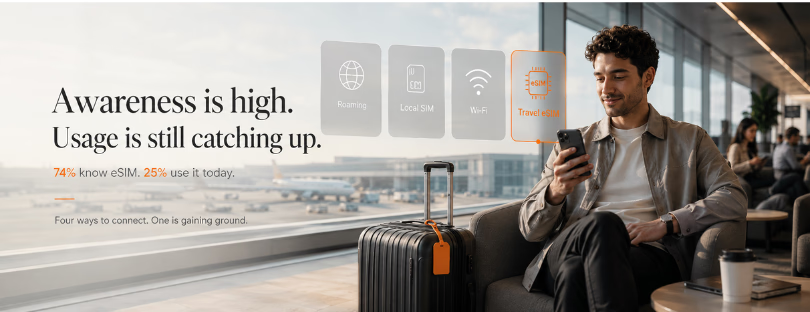
Every new travel technology goes through the same awkward phase. People hear about it, try it, recommend it, and only later realise there are important details behind the simple headline. eSIM is now in that phase.
For travellers, misunderstanding connectivity can cost money. It can mean paying for roaming you thought you had avoided, missing a bank verification code, or discovering at the airport that your “travel eSIM” gives you data but no phone number, no incoming SMS and no traditional calls.
A new survey commissioned by eSIM.net suggests many international travellers are still unclear about one of the biggest differences in the market: data-only eSIMs versus eSIM services that also include voice and SMS.
The research, conducted among 2,000 football fans planning international travel, found that 68% believe all eSIMs support voice calling. It also found that 82% expect to switch off their primary mobile SIM while abroad to avoid roaming charges.
That is the interesting part. Travellers understand the roaming problem. But many still do not fully understand what kind of mobile service they are buying.
The data-only blind spot
Most travel eSIMs are built around mobile data. For many trips, that is enough. Maps, WhatsApp, email, ride-hailing apps, hotel apps, mobile boarding passes and social media all run on data.
But travel is not always that clean.
According to the survey, the biggest concern around relying on data-only mobile service was banking and account access, mentioned by 41% of respondents. Many banks, payment apps and online accounts still use SMS codes or phone-number-based verification.
READ MORE: Saily Adds US Phone Numbers for US$0.99/mo
Healthcare and insurance communications came next, at 29%. If an insurer, clinic or emergency provider expects a normal phone call, relying only on app-based communication can feel fragile.
Another 18% cited access to local services, while 12% cited travel logistics, such as contacting accommodation providers or transport operators. These are the small moments where travellers discover whether their connectivity setup is truly complete.
World Cup travel raises the stakes
The timing is not accidental. The 2026 FIFA World Cup will be hosted across the United States, Canada and Mexico, with 48 teams and 104 matches across 16 host cities. FIFA lists the three host countries as Canada, Mexico and the United States, with the final scheduled for 19 July 2026 in New York New Jersey.
For supporters moving between countries, cities, hotels, stadiums, airports and fan zones, connectivity will be part of the travel experience. It will be how people navigate, pay, coordinate, book rides, access tickets and stay in touch.
READ MORE: Why Your Phone Number Still Matters in the eSIM Era
That is why the voice and SMS question matters. A data-only eSIM may be cheaper and completely suitable for many fans. But it is not the same as a full mobile service.
“eSIM adoption has grown rapidly in recent years, particularly among travellers looking to reduce roaming costs,” said Gerry O’Prey, CEO of eSIM.net. “Our research suggests there is still some confusion about the capabilities offered by different eSIM products, particularly around voice calling and SMS services.”
A full-service eSIM approach
In response to expected demand around North American travel, eSIM.net has launched a North American Tri-Nation eSIM covering the United States, Canada and Mexico.
Unlike many data-only travel eSIMs, the company says its service includes mobile data, voice calling and SMS in one package. eSIM.net also positions its wider offer around “full-service eSIMs”, meaning travellers can use an eSIM-compatible device for data while also retaining more traditional mobile functions.
This is useful for travellers who want one setup across all three host countries, especially if they do not want to rely entirely on WhatsApp calls, VoIP apps or hotel Wi-Fi.
READ MORE: Airhub eSIM: Local Numbers, Voice and Global Plans
Still, it is not automatically the best fit for everyone. If a traveller only needs maps, messaging apps and browsing, a data-only eSIM from providers may be enough, depending on destination, data allowance and price. Some travellers may prefer to keep their primary SIM active for incoming SMS while using a travel eSIM only for data.
The real point is not that every traveller needs voice and SMS. The point is that they need to know before they buy.

What the market still needs to fix
The travel eSIM market has become very good at selling simplicity. Scan a QR code. Land connected. Avoid roaming. That message works, and it has helped eSIM move from niche tool to mainstream travel habit. GSMA reporting shows eSIM smartphone penetration moving from early adoption toward mass-market scale.
But the next stage needs more clarity. Providers should make it obvious whether a plan is data-only, whether it includes a phone number, whether SMS works, whether calls are included, and whether the service supports authentication use cases.
Regulators are also paying more attention to roaming transparency. Ofcom’s strengthened UK roaming protections, which came into force in October 2024, are a useful reminder that consumers need clear information about charges and service conditions before they travel.
Final boarding thought data-only eSIM vs full-service eSIM
The eSIM market is maturing, and this survey points to a gap that needs closing. Travellers are not confused because they are careless. They are confused because too many products are sold under the same simple label.
A data-only eSIM can be brilliant. A full-service eSIM with voice and SMS can be safer for travellers who need banking access, traditional calls or cross-border continuity. Roaming passes from home operators may still make sense for people who need their existing number active at all times.
For the World Cup and other high-pressure international travel, the cheapest plan is not always the best plan. The best plan is the one you actually understand before you need it.
Survey methodology: Survey of 2,000 international football fans planning overseas travel. Fieldwork conducted in May 2026. Percentages have been rounded to the nearest whole number.