Airport Wi-Fi Problems Travelers Know Too Well
Free airport Wi-Fi has one job: help you get online when you have just landed. In theory, that sounds perfect. In real life, it often fails at the exact moment you need it most.
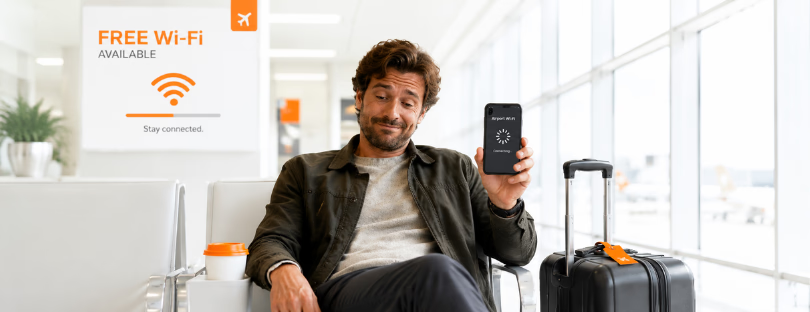
You step out of the aircraft, follow the arrivals signs, and reach for your phone. Maybe you need to message your transfer driver. Maybe you need Uber, Bolt, Google Maps, a hotel address, or a WhatsApp message that says, “I’ve landed.” Then the airport Wi-Fi page opens and asks you to accept terms, enter your email, watch a spinning loading screen, or verify your number by SMS.
The irony is almost beautiful. You need internet so you can receive the code that proves you are allowed to use the internet.
That is the trap.
Useful, until it isn’t
Airport Wi-Fi is not useless. Let’s be fair. It can be helpful when you have time, when you are sitting near the gate, when you only need to check a flight update, or when the network is stable and simple.
The problem is that airport Wi-Fi is rarely designed around the stressed traveler in motion.
It often works best when you are standing still. Travel does not. You are walking through arrivals, pulling luggage, watching signs, avoiding crowds, and trying to make quick decisions. The pickup zone may be outside. The signal may disappear between baggage claim and the exit. The login page may not load properly. Some services may be blocked or unstable. And if you are tired, hungry, or late, even a two-minute delay feels ridiculous.
This is why “I’ll just use airport Wi-Fi” is not really a connectivity plan. It is a hope.
The worst possible moment
The free Wi-Fi trap hurts because of timing.
Most travelers do not need strong mobile data while they are relaxed in an airport lounge. They need it during the messy middle: after landing, before hotel Wi-Fi, before they know where to go, before the ride arrives, before the booking confirmation is easy to find.
That gap is small, but it is where many trips start badly.
A driver messages “Where are you?” The ride app changes the pickup point. Your hotel sends a check-in code. Your family asks if you landed. A payment app wants confirmation. A train ticket sits behind a loading screen.
None of these things are dramatic on their own. Together, they create the feeling every traveler recognizes: I am here, but I am not properly connected to the trip yet.
Where Yesim changes the order
This is where Yesim makes sense.
Not because airport Wi-Fi should disappear. It has its place. But because travelers should not be forced to depend on it in the first ten minutes after landing.
With Yesim, the smarter move happens before departure. You install an eSIM digitally, choose a plan for the destination or a broader global option, and arrive with mobile data ready instead of making connectivity your first airport task. Yesim positions its service around travel and business data plans, one eSIM for 200+ destinations, 1-click installation, hotspot mode, 24/7 support, and global plans for people who move across countries rather than staying in one neat travel box.
READ MORE: Yesim Unveils 2026 Fan eSIM Plan and 2,500 Free Data Giveaway
That matters because travel is increasingly app-first. Transport, maps, translation, banking, hotel check-in, airline notifications, and event tickets all assume your phone is already online. The phone has become the control panel for the trip. Airport Wi-Fi is the backup. It should not be the foundation.
Not every trip needs it
There are exceptions. Some travelers have excellent roaming included. Some airports have fast, open Wi-Fi that works without drama. Some people are meeting family at arrivals and can wait until they reach the hotel.
That is fine. Not every traveler needs an eSIM for every trip.
But frequent travelers, business travelers, solo travelers, digital nomads, and anyone arriving late at night in an unfamiliar city should think differently. For them, mobile data is not a luxury. It is the small layer of control that keeps the first hour from becoming messy.
READ MORE: Yesim Rethinks Unlimited With Its Global Unlim Day Pass
There are also alternatives worth considering. Local SIM cards can still be practical for long stays. Roaming bundles may work for short trips if the pricing is fair. Other travel eSIM providers have helped make the category mainstream.
The real question is not “Which option sounds cheapest?” It is “Which option will work when I am tired, moving, and need my phone immediately?”
Final thought
Free airport Wi-Fi is a nice bonus. It is not a serious arrival strategy.
The modern traveler does too much through the phone to leave the first connection to chance. A weak login page can delay a ride. A dropped signal can hide a message. A blocked app can turn a simple arrival into a small stress loop.
Yesim’s role in this story is practical: it lets travelers prepare before the problem appears. Install the eSIM before departure, choose the right destination or global plan, and land with mobile data already handled.
That is not glamorous. It is better than glamorous. It is useful.
And in travel, useful usually wins.