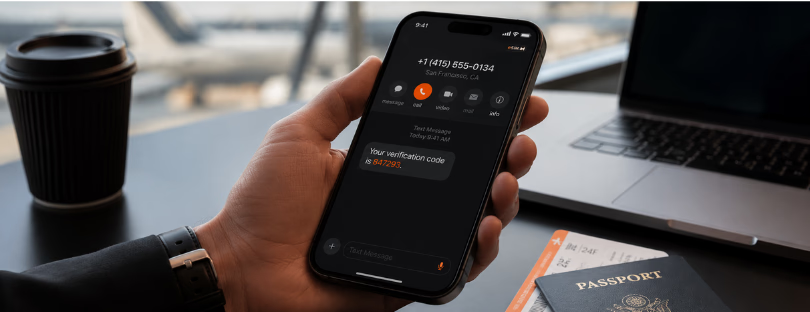
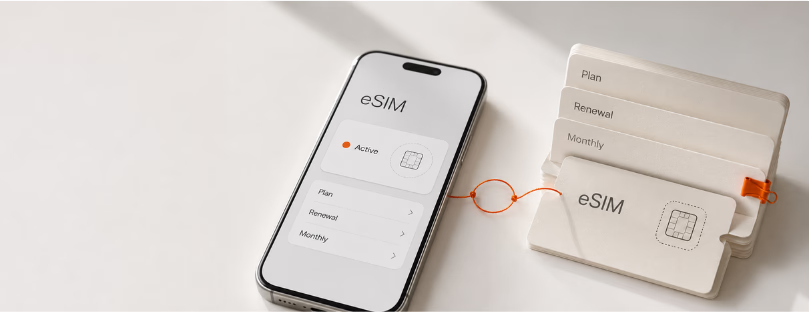
But there is one slightly awkward detail the industry has often pushed to the side: the phone number.
Not the data plan. Not the QR code. Not the coverage map. The actual mobile number.
That small string of digits still carries an enormous amount of power. It is how banks recognize you. It is how WhatsApp, Viber, Telegram, ride-hailing apps, airlines, hotels, delivery platforms, booking sites, and government portals often confirm that you are really you. It is also how friends, clients, and colleagues still reach you when everything else fails.
And this is where the travel eSIM story becomes more complicated than “buy data before you fly.”
Most travel eSIMs are data-only. That works perfectly if you need Google Maps, email, messaging apps, social media, translation, hotspot, or basic browsing. But the moment a traveler needs to receive a verification SMS, make a normal phone call, open a bank app abroad, or register for a local service that insists on a number, the beautiful simplicity starts to crack.
The number is not dead. It has quietly become infrastructure.
Why the phone number still matters
A phone number used to be a communication tool. Today, it is also an identity layer.
That is not always ideal. Security experts have warned for years that SMS-based authentication is weaker than app-based authentication, passkeys, or hardware security keys. NIST’s digital identity guidance has increasingly pushed organizations toward stronger authentication methods, while still acknowledging the role of different authenticator types in real-world systems.
But here is the practical problem: the world has not fully moved on.
Banks still send SMS codes. Government services still ask for phone verification. Airlines and hotels still use numbers for booking alerts. Fintech apps often bind accounts to a mobile number. Messaging platforms use numbers as the user’s primary identity.
So even if the phone number is not the most modern authentication method, it remains one of the most widely used. That gap between “best security practice” and “daily user reality” is where travelers get stuck.
A tourist in Japan may have perfect data through an eSIM but still fail to receive an SMS from their bank. A digital nomad may be online all day but unable to verify a new account because the service rejects VoIP numbers. A business traveler may need local calls for taxis, hotels, or suppliers, but the eSIM they bought only supports mobile data.
This is not a small edge case. It is one of the hidden friction points in global connectivity.
Data-only was the easy phase
Travel eSIM companies grew quickly because they solved a very visible pain: roaming prices.
For most users, a data-only eSIM is enough. Install the eSIM, keep your home SIM active, use mobile data abroad, and avoid paying your home operator’s roaming rates. In many cases, this is the smartest setup.
GSMA Intelligence has been tracking the wider eSIM shift, noting that consumer eSIM adoption is moving from forecast to mass-market reality, with smartphone penetration expected to keep rising through 2026.
That matters because as eSIM becomes normal, users will stop being impressed by installation alone. The question will change from “Can I connect abroad?” to “Can this replace more of my mobile life?”
And that is where the phone number comes back.
A data plan is useful. A number adds continuity. It gives the user a way to receive calls, send SMS, verify services, and behave less like a temporary visitor and more like a connected person.
This is especially important for long-stay travelers, remote workers, expats, international students, frequent flyers, and business users. These groups do not just need internet access. They need reachable, trusted, persistent connectivity.
The security problem nobody can ignore
The phone number is powerful, but that power creates risk.
SIM swap fraud and port-out fraud have become serious enough for regulators to intervene. The FCC describes SIM swap fraud as a situation where a criminal convinces a wireless provider to transfer a victim’s mobile service and number to another device. Port-out fraud involves moving the victim’s number to another provider controlled by the attacker.
That tells us something important: the phone number is valuable because it opens doors. If criminals want the number, it is because banks, email accounts, crypto wallets, social platforms, and payment apps still treat it as a key.
For eSIM providers, this creates a delicate balance. Adding a phone number can make a service much more useful, but it also brings heavier responsibilities: identity checks, number management, fraud prevention, lawful interception requirements in some markets, emergency service rules, and regulatory complexity.
This is why many travel eSIM providers have stayed data-only. It is cleaner. It scales faster. It avoids telecom obligations that pure data resellers do not always want to touch.
But the market is changing. The easier layer is becoming crowded. Coverage, country count, and gigabytes are no longer enough to stand out.
The new fight: number, identity, trust
The next competitive question is not only who has the cheapest data. It is who can provide the most useful mobile identity.
GSMA’s Number Verify initiative is one example of where the industry is heading. It uses mobile network capabilities to help verify that a user is in possession of the phone number, with use cases including device binding, password reset, passwordless login, and two-factor authentication.
That is a very different vision from the old “SMS code to your phone” model. It suggests a future where the mobile network itself becomes part of the authentication flow, quietly checking whether the device, SIM, and number match.
For travel eSIM brands, this opens an interesting strategic question. Do they remain data sellers? Or do they move toward identity-aware connectivity?
Some providers are already testing the edges of this. Holafly has reportedly introduced a global eSIM subscription plan that includes a phone number, positioning itself beyond basic travel data and closer to an international mobile operator-style proposition.
Others still focus mainly on low-cost, data-only travel plans. Airalo, Saily, Ubigi, Nomad, GigSky, and many similar players have different strengths, but in most consumer comparisons the core buying logic is still coverage, price, validity, data allowance, and app experience. Phone number support remains a differentiator rather than a standard feature.
That will not stay invisible forever.
What travelers should understand
For travelers, the smartest setup depends on what they need.
If you only want data abroad, a data-only travel eSIM is usually enough. Keep your home SIM active for calls and SMS, turn off data roaming on the home line, and use the eSIM for internet.
If you need to receive bank codes, check whether your home operator supports incoming SMS abroad without charging heavily. Many do, but not all user experiences are smooth. Also, some banks block verification attempts from unusual locations, regardless of the SIM setup.
If you need a local number, look for plans that clearly state call and SMS support. Do not assume “eSIM” means “phone number included.” In travel connectivity, it often does not.
If you are a business traveler, the question is even bigger. A phone number is not just convenience. It can affect account access, client communication, employee support, compliance, and emergency reachability.
This is why enterprises are moving toward managed mobility and controlled eSIM deployments rather than leaving every employee to buy random travel plans before flying.
Conclusion
The phone number is becoming the uncomfortable truth of the eSIM market.
For years, travel eSIM providers could win by removing friction from data roaming. That was a real breakthrough, and it still matters. But as eSIM adoption grows, the market is moving from connection to continuity. Travelers do not only want to be online. They want their digital life to keep working.
That is where the difference between “data access” and “mobile identity” becomes important.
Data-only providers will continue to dominate short trips, city breaks, and casual travel. They are simple, affordable, and often perfectly adequate. But providers that can combine global data, persistent numbers, authentication support, better security, and clear regulatory handling will move into a stronger category. Not just travel eSIM. Not just roaming alternative. Something closer to portable mobile identity.
The winners will not be the brands shouting the loudest about 200 destinations. They will be the ones who understand why one small phone number still controls so much of the traveler’s digital life.
Driven by wanderlust and a passion for tech, Sandra is the creative force behind Alertify. Love for exploration and discovery is what sparked the idea for Alertify, a product that likely combines Sandra’s technological expertise with the desire to simplify or enhance travel experiences in some way.