eSIM Phone Plans: What to Know Before You Buy
Here’s the thing about eSIM phone plans: most people still think they’re just a “travel hack.” Something you install before a trip, use for a week, and forget.
That’s outdated.
eSIM phone plans are quietly becoming a new category of mobile connectivity. Not just an alternative to SIM cards, but a different way of thinking about how you buy, use, and control mobile data.
Let’s break it down.
What eSIM phone plans actually are
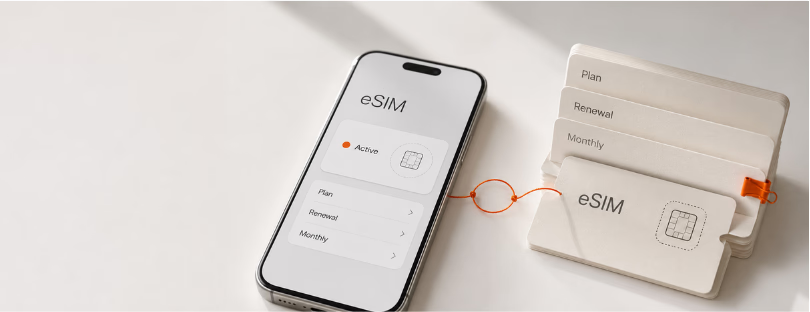
An eSIM phone plan is a mobile data (or full mobile) plan that you download digitally onto your device instead of inserting a physical SIM card.
No plastic. No waiting. No store visit.
You scan a QR code or install it through an app, and your phone connects to a network within minutes.
But the real shift is not the format. It’s the flexibility.
With eSIM, your phone is no longer tied to one carrier, one contract, or even one country.
You can:
- Add multiple plans on one device
- Switch between providers instantly
- Activate or pause plans depending on your needs
That changes everything, especially if you travel frequently or manage connectivity across multiple markets.
Why eSIM plans are gaining traction now
This isn’t just a tech upgrade. It’s a market shift.
Three things are driving it.
First, devices. Apple, Google, Samsung, and others are pushing eSIM aggressively. Some newer models are already eSIM-only in certain markets. That forces both users and carriers to adapt.
Second, pricing transparency. Traditional roaming still feels unpredictable. eSIM plans, especially from global providers, are much clearer. You see exactly what you pay for.
Third, distribution. eSIM plans are sold digitally, which means providers don’t need physical retail, logistics, or local presence. That opens the door to global competition.
The result is simple: more choice, faster innovation, and pricing pressure across the board.

Types of eSIM phone plans (and what people get wrong)
Not all eSIM plans are the same. This is where most confusion starts.
Local eSIM plans
These are tied to a specific country.
You’re traveling to France? You get a France eSIM plan. It connects to local networks and usually offers the best speeds and pricing for that location.
Downside: it stops being useful once you leave.
Regional eSIM plans
These cover multiple countries within a region.
Think Europe, Asia, or the Americas.
If you’re moving across borders, this is where things get interesting. You install one plan and stay connected across multiple countries without switching.
Global eSIM plans
One plan, dozens or even hundreds of countries.
Convenient? Yes.
Always the cheapest? Not necessarily.
But for frequent travelers or business users, the simplicity often outweighs the price difference.
“Unlimited” eSIM plans
This is where you need to be careful.
Most “unlimited” plans are not truly unlimited. They often have fair usage policies, speed throttling, or daily caps.
Some newer models are trying to fix that by introducing structured usage tiers or predictable caps. This is where the market is evolving fast.

How eSIM phone plans compare to traditional SIMs
Let’s be honest. Physical SIM cards still work fine.
But they feel increasingly outdated.
With a traditional SIM:
- You need to physically swap cards
- You are tied to a carrier
- Changing plans takes time
With eSIM:
- You install instantly
- You can store multiple profiles
- You switch plans in seconds
The biggest difference is control.
eSIM puts control back in the hands of the user. Not the operator.
And that’s exactly why telecom players are both excited and slightly nervous about it.
Who eSIM phone plans are actually for
Not everyone needs eSIM. But for certain users, it’s a no-brainer.
Frequent travelers
This is the obvious one.
No more airport SIM kiosks. No more roaming surprises. You land, connect, and move on.
Business users
If your work depends on being connected across markets, eSIM removes friction.
You can assign plans, manage usage, and avoid expensive roaming agreements.
Digital nomads
Constant movement requires flexible connectivity.
eSIM plans allow you to adapt without constantly changing SIM cards or committing to long contracts.
Secondary device users
Tablets, laptops, smartwatches, even cars.
eSIM makes it much easier to keep additional devices connected without managing multiple physical SIMs.
The pricing reality no one talks about
Here’s where things get interesting.
eSIM plans often look cheap upfront. And many are.
But pricing structures vary a lot.
Some providers focus on low entry prices but upsell aggressively. Others position themselves as premium, offering better speeds and more predictable costs.
There’s also a hidden layer most users don’t see: distribution costs.
Because eSIM is digital, providers spend heavily on marketing and partnerships. That cost is often baked into pricing.
So the cheapest plan is not always the best value.
The smarter approach is to look at:
- Cost per GB
- Network quality
- Coverage consistency
- Plan flexibility
That’s where real value shows up.

The shift toward subscription-based connectivity
This is probably the most important trend right now.
We’re moving from one-time data packages to subscription-style eSIM plans.
Instead of buying data every trip, you maintain an active plan that works across countries.
Some models include:
- Monthly data allowances
- Auto top-ups
- Usage-based upgrades
- Spend caps
It’s starting to look a lot like Netflix, but for connectivity.
Predictable. Continuous. Always on.
And this is where traditional telecom struggles to compete.
The challenges eSIM still needs to solve
Despite all the hype, eSIM is not perfect yet.
Activation can still be confusing for non-technical users.
Device compatibility is not universal.
And there’s a lack of standardization in how plans are structured and marketed.
Also, many users simply don’t know what eSIM is.
Education is still a major barrier.
That said, these are temporary problems. The direction is clear.
Where eSIM phone plans are heading next
If you zoom out, eSIM is not just about replacing SIM cards.
It’s about redefining how connectivity is sold and consumed.
Expect to see:
- More bundled connectivity with travel services (airlines, hotels, fintech apps)
- Embedded connectivity inside apps and platforms
- Smarter plans based on usage patterns
- Better transparency around pricing and performance
And most importantly, fewer reasons to ever think about your mobile plan again.
Conclusion
eSIM phone plans are not just a convenience upgrade. They are a structural shift in the telecom industry.
For years, connectivity was locked behind physical limitations, long contracts, and geographic boundaries.
eSIM removes all of that.
But the real story is not the technology itself. It’s the business models forming around it.
Some providers are racing to the bottom on price. Others are building smarter, more predictable, and more user-controlled experiences.
That tension will define the next phase of the market.
If you’re just looking for cheap data, eSIM can already deliver that.
But if you’re looking for control, flexibility, and a better way to stay connected globally, eSIM phone plans are where the real value is starting to emerge.
And we’re still very early in that story.