Airhub eSIM: Local Numbers, Voice and Global Plans
Airhub is not the loudest name in the travel eSIM market, and that may actually be part of its appeal. In a category where many brands compete with the same promises, cheap data, instant activation, no roaming shocks, Airhub has built its position around something more practical: giving travelers more than just a data connection.
That matters. Because the eSIM market has moved past the novelty phase. Travelers no longer ask, “What is an eSIM?” They ask, “Will it work when I land? Can I top it up easily? Will I still be able to call someone? What happens if I need support at midnight?” Airhub’s answer is increasingly built around flexibility, coverage, and services that feel closer to a real mobile experience, not just a data pass.
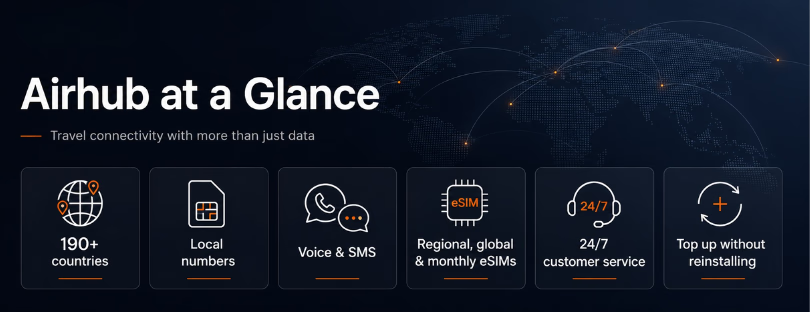
Airhub currently promotes eSIM plans across 190+ countries, with local, regional, global, and monthly options, plus instant activation and no physical SIM swap. It also highlights 24/7 customer service, secure payments, and local geographic number availability, which is one of the more interesting parts of the offer.
More Than Data
Most travel eSIM brands are still data-first. That is fine for tourists who only need Google Maps, WhatsApp, rideshare apps, and hotel confirmations. But it becomes limiting when the traveler needs a local number, voice minutes, SMS, or a more “normal SIM” experience abroad.
This is where Airhub feels different. Some Airhub plans include voice, SMS, and local phone number options, giving travelers something closer to a local mobile setup instead of a silent data-only profile. Airhub’s own app listing describes prepaid eSIM plans for data, voice, and SMS in 190+ countries.
That sounds small until you think about real travel behavior. A business traveler may need to call a local office. A student arriving in a new country may need a number for registration. A tourist may need to call a restaurant, guide, clinic, bank, or delivery driver. Yes, apps replaced many calls. But not all of them. Travel still has awkward moments where a working local number solves the problem faster than another chat app.
Alertify has covered this angle before, especially when comparing Airhub with data-only competitors. The point is not that every traveler needs calls and SMS. Many do not. The point is that Airhub gives certain users an option that many eSIM brands skip.
More on Alertify
Follow the latest Airhub eSIM news
eSIM updates, travel connectivity moves and Airhub stories in one place.
Explore news →
The Lifetime eSIM Idea
Another notable move is Airhub’s lifetime eSIM concept. Instead of treating every trip as a new purchase, the idea is to let the traveler keep the same eSIM profile and top it up when needed. Alertify previously framed this as a shift from disposable travel connectivity toward a more permanent travel companion.
This is smart because frequent travelers hate repetition. They do not want to install another QR code before every trip. They do not want to dig through emails at the airport. They do not want to guess whether the right eSIM is active. A reusable eSIM profile turns the product from “something I buy before Spain” into “something I keep on my phone.”
That is exactly where the market is going. Travel eSIMs are becoming less about one-off cheap data and more about continuity. Top-ups, saved profiles, regional bundles, app-based management, and long-term plans are becoming the real battleground.
Where Airhub Fits
Airhub sits in an interesting middle space. It is not only trying to be the cheapest data marketplace. It is also not presenting itself as a luxury unlimited-data brand in the Holafly style. And it is not simply following the clean, app-first simplicity of Airalo or Nomad eSIM.
Its strength is breadth. Local eSIMs, regional plans, global plans, monthly plans, top-ups, local number options, and in some cases voice and SMS. For travelers who want choice, that is useful. For travel businesses, affiliates, and platforms, it also creates more ways to match connectivity to specific use cases.
Airhub’s B2B angle should not be ignored either. Alertify has already covered how Airhub’s eSIM API can allow travel apps, airlines, or platforms to embed eSIM connectivity directly into their own customer journey. That is a bigger story than consumer eSIM alone. The next phase of this market will not only be about who sells the best plan. It will be about who gets embedded at the right moment: booking, check-in, hotel confirmation, travel insurance, loyalty apps, fintech apps, and corporate travel tools.
GSMA Intelligence has also pointed out that travel eSIM is becoming one of the clearest consumer benefits of eSIM adoption, because it gives people an obvious reason to use the technology. That is exactly why brands like Airhub matter. They translate eSIM from a telecom feature into a travel habit.
The Trust Test
Of course, Airhub operates in a crowded and sometimes messy category. Travel eSIM buyers are more informed than they were two years ago. They now compare coverage, fair usage policies, speed claims, hotspot rules, refunds, and support quality. A cheap plan is no longer enough if the experience is unclear.
This is where Airhub’s broader offer can work in its favor, but only if the communication stays simple. Voice and SMS are useful. Local numbers are useful. Lifetime eSIMs are useful. But travelers need to know exactly which plan includes what, where it works, and what the limits are. In eSIM, trust is built before checkout, not after activation.
Final Take
Airhub’s real opportunity is not to shout louder than Airalo, Holafly, Saily, Ubigi, or Nomad eSIM. It is to own a more practical position: the eSIM for travelers who want options beyond basic data.
Airalo has scale and familiarity. Holafly has made unlimited data easy to understand. Ubigi has strong infrastructure credibility through Transatel. Nomad eSIM and Saily lean into clean digital simplicity. Airhub’s edge is different. It can be the flexible, feature-rich choice for travelers who still need the messy parts of mobile connectivity: calls, SMS, local numbers, top-ups, longer use, and multi-country movement.
That is not as glossy as “unlimited data everywhere.” But it may be more useful. And in travel connectivity, useful usually wins.
Driven by wanderlust and a passion for tech, Sandra is the creative force behind Alertify. Love for exploration and discovery is what sparked the idea for Alertify, a product that likely combines Sandra’s technological expertise with the desire to simplify or enhance travel experiences in some way.