iPhone Dual SIM: Two Lines that Matter
Dual SIM on iPhone used to feel like a niche feature for business travellers, expats, and people who did not want to carry two phones. Now it is becoming something much more ordinary: a practical connectivity setup for modern life.
Apple’s Dual SIM feature allows iPhone users to run two mobile lines on one device. Depending on the model and region, that can mean one physical nano-SIM plus one eSIM, or two active eSIMs at the same time. Apple says iPhone 13 models and later support Dual SIM with two eSIMs, while earlier eSIM-compatible models generally rely on the classic physical SIM plus eSIM setup. Physical SIM support also varies by region and model, which matters more than many users realise.
That detail may sound technical, but the use case is beautifully simple. One line can be your main number. The second can be for travel, work, data, privacy, testing a new provider, or keeping a local number active while you are abroad.
Why it matters now
The iPhone has quietly turned Dual SIM from a telecom feature into a lifestyle tool.
For travellers, it solves one of the oldest roaming problems: how to keep your home number reachable while using cheaper mobile data abroad. You can keep your primary line active for calls, banking SMS, WhatsApp continuity, and two-factor authentication, then add a travel eSIM for data in the destination. No SIM tray hunting. No airport kiosk panic. No “I’ll just use hotel Wi-Fi” optimism that lasts until the taxi ride.
For business users, Dual SIM separates personal and professional life without requiring a second device. Calls can be labelled. Data can be assigned to one line. Messages can stay tied to the right number. It is not perfect, but it is cleaner than the old two-phone routine.
READ MORE: Roaming with dual SIM smartphones: advantages and limitations
For digital nomads and frequent cross-border workers, the value is even clearer. Someone living between Croatia, Germany, Dubai, and Turkey might keep a home number, use a regional European plan, and activate short-term eSIMs only when needed. The iPhone becomes less of a locked operator device and more of a flexible connectivity terminal.
The GSMA describes eSIM as a global specification that enables remote SIM provisioning, meaning a mobile plan can be activated digitally without inserting a removable SIM card. That is the foundation behind this shift: connectivity becomes downloadable, movable, and easier to manage.
How it works
On an iPhone, Dual SIM means your device can keep two mobile plans active at the same time. One can be your regular home number, and the other can be a second line from another operator or an eSIM provider.
In practice, the setup usually works like this. You keep your main number for calls, SMS, WhatsApp, banking codes, and normal contacts. Then you add a second plan, often an eSIM, for mobile data. When you travel, that second plan can handle the internet connection, while your main number stays reachable.
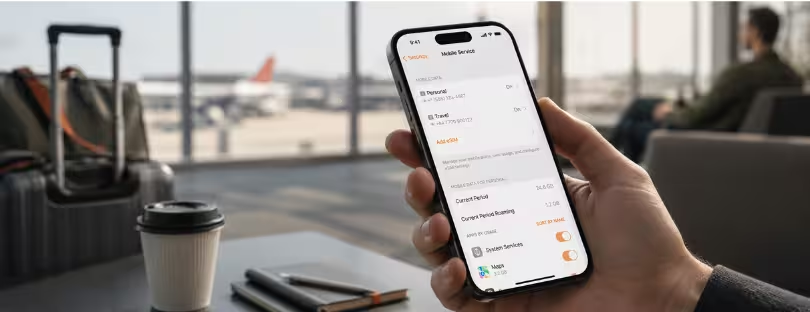
Inside iPhone settings, Apple lets you label each line, for example, “Personal,” “Business,” or “Travel.” You can choose which line is used for mobile data, which line is the default for calls, and which number should be used when contacting specific people. So, if you call your accountant from your business line once, the iPhone can remember that preference for next time.
The important part is data selection. If you buy a travel eSIM for Spain, Japan, or the US, you normally go to Settings > Cellular/Mobile Data, select the travel eSIM as your data line, and keep your home SIM active for calls and messages. That way, you avoid using expensive roaming data from your home provider.
There are a few model differences. Some iPhones use one physical SIM and one eSIM. Newer models can use two active eSIMs at the same time. In the US, recent iPhone models no longer include a physical SIM tray, so everything runs through eSIM. This is why users should always check their exact iPhone model before buying a travel plan.
It is simple once set up, but one mistake can be expensive: leaving mobile data on the wrong line. Dual SIM gives you control, but you still need to choose the right data line before travelling.
 The Apple effect
 The Apple effect
Apple did not invent eSIM, but it has done what Apple often does: make the behaviour mainstream.
Once iPhone users become comfortable adding a second plan in settings, the mental barrier changes. Buying mobile data starts to feel closer to downloading an app than visiting a telecom store. That is a massive behavioural change for operators, eSIM providers, travel brands, and anyone trying to sell connectivity at the right moment.
READ MORE: Apple Brings eSIM Quick Transfer to China: A Major Step for Local iPhone Air Users
Apple’s own support pages now explain several activation methods, including eSIM Carrier Activation, eSIM Quick Transfer, and QR-code-based activation, depending on the carrier. That may sound like backend plumbing, but it has a real market impact. The easier activation becomes, the less patience users have for messy onboarding, unclear instructions, or providers that still treat eSIM like an add-on product.
This is where the market gets interesting. Dual SIM is no longer just “two numbers.” It is a distribution layer. Travel eSIM providers, mobile operators, fintech apps, airlines, hotel apps, and super-apps can all compete for that second line.
What users still get wrong
The biggest misunderstanding is that “eSIM-compatible” automatically means “two active eSIMs at once.” It does not.
Older iPhones may support eSIM, but often in combination with a physical SIM. Newer models are more flexible. Apple’s guidance is the safest source here: iPhone 13 and later support two active eSIMs, while iPhone SE 3rd generation and later also support two eSIMs. But physical SIM availability is not universal, especially as Apple has moved some iPhone models in certain markets toward eSIM-only designs.
READ MORE: Best Dual SIM Phones
Another common mistake is assuming both lines behave the same. In practice, users need to choose which line is used for cellular data, which is the default voice line, and which number is used for specific contacts. That control is powerful, but it requires a little setup. A poorly configured dual-SIM iPhone can still burn through roaming data if the wrong line is selected.
The third mistake is buying the cheapest travel eSIM and expecting premium performance everywhere. Dual SIM gives users flexibility, but network quality still depends on the provider, roaming agreements, local partner networks, throttling policies, and support. The iPhone makes switching easier. It does not magically make every plan equal.

The market angle
For consumer eSIM providers like Airalo, Holafly, Nomad eSIM, Ubigi, Yesim, and others, iPhone Dual SIM is one of the biggest reasons the category exists at scale. The second line is the entry point. Users do not need to abandon their home operator. They simply add temporary data.
But the same feature also gives mobile network operators a warning. If the secondary line becomes easy, cheap, and reliable, it can slowly steal usage from the primary operator, especially for roaming. That does not mean operators disappear. It means they need better travel offers, better app journeys, and clearer international pricing.
Samsung and Google phones also support eSIM and Dual SIM on many models, so this is not only an Apple story. But the iPhone matters because it influenced user behaviour. When Apple normalises a connectivity habit, app developers, carriers, and travel platforms follow.
What comes next
The next stage is not simply “more eSIMs.” It is smarter line management.
Users will expect their phone to know when to use the cheapest or fastest available connection. Business travellers will expect company-managed eSIM profiles. Families may expect shared travel data. Banks and fintech apps may bundle connectivity into premium accounts. Airlines may offer destination data before arrival. Hotels may use eSIM as part of the guest journey.
That is where Dual SIM becomes less visible but more important. It is the quiet bridge between the old operator-controlled SIM world and the new app-driven connectivity market.
Conclusion
iPhone Dual SIM is not a flashy feature anymore, and that is exactly why it matters. The feature has moved from “nice to have” into everyday infrastructure.
Compared with Android players, Apple is not always the most open or flexible environment, but it is often the one that changes mainstream habits fastest. For travel eSIM providers, that is good news. For operators, it is both an opportunity and a warning. For users, it means one simple thing: your mobile connection no longer has to be tied to one provider, one country, or one plastic SIM card.
The real trend is not Dual SIM itself. The real trend is that choice is becoming normal. And once travellers get used to that, it is very hard to convince them to go back.