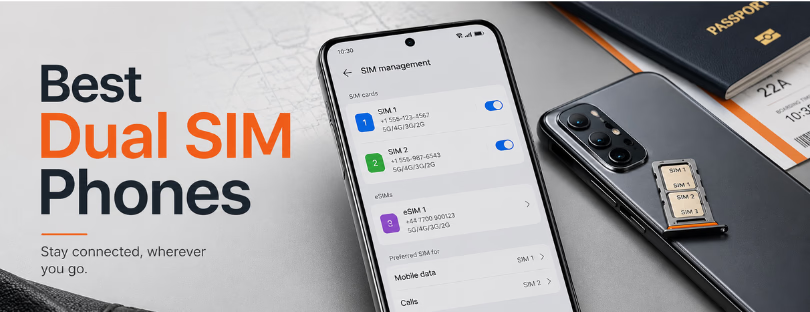
Best Dual SIM Phones
Dual SIM used to be a small feature buried in the spec sheet. In 2026, it has become one of the most practical reasons to choose one phone over another.
For Alertify readers, this is not just about having “two numbers.” It is about keeping your home line active while using a local travel eSIM, separating work and personal calls, testing different networks, avoiding roaming shocks, or keeping a backup line when one operator disappoints you. And yes, that last one happens more often than operators like to admit.
The best dual SIM phone today is not simply the phone with two slots. It is the phone that makes dual connectivity easy, reliable, and flexible.
What does dual SIM mean now?
There are three main setups buyers should understand.
The traditional version is two physical nano-SIM cards. This is still useful in some markets, especially where eSIM support is weaker or where users regularly swap local prepaid SIMs.
The more common premium setup is one physical SIM plus one eSIM. This is ideal for most travelers because you can keep your home SIM inside the phone and add a travel eSIM before or during the trip.
The most future-facing setup is dual eSIM, where two digital SIM profiles can be active at the same time. Apple says iPhone 13 models and later support Dual SIM with two eSIMs, while Apple also notes that physical SIM support depends on the model and market. Google says Pixel phones support dual SIM use, and Pixel 7 or later models can use two eSIMs at the same time in supported setups. Samsung’s latest Galaxy devices also support eSIM across many flagship models, with regional differences in SIM configuration.
That “regional differences” part matters. A phone sold in Europe, the US, China, Hong Kong, or the Middle East may not have the same SIM tray or eSIM behavior. Always check the exact model number before buying.
Best overall: iPhone
For many travelers and business users, the iPhone remains the safest dual SIM choice. Not because Apple is always the most flexible, but because the eSIM experience is mature, widely supported, and easy to understand.
Recent iPhones can store multiple eSIMs and use two lines actively on supported models. Apple also clearly positions eSIM as a travel tool, especially for keeping a home number active while using another eSIM abroad.
READ MORE: iPhone Dual SIM: Two Lines that Matter
The big advantage is predictability. If you are buying an eSIM from a travel provider, airline, bank, or app-based service, iPhone compatibility is usually the first thing they test properly. Activation flows tend to be polished. QR code setup, carrier transfer, and profile management are all straightforward.
The drawback? Apple’s SIM strategy varies by country. Some iPhones are eSIM-only in certain markets, while others still support physical SIMs. For frequent travelers who still buy local plastic SIM cards, that can be annoying. For users already comfortable with eSIM, it is less of a problem.
Best for: frequent travelers, business users, people who want the least confusing eSIM experience.

Best Android flagship: Samsung Galaxy
Samsung is the Android brand that comes closest to matching Apple’s mainstream dual SIM confidence. The Galaxy S series, especially the latest S25 and S26 generation devices, is strong for users who want physical SIM plus eSIM flexibility, and in some models, dual eSIM capability.
Samsung’s own support pages list a wide range of Galaxy S and Z devices with eSIM support, including the Galaxy S25 family, Galaxy Z Fold and Flip lines, and newer Galaxy devices. Samsung Business UK lists the Galaxy S26 Ultra with Dual-SIM support, nano-SIM and embedded SIM, and slot options including SIM 1 plus SIM 2, SIM 1 plus eSIM, or dual eSIM.
READ MORE: The Galaxy S22 series will support dual SIM with eSIM at launch in the US
This makes Samsung especially attractive for people who still want a physical SIM tray. In Europe, many Galaxy models remain more flexible than eSIM-only phones. For travel, that is useful. You can keep your main SIM, add an eSIM, or still buy a physical prepaid card in markets where eSIM is not convenient.
The downside is that Samsung’s dual SIM behavior can be more region-specific than buyers expect. A Galaxy model bought in one market may not match the SIM setup of the same brand name sold elsewhere.
Best for: Android users, business travelers, people who want both physical SIM and eSIM flexibility.
Best clean Android option: Google Pixel
Pixel phones are excellent dual SIM devices on paper. Google’s own support explains that Pixel 3a and later phones support Dual SIM Dual Standby using physical SIM and eSIM, while Pixel 7 and later can support two eSIMs in certain setups.
The Pixel advantage is software clarity. SIM settings are clean, switching data lines is simple, and Android updates arrive directly from Google. For people who travel often and do not want a heavily customized Android interface, the Pixel is appealing.
READ MORE: Google Pixel 10 Could Go eSIM-Only in the US
But there is a caveat. Recent reports have mentioned eSIM issues affecting some Pixel users after software updates, including complaints around Pixel 9 and Pixel 10 devices. That does not mean Pixel should be avoided, but it does mean reliability-sensitive users should check recent carrier and device feedback before depending on Pixel as their only travel connectivity device.
Best for: Android purists, Google services users, people who value clean software over extra features.

Best value picks: OnePlus, Xiaomi and Motorola
Outside Apple, Samsung, and Google, there are strong dual SIM phones from OnePlus, Xiaomi, Honor, Oppo, Vivo, and Motorola. These brands often offer excellent hardware for the money, and many models still support two physical SIMs or a physical SIM plus eSIM, depending on the region.
This is where buyers need to be careful. The same phone name can have different SIM support across markets. A European version may include eSIM, while another regional version may not. A cheaper variant may offer two physical SIMs but no eSIM. A carrier-sold version may restrict some features.
For travelers, this group can be an excellent value. But the rule is simple: do not buy based only on the marketing name. Check the model number, the local spec page, and whether your operator or travel eSIM provider supports that exact device.
Best for: price-conscious buyers, Android fans, people comfortable checking specifications.
What to look for before buying
The best dual SIM phone should answer five questions clearly.
Can it keep two lines active at once? Does it support eSIM in your country? Can it use two eSIMs, or only one physical SIM plus one eSIM? Is the phone unlocked? And does your carrier support eSIM activation properly?
That last point is underrated. A phone can support eSIM perfectly, but if the carrier’s activation process is poor, the experience will still feel broken. Apple also reminds users that the phone must be unlocked or both plans must be from the same carrier, and that both providers must support Dual SIM with eSIM.
Final take
The best dual SIM phone for most people is still an iPhone if they want the smoothest eSIM experience. The best Android choice is the Samsung Galaxy, especially for users who want a more flexible mix of physical SIM and eSIM. Pixel is attractive, but slightly less bulletproof for those who cannot tolerate eSIM glitches. OnePlus, Xiaomi, Honor, Oppo, Vivo, and Motorola can be excellent value, but only if the exact model supports the setup you need.
The bigger story is clear: dual SIM is shifting from “two plastic cards” to “one device, many connectivity identities.” Apple is pushing the market toward eSIM-first behavior. Samsung is keeping hybrid flexibility alive. Google is making dual SIM feel native inside Android. Travel eSIM providers, banks, airlines, and enterprise mobility platforms are all building around that reality.
So the smartest dual SIM phone is not necessarily the one with the most impressive camera or benchmark score. It is the one that gives you control over connectivity when you cross borders, change networks, separate work from life, or simply refuse to pay ridiculous roaming fees. For Alertify readers, that is the real premium feature.