Tata Communications and the Deeper eSIM Layer
Tata Communications is not the kind of company travellers usually discover while searching for a 5 GB eSIM before flying to Paris.
And that is exactly why it matters.
In the eSIM world, the visible layer gets most of the attention. Travel eSIM apps, pretty checkout pages, destination plans, unlimited-data promises, and affiliate rankings. That is where the market feels busy, noisy, and sometimes a little too similar.
Tata Communications sits much deeper in the stack. Its story is not really about selling a cheap travel plan to one person. It is about helping enterprises, IoT platforms, connected vehicle players, service providers, and global businesses manage cellular connectivity across countries, networks, devices, and regulatory environments.
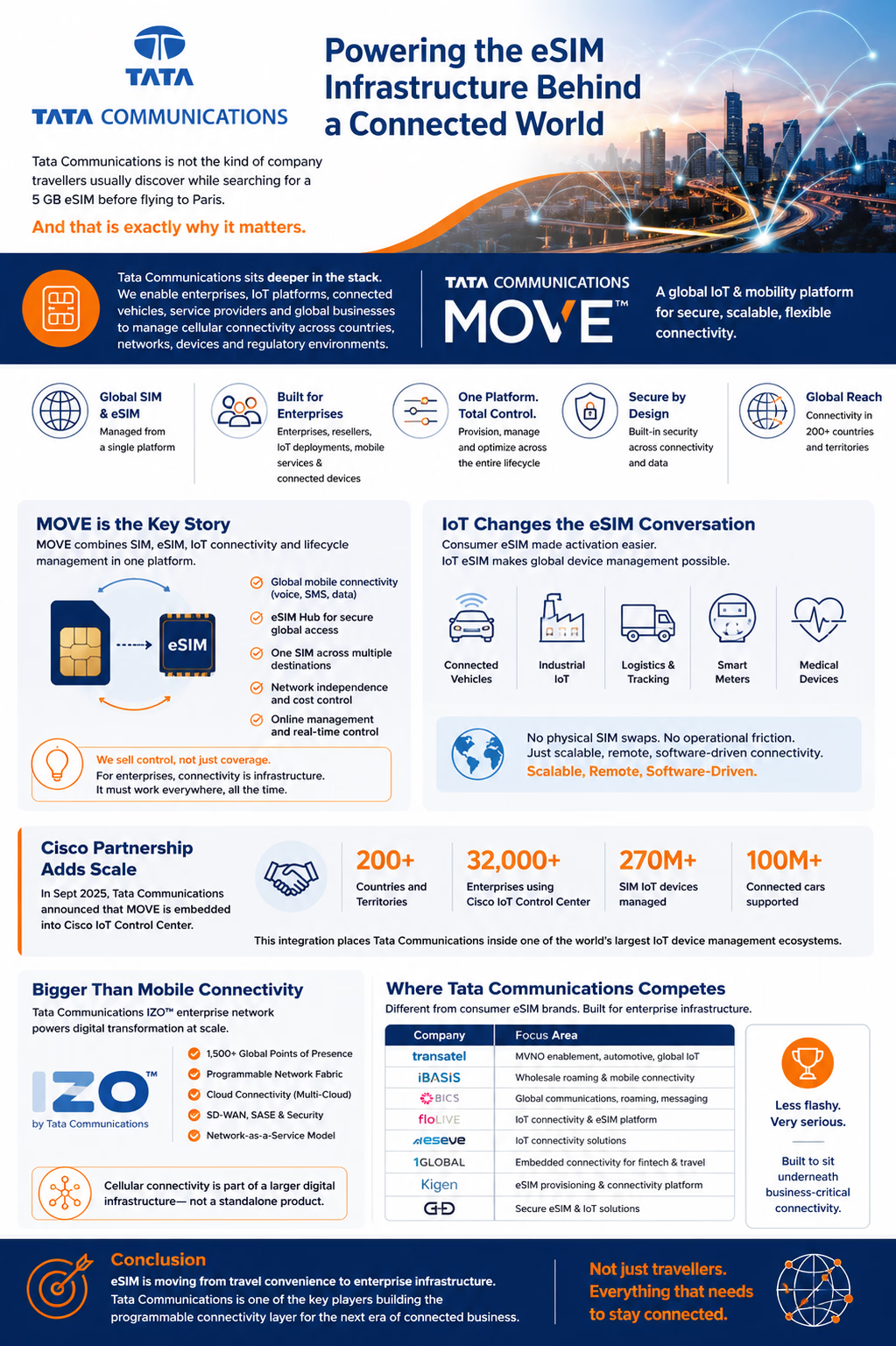
The company positions Tata Communications MOVE as a global IoT and mobility platform built for secure, scalable, flexible connectivity. Its Global SIM and eSIM services are managed from a single platform, with use cases for enterprises, resellers, IoT deployments, mobile services, and connected devices.
That makes Tata Communications a very different player from consumer eSIM brands. It is not fighting mainly for the traveller’s first click. It is fighting for the infrastructure contract behind millions of connected things.
MOVE is the key story
The most relevant product for the eSIM conversation is Tata Communications MOVE.
MOVE is designed around global mobile connectivity, including SIM, eSIM, IoT connectivity, lifecycle management, and platform control. The company describes its eSIM Hub as a secure global SIM for mobile voice, SMS, and data access, while its broader Global SIM and eSIM offer focuses on one SIM across multiple destinations, network independence, cost control, and online management.
That language may sound less glamorous than “instant travel data,” but it solves a more complicated problem.
READ MORE: Tata Communications and NICE Partner to Redefine AI-Powered Customer Experience at Scale
A traveller can switch providers if an eSIM disappoints them. A connected vehicle, smart meter, logistics tracker, medical device, or enterprise fleet cannot behave that way. Once a device is deployed at scale, connectivity becomes operational infrastructure. It has to be managed remotely. It has to keep working across borders. It has to avoid permanent roaming problems where possible. It has to make sense commercially.
That is where Tata Communications feels relevant. It is selling control, not just coverage.
IoT changes the eSIM conversation
Consumer eSIM made activation easier. IoT eSIM makes global device management possible.
That difference is important.
Tata Communications’ eSIM messaging is closely tied to IoT and embedded connectivity. In its material around eSIM technology, the company highlights how Tata Communications MOVE and Infineon’s OPTIGA Connect eSIM can help businesses embed connectivity, manage updates, and keep devices connected globally.
This is the part many consumer-focused eSIM discussions miss. Industrial and enterprise eSIM is not only about convenience. It is about reducing operational friction before it becomes expensive.
Imagine a manufacturer shipping devices to 40 countries. Or an automotive company selling connected services across Europe, North America, and Asia. Or a logistics business that needs trackers moving through several network environments. Physical SIM swaps are not just annoying in those scenarios. They are commercially ridiculous.
eSIM and remote provisioning give these companies a way to manage connectivity as software. That is the shift.
Cisco partnership adds scale
One of the strongest recent signals came from Tata Communications’ collaboration with Cisco.
In September 2025, Tata Communications announced that MOVE would be embedded into Cisco’s IoT Control Center. The announcement described MOVE as a multi-generational global eSIM orchestration solution with managed SIM lifecycle capabilities and reach across more than 200 countries and territories. Cisco’s IoT Control Center is used by over 32,000 enterprises and supports more than 270 million SIM IoT devices, including 100 million connected cars.
READ MORE: Cisco and Tata Communications Forge Next-Gen eSIM & IoT Partnership
That is not a small integration. It places Tata Communications inside one of the most important IoT device-management environments in the market.
For Alertify readers, this is the kind of move worth watching. It shows that eSIM is not just moving into travel apps and fintech wallets. It is being embedded into enterprise platforms where device connectivity is managed at enormous scale.
That is a much harder market to enter than consumer travel eSIM, but also a more defensible one.
Bigger than mobile connectivity
Tata Communications also has a broader enterprise network story.
Its IZO enterprise network services are built around global reach, programmable network fabric, cloud connectivity, SD-WAN, SASE, and security. The company cites more than 1,500 global points of presence and positions its network as an as-a-service model for enterprise transformation.
This matters because enterprise eSIM rarely lives alone.
A company does not usually buy IoT connectivity in isolation. It needs cloud access, security, device visibility, compliance support, analytics, private network options, and integration with wider enterprise infrastructure. Tata Communications can speak to that broader architecture in a way that smaller eSIM-only players cannot.
That is one of its advantages. It can position cellular connectivity as part of digital infrastructure, not as a standalone product.
Your customers will buy connectivity. The question is: from you, or from someone else?
We help airlines, banks, and travel platforms turn that demand into a built-in product — not a missed opportunity.
Where Tata Communications competes
Tata Communications belongs in a different competitive set from Airalo, Holafly, Nomad, or other consumer eSIM brands.
The better comparisons are companies such as Transatel, iBASIS, BICS, Syniverse, floLIVE, Eseye, 1GLOBAL, Kigen, and G+D. Each plays in parts of the global connectivity, IoT, roaming, eSIM provisioning, or mobile infrastructure stack.
READ MORE: JLR & Tata Communications Advance the Connected Vehicle Ecosystem with Global Connectivity
Compared with Transatel, Tata Communications has a broader enterprise network and cloud-connectivity story. Transatel is very strong in MVNO enablement, automotive connectivity, and global IoT through its NTT backing. Compared with iBASIS and BICS, Tata Communications feels less like a pure roaming and wholesale-carrier specialist and more like a global enterprise digital-infrastructure provider. Compared with floLIVE or Eseye, it has more enterprise-network scale and a bigger global corporate brand. Compared with 1GLOBAL, it is less visible in fintech-style embedded travel eSIM, but stronger in broad enterprise, IoT, and network transformation.
That makes Tata Communications less flashy, but very serious.
It is not trying to become the most downloaded travel eSIM app. It is trying to sit underneath business-critical connectivity.
Conclusion
Tata Communications matters because it shows the real direction of eSIM: from travel convenience to enterprise infrastructure.
The market is no longer one simple category. At the top, consumer eSIM brands compete for travellers. In the middle, embedded-connectivity platforms help fintechs, apps, and travel brands add mobile services into their customer journeys. At the deeper layer, companies like Tata Communications manage the connectivity behind devices, vehicles, enterprise fleets, IoT platforms, and global digital operations.
That deeper layer will not always win the loudest headlines. But it may decide who actually controls the next phase of connected business.
For Alertify readers, the signal is clear. eSIM is not just a product people buy before a trip. It is becoming a programmable infrastructure layer for enterprises. Tata Communications is one of the companies proving that the biggest eSIM opportunity may not be the traveller’s phone at all.
It may be everything else that needs to stay connected.