Why Consumer eSIM Brands Are Becoming Too Dependent on the OS
For years, consumer eSIM brands sold one very clean promise: skip roaming, skip airport SIM shops, land connected.
It worked. Airalo, Holafly, Nomad eSIM, Yesim, Ubigi, Saily, GigSky and others helped make travel connectivity feel like an app purchase instead of a telecom transaction. Open an app. Pick a country. Pay. Scan a QR code. Activate before departure or after landing. Done.
But the next phase of the market is less comfortable.
Consumer eSIM brands may own the customer relationship, the app, the pricing, the support conversation, and the destination landing pages. Yet Apple and Google increasingly shape the most sensitive part of the journey: activation, transfer, device setup, and how the user understands what is happening inside the phone.
That matters because the real battleground in eSIM is no longer only “who has the best data package for Japan?” It is who controls the moment when the traveller tries to connect.
Apple’s own support flow now puts eSIM setup, eSIM Quick Transfer, carrier activation, and transfer from Android directly inside the iPhone settings experience. Apple says users can transfer a phone number using eSIM Quick Transfer, and that once the plan activates on the new iPhone, the previous SIM is deactivated. It also lists carriers that support this experience, which shows how much the OS layer is becoming part of the connectivity journey itself.
The customer is yours, until setup starts
This is the quiet tension for travel eSIM brands.
A customer may discover Airalo through Google, buy Holafly because of unlimited data messaging, choose Nomad eSIM because the plan looks clean, or pick another provider because the price and coverage fit. In marketing terms, the eSIM brand won the customer.
Then the phone takes over.
The user leaves the provider’s beautiful checkout flow and enters iOS or Android settings. The wording changes. The buttons change. The permissions change. The error messages change. The user is suddenly dealing with “Cellular,” “Add eSIM,” “Transfer SIM,” “Network & internet,” “SIM manager,” or a carrier-specific prompt.
READ MORE: Top 5 Budget eSIM Phones
For confident users, this is fine. For everyone else, this is where trust can crack.
The provider can explain the plan perfectly, but it cannot fully control how Apple, Google, Samsung, or a device manufacturer presents the installation journey. It can guide, document, and support. It cannot own the entire operating system experience.
And in travel, this happens at the worst possible moment. Not on a sofa with good Wi-Fi and patience. It happens in an airport, after a long flight, with a 12 percent battery and a hotel address sitting inside WhatsApp.
Apple and Google are not just neutral pipes
The industry often talks about eSIM as if it is simply a digital version of a plastic SIM. That is too simple.
The GSMA describes eSIM as a global specification enabling remote SIM provisioning, allowing users to download and manage operator profiles without a physical SIM card. Android’s own technical documentation says the Android framework provides standard APIs for accessing eSIM and managing subscription profiles, with eSIM based on GSMA remote SIM provisioning.
That sounds technical, but the business implication is huge. If eSIM lives inside software, then the software environment matters.
Apple and Google are not selling most travel eSIM plans directly. But they increasingly influence the rules of the room. They decide how smooth setup feels. They decide where warnings appear. They decide how the transfer is presented. They decide which flows are native, which are clunky, and which require extra user effort.
READ MORE: HONOR Adds OWN eSIM to Smartphones Across the GCC
Google’s Pixel support documentation, for example, now includes a SIM transfer flow from another device and tells users to contact their carrier if persistent transfer issues continue. That is a small support line, but it reveals the broader structure: the OS can start the journey, but the provider or carrier may still own the failure.
That is uncomfortable for consumer eSIM brands. The smooth part becomes “Apple made it easy.” The broken part becomes “my eSIM provider failed.”

QR codes are starting to look old
The QR code was brilliant for early eSIM adoption because it made the invisible visible. Buy plan. Receive QR. Scan. Install.
But as eSIM becomes more native, QR codes start to feel like a transitional technology. They are useful, but they are not elegant. They also create friction: one device needs to show the QR code, another needs to scan it, and the user needs to understand when to install, when to activate data roaming, and when not to delete the profile.
The direction of travel is obvious. Device-native activation, account-linked setup, app-to-settings handoff, and phone-to-phone transfer will keep improving. Apple already supports multiple eSIM setup methods, including carrier activation, QR code, manual entry, Quick Transfer, and Android-to-iPhone transfer in certain cases.
For travellers, this is good news. For eSIM brands, it is more complicated.
The more native activation becomes, the less visible the provider may become during the most important emotional moment: “Am I connected?”
That may sound dramatic, but it is exactly how platform power works. First, platforms reduce friction. Then users trust the platform interface more than the brand underneath it. Then brands compete by the rules they did not write.
Airalo, Holafly, Nomad eSIM, and the platform squeeze
This does not mean Airalo, Holafly, Nomad eSIM and others are suddenly weak. Far from it. These brands still control discovery, pricing, destination coverage, affiliate distribution, content, customer education, and support. They also have scale, app installs, reviews, and user habits on their side.
But their dependency is becoming more visible.
Airalo’s strength has always been marketplace breadth and destination-led discovery. Holafly built a strong consumer position around unlimited-style travel data and simplicity. Nomad eSIM has leaned into clean plan presentation and a polished digital purchase flow. Other players differentiate through pricing, regional packages, refunds, loyalty, or enterprise-adjacent features.
Yet all of them face the same platform reality: the phone is the final gatekeeper.
READ MORE: eSIM Smartphones Hit 60% in Premium Market
A provider can spend millions building brand trust, but if a traveller cannot install the profile smoothly on a new iPhone or Pixel, the experience becomes a support ticket. Worse, it becomes a review. “Didn’t work” is often not a fair technical diagnosis, but it is a very powerful consumer verdict.
This is where the market will separate. Not only by price. Not only by coverage. But by how well brands manage the messy handover between their own app and the device operating system.
The hidden risk is commoditisation
There is another problem. When activation becomes increasingly standardized by Apple and Google, consumer eSIM brands risk looking more similar at the surface.
If every provider says “instant activation,” “global coverage,” “easy setup,” and “works on iPhone and Android,” the customer starts comparing only price, data allowance, and destination. That pushes the category toward commoditisation.
The smarter brands will not fight this by shouting louder. They will fight it by explaining better.
Coverage must become clearer. Network partners should be easier to understand. Fair usage policies need plain language. Hotspot rules should not be buried. Refunds should be human-readable. Transfer limitations should be explained before the user changes phones. And support should be designed around real failure moments, not ideal screenshots.
Because the customer does not care whether the problem sits with the SM-DP+, the local profile assistant, the handset, the carrier entitlement process, or the provider’s backend. They care whether mobile data works when they arrive.
The OS could become the new travel shelf
There is also a bigger strategic question: what happens if the operating system becomes a stronger discovery layer for connectivity?
Today, most travel eSIM purchases still happen through provider websites, apps, affiliates, search results, travel blogs, comparison pages, influencers, and marketplaces. But if device-native eSIM management keeps improving, the OS could become more than a setup layer. It could become a recommendation layer.
That does not mean Apple or Google needs to become travel eSIM providers themselves. They only need to make the native path more trusted than the external path.
We have seen this pattern before. Wallets changed payments. App stores changed software distribution. Maps changed local discovery. Browser defaults changed search behavior. Once the platform owns the user’s moment of intent, everyone else negotiates for visibility.
Travel eSIM brands should pay attention now, not later.
What smart brands should do next
The answer is not to fear Apple or Google. The answer is to build around the reality that the operating system is now part of the product experience.
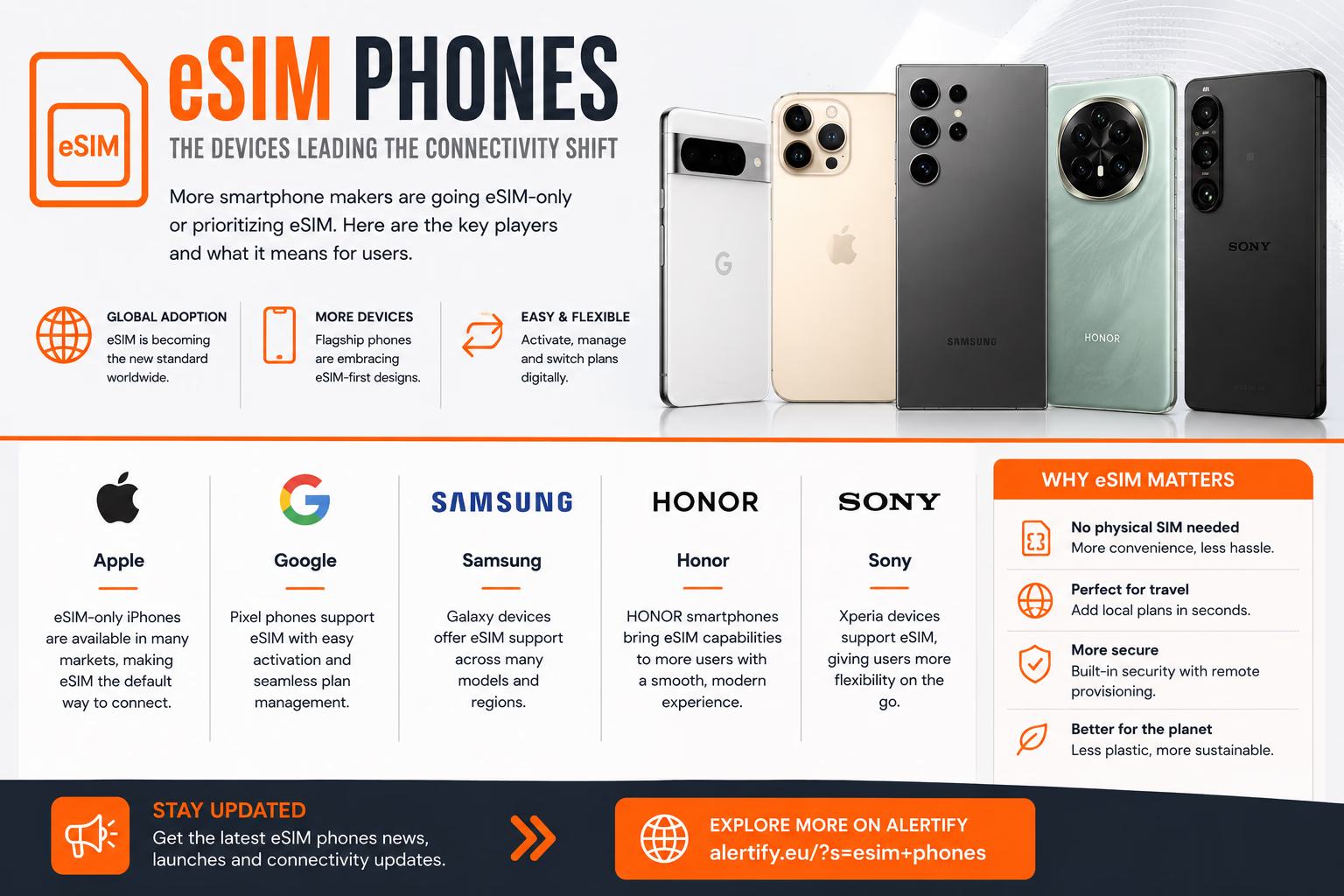
That means consumer eSIM providers need much tighter device-specific education. Not generic “install your eSIM” guides, but clear flows for iPhone, Samsung, Pixel, dual-SIM behavior, eSIM-only devices, phone transfers, and what happens when a user deletes a profile.
READ MORE: AI-eSIM: China Mobile Pushes eSIM Beyond Phones
They also need better pre-purchase expectation setting. A traveller should know whether the eSIM activates immediately, whether validity starts on install or first network connection, whether hotspot use is allowed, and what to do when moving to a new phone.
Most importantly, brands need to stop treating activation as a post-sale technical step. It is part of the product. It is part of the brand. It is part of trust.
Final thoughts about eSIM OS dependency
The consumer eSIM market was built by brands that made roaming feel optional. The next market will be shaped by brands that make activation feel invisible without becoming invisible themselves.
That is the paradox.
Apple and Google are making eSIM easier for the mass market, and the entire category benefits from that. But as activation and transfer move deeper into iOS and Android, consumer eSIM providers lose some control over the most emotionally important part of the journey. The winners will not simply be the cheapest provider, or even the one with the widest coverage map. They will be the brands that understand platform dependency and design around it.
Airalo, Holafly, Nomad eSIM and the rest still have room to build powerful consumer relationships. But they need to own what the operating system does not: clarity, honesty, support, destination intelligence, and the confidence that when the phone says “Add eSIM,” the traveller already knows exactly what will happen next.