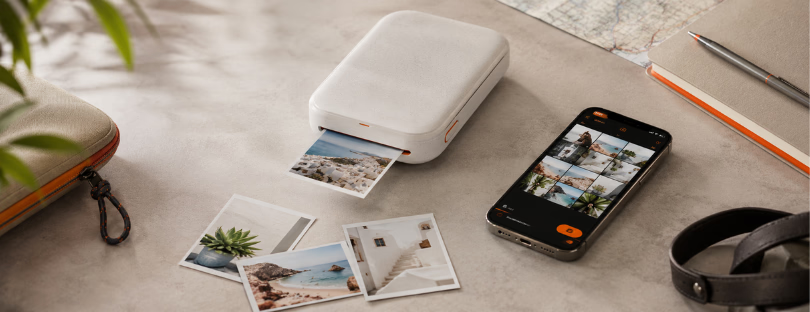
Best Smartphone Photo Printer for Travel Memories
For years, smartphone photography has been trapped inside the camera roll. We take thousands of photos, send a few to WhatsApp, post one carefully chosen image on Instagram, then forget the rest exist. That is exactly why the small smartphone photo printer is quietly becoming interesting again. shop smartphone photo printer
Not because people suddenly want to replace professional photo labs. They do not. The real shift is more personal. Travellers, families, students, creators and even small hospitality brands want physical photos again, but without the old friction: no laptop, no memory card, no print shop, no “I’ll do it later.”
A smartphone photo printer solves a very specific modern problem. It turns the photo you just took into something you can give, stick, frame, label, gift or keep. That sounds simple, but in a digital world drowning in images, simple is powerful.
The category is also growing. Global Market Insights valued the mobile photo printer market at USD 4.6 billion in 2025 and expects it to reach USD 11.3 billion by 2035, with growth driven by smartphone photography, instant sharing culture and demand for portable printing devices.
Not all mini printers are the same
When you shop for a smartphone photo printer, the biggest mistake is treating them all as cute little gadgets. They are not. The printing technology matters.
Zink printers, used by many pocket models, do not need ink cartridges. The colour is embedded in the special paper, which makes them compact, low-maintenance and easy to throw into a bag. HP’s Sprocket line, for example, uses Zink paper and connects to smartphones via Bluetooth, with app-based editing, stickers and social photo access.
The trade-off? Zink is fun, fast and convenient, but image quality is usually not at the same level as dye-sublimation printers. Digital Camera World makes this distinction clearly, noting that Zink tends to be cheaper and more casual, while Instax and dye-sub options generally deliver better image quality.
READ MORE: Smartphone Photo Printer Market to Boom at $37 Billion by 2032
Dye-sublimation printers, like Canon’s SELPHY CP1500, are less “pocket gadget” and more “compact photo station.” Canon says the CP1500 prints 4×6 postcard-sized photos in around 41 seconds, supports Wi-Fi and USB-C, and produces prints designed to last up to 100 years. That puts it in a different lane: better for albums, gifts, home use, travel journaling and small business display material.
Then there is the Instax universe. Fujifilm has managed to keep instant photography culturally relevant by making prints feel social, playful and deliberately imperfect. Its newer hybrid models, such as the Instax Wide Evo, also blur the line between instant camera and smartphone printer, letting users print from a phone as well as shoot directly.
Travel makes the use case stronger
For Alertify readers, the travel angle is where this category gets more interesting.
Think about a city break, a family road trip, a wedding weekend, a sports event, a hostel wall, a boutique hotel guestbook, or a digital nomad scrapbook. Most travel tech is about staying connected, booking faster, paying easier or moving smarter. A smartphone photo printer does something different. It makes the trip tangible.
READ MORE: Portable Printers Slated for Robust Growth Worldwide. These are the best ones
That matters because travel has become extremely digital. Boarding passes, hotel keys, eSIMs, maps, tickets, restaurant bookings and memories all live on the phone. A printed photo is one of the few travel objects that still feels personal. It is low-tech in the best possible way.
There is also a small but real hospitality use case. Boutique hotels, tour operators, event hosts and destination marketers can use portable printers for guest experiences: instant souvenir photos, branded memory walls, Polaroid-style check-in moments, small printed cards for campaigns or creator activations. It is not a core infrastructure tool like Wi-Fi or mobile connectivity, but it can add emotional value at very low complexity.

What to check before buying
The market is getting more stylish
One thing is clear: this category is no longer only about printing. It is about experience.
Polaroid’s newer Hi-Print 3×3, launched in 2026, leans into square-format nostalgia while using dye-sublimation technology and even doubles as a small photo frame when not in use. That is a smart signal. Brands understand that people are not buying these devices because they lack screens. They are buying them because screens made memories feel disposable.
HP Sprocket plays the social, sticker-style angle. Canon SELPHY plays the quality and longevity angle. Fujifilm Instax plays the emotional and instant-photo culture angle. Polaroid plays nostalgia with a design twist. Same broad category, very different reasons to buy.
Final take shop smartphone photo printer
The best smartphone photo printer is not the one with the longest feature list. It is the one that matches how you actually use photos.
For casual fun, parties and travel journals, a Zink pocket printer makes sense. For better-looking keepsakes, family albums, or small business use, dye-sublimation is the safer choice. For the emotional “instant memory” feeling, Fujifilm Instax and Polaroid still understand the assignment better than most.
The bigger trend is worth watching. As travel becomes more digital, people are starting to value small physical moments again. A smartphone photo printer will not replace the camera roll. But it gives your best photos a second life outside it, and that may be exactly why this little gadget category is suddenly relevant again.