A few years ago, the question was simple: “Can I avoid roaming charges?” Airalo helped make that answer mainstream. It built one of the most recognizable eSIM stores, with local, regional, and globaI eSIM packages across more than 200 destinations, aimed at travelers who want to land with data already sorted.
But the market has matured. The better question now is not whether Airalo works. In many cases, it does. The sharper question is: is Airalo the best fit for this specific trip, device, budget, and usage pattern?
That is where alternatives become interesting.
Why travelers look elsewhere
Airalo’s strength is clarity. It is easy to understand, easy to browse, and familiar enough that many travelers now treat it as the default option. For a weekend city break, a simple country plan, or a first-time eSIM user, that matters.
Still, travel connectivity is not one-size-fits-all. Some travelers want unlimited data because they are working from hotels and trains. Others want a reusable eSIM that can stay installed across multiple trips. Some care about tethering. Some want calls and SMS. Some are going on a cruise. Some simply want the cheapest possible data bucket for one country.
And then there is the quiet technical layer. Two eSIMs may connect to the same local network and still behave differently because of routing, roaming agreements, latency, fair-use policies, and how the provider structures its core network. That is why “covered in 200 countries” is useful, but not enough.
More on Alertify
Follow the latest Airalo news
eSIM updates, travel connectivity stories and market moves from one of the biggest names in global eSIM.
Explore news →
GSMA Intelligence has noted that travel eSIM adoption is growing alongside the number of providers, with 12% of surveyed international travelers across 11 major countries using eSIM abroad in the previous 12 months. Counterpoint Research has also projected strong growth for third-party travel eSIM downloads between 2025 and 2030. In other words, competition is no longer a side story. It is the story.
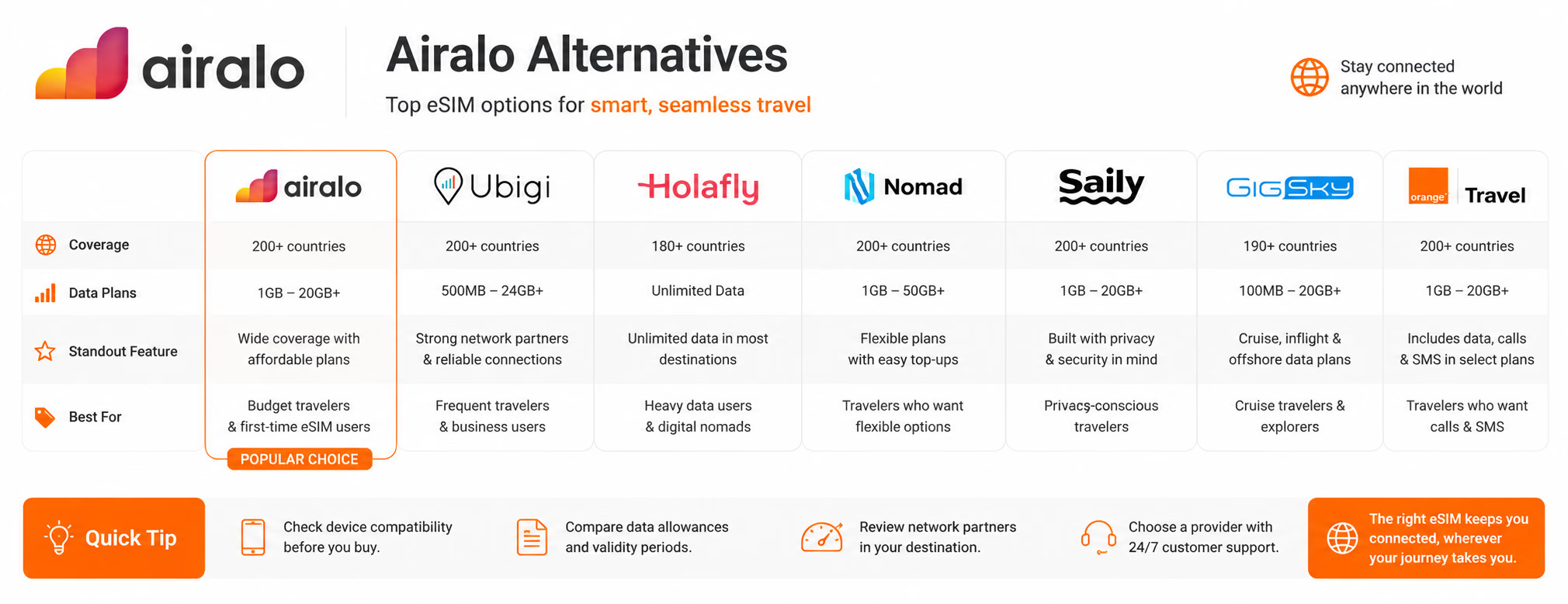
Ubigi
Ubigi is one of the most serious Airalo alternatives, especially for travelers who care about repeat use and network transparency. It offers travel eSIM plans in 200+ destinations and publishes mobile network partner information by country, including available connection types such as 3G, 4G, and 5G where listed.
That detail matters. Many eSIM providers sell the destination first and explain the network later, if at all. Ubigi feels a bit more infrastructure-minded. It is also part of Transatel, which gives it a slightly different profile from app-first travel eSIM brands. For users who travel often, especially in places like Japan, Europe, or North America, Ubigi can feel less like a disposable trip product and more like a connectivity account you keep topping up.
The trade-off? It is still mostly a data-first proposition. If you need a traditional phone number, SMS, or a very simple “buy and forget” unlimited offer, you may look elsewhere.
Holafly
Holafly is the obvious alternative for travelers who do not want to count gigabytes. Its pitch is built around unlimited data for international travel, and that simplicity is powerful.
For a heavy Instagram user in Tokyo, a remote worker in Mexico City, or a traveler who hates checking data balances, Holafly makes emotional sense. You pay more, but you reduce mental load. That is a real product benefit, not just a marketing line.
The catch is the word “unlimited.” In the travel eSIM world, unlimited often comes with fair-use policies, speed management, or hotspot restrictions depending on the plan and destination. That does not make it bad. It just means travelers should read the conditions before assuming it behaves like home broadband. Holafly is best for users who value simplicity more than price-per-GB precision.
Nomad eSIM
Nomad eSIM sits closer to Airalo in spirit: app-based, broad coverage, flexible plans, and a clean buying flow. It offers data eSIMs in over 200 destinations, with country and regional plans managed through its app.
Where Nomad eSIM often appeals is in the middle of the market. It is not necessarily the loudest brand, nor the most “unlimited” one, but it is practical. For travelers comparing a few providers before a trip, Nomad is often worth checking because prices and plan sizes can vary quite a lot by destination.
It is especially relevant for people who already know their data habits. If you need 10GB for ten days, not “unlimited,” not 1GB, not a global plan, Nomad can be a good fit.
Saily
Saily is interesting because it enters the eSIM market from a security and privacy angle. The service comes from the team behind NordVPN and offers eSIM data plans in 200+ destinations.
That gives it a different type of trust signal. Airalo is known as an eSIM store. Saily is trying to make travel connectivity feel like part of a broader digital safety toolkit. For less technical travelers, that may not matter. For remote workers, solo travelers, and people who use public Wi-Fi too often, it might.
Still, Saily is newer in the travel eSIM conversation than Airalo, Ubigi, or Holafly. The brand is strong, but destination-by-destination performance will matter more than the logo behind it.
GigSky
GigSky deserves a place because it is not only thinking about airports and hotel Wi-Fi. It supports international roaming in over 190 countries and also offers cruise, inflight, and offshore data plans.
That makes it one of the more distinctive Airalo alternatives. If your trip includes a cruise ship, island hopping, or unusual travel patterns, GigSky may be more relevant than a standard country eSIM. It also offers a free data plan in eligible countries, which is useful for testing before committing.
For ordinary city travel, it may not always be the first comparison. For edge-case travel, it absolutely should be.
Orange Travel
Orange Travel is different because it comes from an actual telecom operator brand, not just a travel eSIM marketplace. Its prepaid eSIMs cover more than 200 destinations and can include data, calls, and SMS depending on the plan.
This is especially relevant in Europe, where some travelers still want a phone number, not just data for WhatsApp and maps. Orange Travel is less “startup slick” than some app-first providers, but it can be a better match for travelers who want a more traditional telecom-style product.
Final take
Airalo remains a strong default, especially for travelers who want a simple, recognizable eSIM store with broad coverage. But “default” is not the same as “best.”
Ubigi looks strong for repeat travelers who care about network detail. Holafly is the comfort choice for people who do not want to count data. Nomad is practical for flexible, data-bucket shopping. Saily adds a security-led angle. GigSky is smart for cruises, flights, and unusual routes. Orange Travel still matters when calls, SMS, and operator trust are part of the decision.
The bigger trend is clear: travel eSIMs are moving beyond cheap roaming avoidance. The next battle is about trust, routing quality, transparency, support, and who owns the traveler relationship before, during, and after the trip. Airalo helped open the door. Its alternatives are now proving how crowded and how much more sophisticated the room has become.
Driven by wanderlust and a passion for tech, Sandra is the creative force behind Alertify. Love for exploration and discovery is what sparked the idea for Alertify, a product that likely combines Sandra’s technological expertise with the desire to simplify or enhance travel experiences in some way.