Why Orange Travel eSIM Feels Different Abroad
There’s been a subtle shift in the travel connectivity space lately. For years, the narrative was simple: traditional telecom operators were slow, expensive, and completely outpaced by agile eSIM startups. Then something interesting happened. The operators started adapting.
One of the clearest examples right now is Orange and its travel eSIM offering. Not a flashy disruptor. Not a startup trying to reinvent connectivity. But a legacy operator that’s quietly repositioning itself for the global traveler.
And if you’ve been watching the market closely, you’ll notice this isn’t just another product launch. It’s part of a broader correction happening in the eSIM ecosystem.
What Orange Travel eSIM actually is
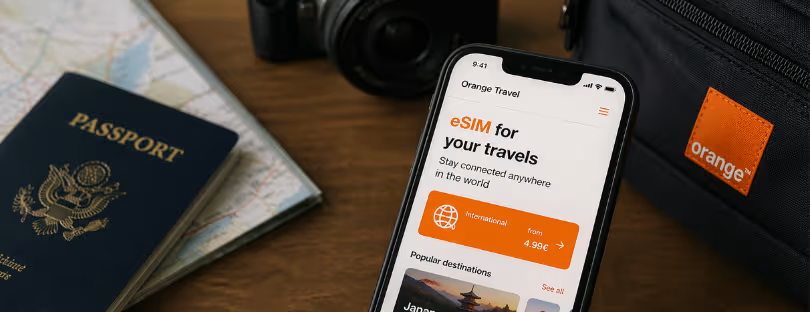
At its core, Orange Travel eSIM is exactly what you’d expect from a major telecom group stepping into the travel space. It offers prepaid data plans for international use, covering a wide range of destinations with a focus on reliability rather than gimmicks.
The positioning is very different from most eSIM players. Instead of selling “unlimited freedom” or “cheap data everywhere,” Orange leans into something else entirely: network credibility.
That matters more than it sounds.
Because while many travel eSIM brands rely on wholesale agreements and multi-layered infrastructure, Orange is a network operator with its own backbone, roaming agreements, and long-standing relationships with global carriers. That translates into a different kind of user experience. Not necessarily cheaper. But often more stable.
Spring deals and aggressive timing
Right now, Orange is pushing hard with seasonal campaigns. The current one is straightforward:
Spring Deals: Up to 40% Off
Your next adventure starts now.
Don’t wait for summer. Destinations like Japan, Thailand, Morocco, Brazil, and Australia are already in demand.
This isn’t just marketing fluff. Timing matters here.
Travel demand patterns have shifted post-pandemic. Shoulder seasons like spring are no longer quiet. They’re competitive. And connectivity providers are starting to treat them like peak revenue windows.
Discounting eSIMs by up to 40% is a clear signal that Orange is not just testing the waters. It’s actively competing.

Where it fits in the market
If you place Orange Travel eSIM next to typical eSIM players, the differences become obvious pretty quickly.
Most eSIM brands optimize for accessibility. Quick purchase, easy activation, aggressive pricing. The trade-off is often inconsistency. Network quality varies. Speeds fluctuate. And in some regions, performance depends heavily on which partner network you land on.
Orange takes the opposite approach.
Instead of competing purely on price, it competes on trust. The kind of trust built over decades of telecom operations. For certain users, that matters more than saving a few euros.
Who does this actually make sense for?
This is where things get more nuanced.
Orange Travel eSIM is not designed for everyone. If you’re a budget traveler looking for the cheapest possible data option, you’ll likely find better deals elsewhere.
But if you’re in any of these categories, the value proposition changes:
Business travelers
You don’t want to troubleshoot connectivity in a new country before a meeting. Reliability beats price every time.
Frequent travelers
Consistency across destinations becomes more important than finding the absolute lowest rate in each country.
Users tired of “unlimited” limitations
The industry has overused the word “unlimited” to the point where it barely means anything anymore. Many plans throttle speeds after a few gigabytes. Orange doesn’t play that game as aggressively. What you see is generally closer to what you get.
The subtle advantage Orange has
There’s one thing Orange has that most eSIM startups don’t.
Control.
Not complete control, but significantly more influence over the network layer. That reduces dependency on third-party infrastructure and can lead to more consistent performance, especially in high-demand regions.
You don’t notice this immediately when everything works. You notice it when things don’t.
Congested networks. Rural coverage gaps. High-traffic urban zones. That’s where the difference between operator-backed and aggregator-based eSIMs becomes visible.

What to watch next
The interesting question is not whether Orange will succeed in the travel eSIM space. It’s how far it’s willing to evolve.
Will it stick to traditional data bundles, or will it adopt more flexible models like usage-based pricing or subscription layers?
Will it integrate app-level features that competitors are already building, like real-time usage control or network switching?
Because right now, Orange has credibility. But the market is moving toward flexibility.
Conclusion: stability vs flexibility is the real battle
At a glance, Orange Travel eSIM might look like just another option in an already crowded market. It’s not.
It represents something bigger. A legacy telecom operator stepping into a space it once ignored, bringing reliability and infrastructure strength into a market driven by agility and innovation.
Compared to newer eSIM players, Orange feels less flexible, less experimental. But also more grounded. More predictable. And for a certain segment of travelers, that’s exactly the point.
The eSIM market is no longer just about who offers the cheapest gigabyte. It’s about who delivers the most consistent experience across borders, devices, and usage patterns.
And that’s where things get interesting.
Because if operators like Orange continue to adapt while startups keep pushing pricing and flexibility models, we’re heading toward a hybrid future. One where the best solutions combine both.
Until then, the choice is simple. Do you want flexibility, or do you want certainty?
Right now, very few providers truly offer both.