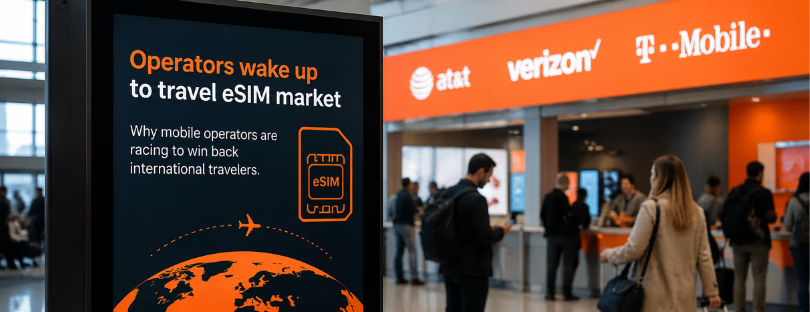
Operators Wake Up as Travel eSIMs Change Roaming
For years, mobile operators had a strange blind spot.
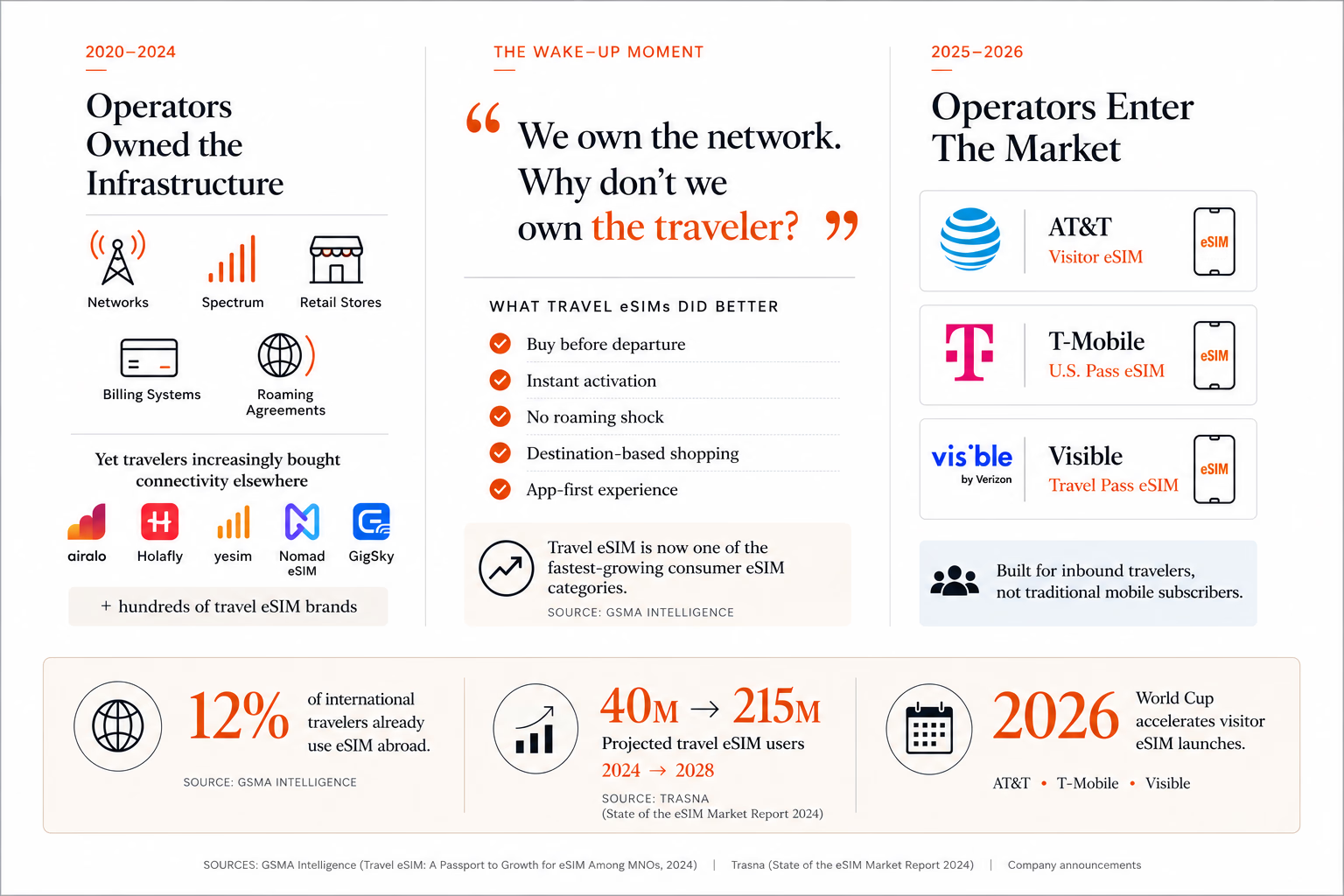
They owned the networks. They controlled the infrastructure. They had the spectrum, the retail stores, the billing systems, the roaming agreements and the local brand recognition. And yet, when international travelers started looking for easier mobile data, much of the energy came from somewhere else.
Airalo. Holafly. Yesim. Nomad eSIM. GigSky. And a long tail of smaller travel eSIM brands.
These companies did not own the radio networks in most markets. They did something different. They made connectivity feel simple before the trip even started. Open an app, choose a destination, pay, install, land, connect. No kiosk. No passport scan at a random airport counter. No roaming shock.
That was the real innovation. Not just eSIM. The experience around it.
Now operators are waking up to a question they probably should have asked earlier:
“We already own the network. Why are third parties making money from visitors on our infrastructure?”
And honestly, that is a much more interesting strategic angle than another simple “operator versus travel eSIM app” story.
That matters because travel eSIMs are no longer a niche workaround. GSMA Intelligence has been framing travel eSIM as a growth driver for consumer eSIM adoption, while major US operators are now launching or sharpening visitor-focused eSIM offers around large inbound travel moments such as the 2026 World Cup.
The old roaming habit
Here is where the debate gets more nuanced.
Some argue that every traveler who buys an operator-branded travel eSIM before departure is one less customer choosing a travel eSIM app.
Not necessarily.
That assumes the traveler already knows the operator product exists. In many cases, they do not. A tourist flying to the United States might know AT&T, Verizon or T-Mobile as big network names, but that does not mean they know where to buy a visitor eSIM, whether it works before arrival, whether it needs ID verification, or whether the checkout will accept their card.
Travel eSIM apps solved that visibility problem better than operators did.
But the real competition is not always operator versus travel eSIM. Very often, it is travel eSIM versus roaming.
READ MORE: World Cup eSIM Offers Rise Ahead of FIFA 2026
Most travelers still use roaming because it is familiar. They land, switch data on, and hope the bill will not be painful. Business travelers may have corporate roaming bundles. Families may not want to deal with the setup. Less tech-confident users may not even know what an eSIM is.
So when an operator launches a proper visitor eSIM, it is not only stealing from Airalo or Holafly. It may be converting someone who would otherwise have used expensive roaming, airport Wi-Fi, or a messy physical SIM purchase.
That distinction matters.
Why have apps moved faster?
Travel eSIM brands were not burdened by legacy telecom thinking. They did not need to protect roaming margins in the same way. They built for the traveler’s moment of need.
That moment is not “I want a telecom plan.”
It is: “I land in Tokyo tomorrow and need maps, WhatsApp, hotel check-in, taxi apps and maybe hotspot for my laptop.”
The best travel eSIM apps understand that emotional context. Their product pages speak the language of destinations, gigabytes, validity and instant setup. Operators often still speak in monthly plans, add-ons, bundles, account flows and terms that make sense internally, but not always to someone arriving for six days.
This is why third-party brands gained ground. They removed friction from a category that operators had made feel unnecessarily complicated.
The operator advantage
Still, operators have something travel eSIM apps cannot easily copy: direct network ownership.
That matters for performance, support and trust. If a visitor buys an eSIM directly from a local operator, there is a clear promise behind it. You are not just buying access through a chain of intermediaries. You are buying into the network itself.
That can be powerful, especially for high-value travelers. Think business visitors, conference attendees, families staying several weeks, students, medical tourists or people who need voice and SMS as well as data.
READ MORE: World Cup 2026 eSIM Guide: What Fans Must Check
AT&T now promotes eSIM by AT&T for international travelers visiting North America, while T-Mobile has moved further into visitor-first positioning with its U.S. Pass eSIM for travelers across the U.S., Mexico and Canada. Interestingly, Verizon’s clearest travel eSIM move may now come through Visible. While Verizon itself still largely presents eSIM through prepaid and mobile-plan language, Visible’s eSIM Travel Pass is much closer to the travel eSIM playbook: short-term access, instant activation, no roaming charges, and a clear visitor-first message.
This is the gap. Operators may have the stronger network story, but travel eSIM apps often still have the stronger shopping experience.


Where operators still miss
The biggest weakness is not pricing. It is packaging.
A traveler does not want to decode whether a prepaid plan, tourist plan, BYOD activation or eSIM activation kit is the right path. They want one clear page: visiting this country, staying this long, need this much data, install before departure.
Operators also need better international visibility. If someone in Croatia, Germany or Brazil searches for “USA eSIM,” the first results are usually travel eSIM brands, comparison sites and affiliate content. Operator products are often buried, fragmented, or written for domestic prepaid customers rather than inbound visitors.
That is a marketing problem, not a network problem.
And it is fixable.
Not for every traveler
Operator-branded visitor eSIMs will not replace travel eSIM apps completely.
A traveler visiting five countries in ten days may still prefer a regional or global plan from Yesim, Nomad eSIM, GigSky, Airalo or Holafly. Someone who wants one app for every trip may not want to create a new relationship with each country’s operator. A light traveler who only needs 1GB for maps and messaging may find third-party plans simpler and cheaper.
But for single-country trips, longer stays, heavy data use, hotspot needs, or travelers who want the comfort of a known local network, operators have a real opening.
They just need to stop treating visitor connectivity like an afterthought.
The real shift
The next phase of travel connectivity will not be won only by the cheapest gigabyte.
It will be won by whoever makes the traveler feel confident before departure.
Travel eSIM apps understood that early. They built convenience, comparison and destination-based buying into the product. Operators are now entering the space with a different advantage: infrastructure, brand trust and network control.
The interesting question is not whether AT&T, Verizon, T-Mobile or other operators can “beat” Airalo, Holafly, Yesim, Nomad eSIM or GigSky. The better question is whether they can expand the market beyond people already shopping for eSIMs.
Because the biggest pool of travelers is still not choosing between two eSIM products. They are choosing between changing their habit or staying with roaming.
That is where operators have a second chance. Not by copying travel eSIM apps, but by learning from them.