Roamless Pay-As-You-Go eSIM: Flexible Travel Data
For years, travel eSIMs have mostly copied the same simple formula: pick a country, pick a data bundle, use it before it expires, then buy another one when the trip changes. It works, but it still feels very “trip-based.” Roamless is trying to push a different idea into the market: one global eSIM, one balance, and a pay-as-you-go model that follows the traveller instead of the itinerary.
That sounds small at first. It is not.
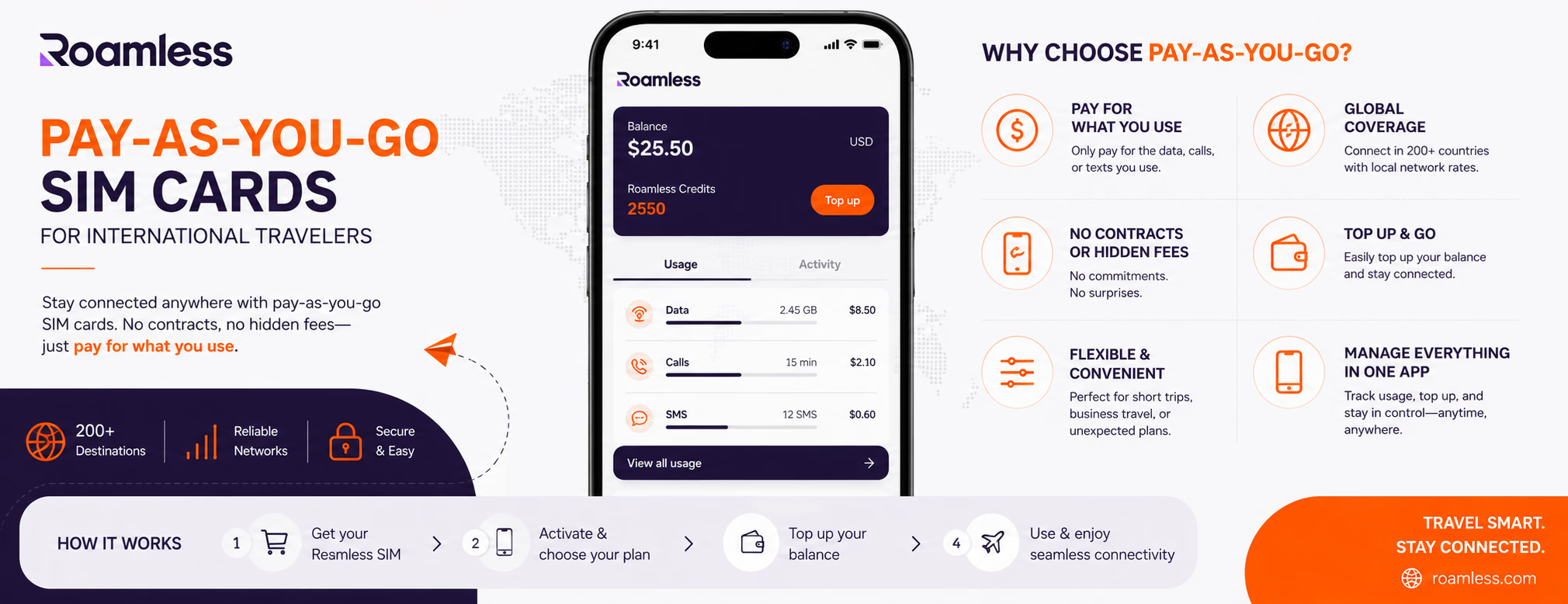
The company positions Roamless as a global mobile connectivity app for data, phone numbers, international calls and SMS, all managed from one place. Its Single GIobal eSIM is designed to work across 200+ destinations, with users able to add Roamless Credits for pay-as-you-go data or buy data plans when that makes more sense. The core promise is simple: install once, use across borders, avoid swapping eSIMs every time the map changes.
That “install once” part matters more than most providers admit. A lot of travellers do not hate buying data. They hate managing it. They hate wondering whether the Spain plan also works in Portugal. They hate landing late, opening five browser tabs, checking expiry dates, and trying to remember which QR code belongs to which trip. Roamless is betting that the next phase of travel connectivity will be less about buying a bundle and more about having a persistent connectivity layer ready when needed.
Why pay-as-you-go feels different
The Roamless pay-as-you-go eSIM model is built around usage rather than expiry. According to Roamless, users pay for what they use, with one balance covering mobile data, calls and SMS. The company also says credits can be topped up directly in the app, giving travellers more control over consumption instead of locking them into fixed allowances and durations.
That changes the psychology of buying travel data.
With a classic fixed plan, the traveller has to predict behaviour before the trip starts. Will 3 GB be enough for four days in Istanbul? What if the hotel Wi-Fi is poor? What if Google Maps, WhatsApp calls, Uber, translation apps and hotspot sharing burn through the allowance faster than expected? Buy too little and you top up in a hurry. Buy too much and unused data disappears when the plan expires.
READ MORE: Roamless Backup Connectivity: Travel eSIM Safety Net
Pay-as-you-go is cleaner for uncertain travel. It suits people who travel irregularly, cross borders often, or want a backup line without committing to a full package every time. Think of a consultant flying between London, Dubai and Singapore, or a couple doing a multi-country rail trip through Europe. They may not need a big regional plan. They need data to be available when the real world becomes messy.
Roamless also offers fixed data options alongside pay-as-you-go credits, which is probably the smarter approach. Some travellers still want the certainty of a defined package. Others prefer a wallet-style model. The winner is not one format replacing the other. The winner is giving users both, without making them reinstall or rethink the product each time.
The app is becoming the product
What makes Roamless more interesting is that it is not only presenting itself as a cheaper roaming alternative. It is edging toward a broader “connectivity app” model. On its official site, Roamless describes itself as combining eSIM, data, phone numbers, international calls and SMS in one app. Its Google Play listing also highlights pay-as-you-go credits, data plans, a second phone number and connectivity in 200+ destinations.
This is where the market is quietly moving. Travel eSIM used to be a purchase. Now it is becoming a relationship.
READ MORE: Roamless App: One eSIM for Data, Calls and Travel
That is why features such as second numbers, in-app calling, SMS and persistent balances matter. They create a reason to keep the app installed after the trip ends. Airalo built scale around marketplace-style simplicity. Holafly pushed unlimited plans into the consumer mainstream. Ubigi has a strong position in device and automotive connectivity thanks to Transatel’s network background. Yesim has leaned into always-ready use cases with products such as Pay & Fly and unlimited day-based models. Roamless is playing the flexibility card: one eSIM, credits when needed, and a broader app layer around connectivity.
None of this removes the basic questions users should still ask. What are the real country rates? Is 5G available on the networks they will actually use? How transparent is speed management? How responsive is support when something fails at the airport? The eSIM market is full of good-looking apps. The difference appears when the user lands, the phone connects, and the plan behaves exactly as promised.
A market ready for flexible models
The timing is good for Roamless. GSMA Intelligence says travel eSIM has become a successful roaming use case, with 12% of consumers who travelled internationally in the past 12 months using eSIM abroad across 11 major surveyed countries. The same GSMA analysis notes that most of those users still relied on telco eSIM services, while the rest used travel eSIM brands such as Airalo, Ubigi, Instabridge and others.
That tells us two things. First, travel eSIM is no longer a niche product for tech obsessives. Second, the category is still fragmented and young. There is room for different models: marketplaces, unlimited plans, operator-led roaming alternatives, embedded eSIM offers inside banking apps, and pay-as-you-go wallets.
READ MORE: Roamless Adds Calls, SMS and Phone Numbers — Is This the All-in-One Travel eSIM?
GSMA also points out that travel eSIMs are increasingly being bundled into travel and financial services, including examples such as Trip.com perks and Revolut packaged accounts. That is important because it shows connectivity is moving closer to the customer moment. The eSIM is not always bought from an eSIM brand anymore. Sometimes it appears inside the booking app, banking app, airline journey or hotel loyalty flow.
For Roamless, that creates both opportunity and pressure. The opportunity is obvious: a wallet-style, persistent globaI eSIM can be easier to embed into travel lifestyles than a one-off destination package. The pressure is that distribution will matter as much as product. In a crowded eSIM market, being technically flexible is not enough. Travellers still need to discover the product before they leave home, or at the exact moment they panic about roaming costs.
Conclusion
Roamless is not interesting because it offers another travel eSIM. The market already has plenty of those. It is interesting because its pay-as-you-go model points to a bigger shift: travel connectivity is becoming less like buying a souvenir SIM at the airport and more like keeping a global data wallet in your pocket.
Compared with Airalo, Roamless feels less like a destination-plan marketplace. Compared with Holafly, it is less focused on unlimited simplicity and more focused on usage control. Compared with Ubigi, it does not carry the same infrastructure-heavy device ecosystem story, but it does feel more consumer-app native. Compared with Yesim’s Pay & Fly, Roamless sits in a similar “persistent connectivity” lane, where the real value is not just the data rate but the reduced mental effort.
The trend is clear: the best travel eSIM products are moving away from one-off transactions. They are becoming always-ready utilities. Roamless has a credible angle there. Its challenge now is to prove that pay-as-you-go is not only flexible on paper, but reliable, transparent and easy enough for ordinary travellers to trust when the airport Wi-Fi disappears.