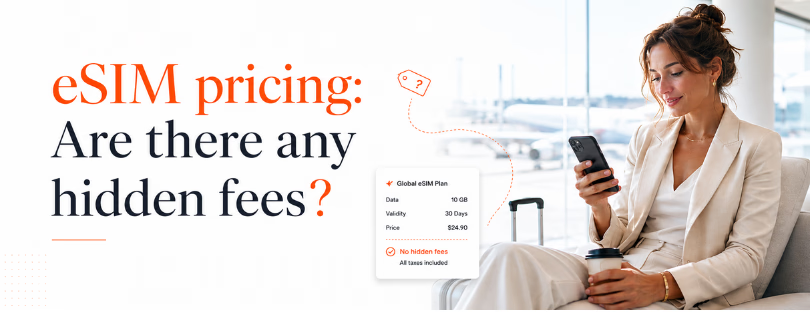
eSIM pricing: Are there any hidden fees?
The travel eSIM market has become very good at one thing: showing you a neat price before your trip.
€4.50 for 1GB in Turkey. €12 for 10GB in Europe. Unlimited data for a week in Japan. It looks simple, especially compared with traditional roaming, where nobody wants to do mental math after landing. But the honest answer is this: most reputable eSIM providers do not hide fees in the old roaming sense. You usually pay upfront, you get a defined data plan, and there is no surprise bill waiting at the end of the month.
That does not mean eSIM pricing is always as simple as it looks.
The “hidden fee” is often not a fee at all. It is a condition. A limitation. A missing feature. A short validity window. A speed policy that appears only after you read the small print. And for travelers, that can feel just as annoying as an extra charge.
What you usually pay for
With most travel eSIMs, the visible price covers a data bundle for a specific destination, region, or global zone. A local eSIM may cover one country. A regional plan may cover Europe, Asia, or Latin America. A global plan may cover dozens, sometimes more than 100 destinations.
That price normally includes the eSIM profile itself, access to one or more local networks, and a fixed amount of mobile data for a fixed period. For example, 5GB is valid for 30 days, or unlimited data for 10 days.
READ MORE: Is the Unlimited eSIM Offer Truly Unlimited?
This is why eSIMs feel cleaner than roaming. There are no daily roaming passes automatically triggered in the background. There is no “you used 1MB, so we charged you for the day” moment. You buy before or during travel, install the eSIM, and use it until the data or validity runs out.
The GSMA, which sets global eSIM specifications, describes eSIM as a remote SIM provisioning technology that lets users store and switch operator profiles digitally. That digital setup is what makes this pricing model possible: no kiosk, no plastic SIM, no contract in most cases.
Where costs can appear
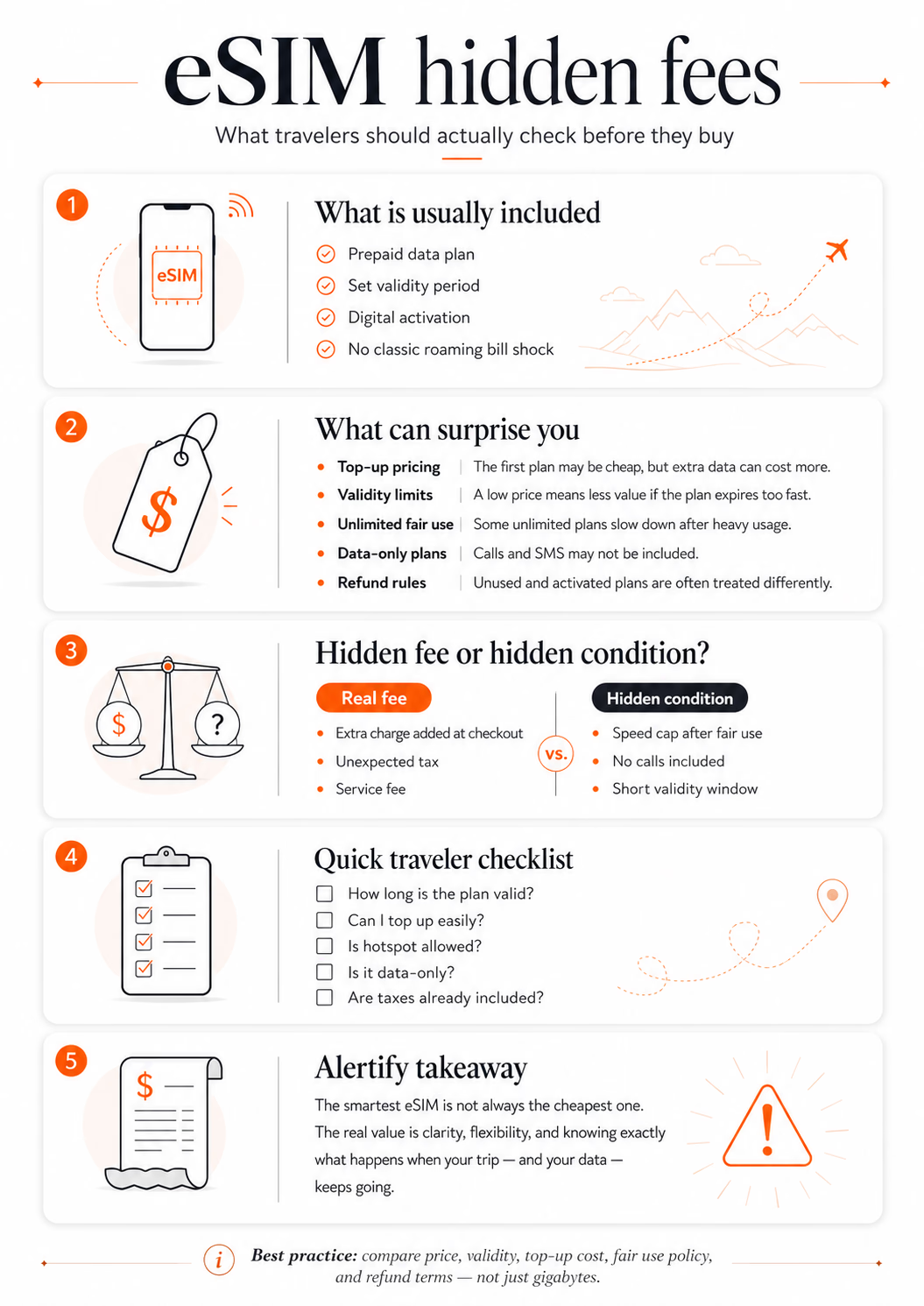
The first real cost is top-up pricing. A cheap first plan may look attractive, but if you run out of data halfway through the trip, the top-up may not be as competitive as the original offer. Some providers make topping up easy. Others require you to buy a new plan, reinstall, or switch profiles. That is not exactly a hidden fee, but it is friction.
The second is validity. A 10GB plan valid for seven days is not the same as 10GB valid for 30 days. If you are on a short city break, fine. If you are moving slowly through Europe, that cheap plan may expire before you use the data. The leftover data is usually not refunded or carried over.
READ MORE: Best eSIM for Europe 2026 — Tested for Latency, Throttling & Multi-Network Resilience
Then there is the unlimited question. Unlimited eSIMs are popular because they remove decision fatigue. But many unlimited plans are governed by fair usage policies. That means the plan may technically be unlimited, while speed can be reduced after heavy use or during network congestion. Holafly, for example, states in its terms that unlimited data may be subject to fair use rules by network providers. That is not necessarily bad. It is normal in telecom. But travelers should know what they are buying.
The missing extras
Another “hidden” cost is what is not included.
Many travel eSIMs are data-only. No local phone number. No SMS. No traditional voice calls. For a traveler who only needs WhatsApp, maps, email, and ride-hailing apps, that is perfectly fine. For someone who needs bank SMS codes, local restaurant calls, delivery drivers, or business verification, it can become a problem.
This is where the market is splitting. Providers such as Airalo, Nomad eSIM, Holafly, Ubigi, GigSky, Yesim, Saily, and others all compete around convenience, coverage, price, and plan design. But they do not all solve the same problem. Some are better for quick tourist data. Some are stronger for regional travel. Some focus on unlimited use. Some are better for annual or second-device connectivity. Others are moving closer to business and API-based distribution.
So the cheapest eSIM is not always the best one. It may be perfect for a weekend in Rome. It may be a poor choice for a remote worker taking video calls from three countries in ten days.


Refunds are not universal
Refund policies are another area where travelers should slow down. Because eSIMs are digital products, providers often apply stricter refund rules than people expect.
Some providers allow refunds within a certain window if the eSIM has not been used or if there is a technical issue. Nomad eSIM, for instance, explains that refund requests should generally be made within 30 days, with full refunds possible for unused plans and partial refunds possible in some service-related cases. Airalo also has a refund process, but conditions apply.
This is reasonable from the provider side. Once an eSIM profile is delivered, installed, or activated, it is not like returning an unopened adapter to a shop. Still, the customer experience could be improved. Refund and activation rules should be more visible before checkout, not buried in help pages.
How to avoid price surprises
The easiest way to avoid disappointment is to stop comparing only the headline price.
Before buying, check five things: how long the plan is valid, whether top-up is available, whether the eSIM supports hotspot, whether the plan is data-only, and whether unlimited really means full-speed unlimited. Also, check when the validity starts. Some plans start when installed. Others start when connected to a supported network.
READ MORE: eSIMs for the Frequent Travelers
For most travelers, a transparent 10GB or 20GB plan is often better than the absolute cheapest option. Business travelers may want a provider with stronger support and clearer reliability. Heavy users may prefer unlimited plans, but only if they accept possible speed management. Occasional travelers may not need anything fancy at all.
The real price is predictability
The eSIM market is not full of hidden fees in the classic roaming sense. That is the good news. The better providers have made international data much more understandable than old roaming bundles ever were.
But the industry still has a transparency problem. Too many offers are sold as if all eSIMs are interchangeable: same data, same speed, same support, same experience. They are not.
Airalo and Nomad eSIM are strong examples of app-first marketplace convenience. Holafly has pushed unlimited travel data into the mainstream. Ubigi has built a different angle around recurring and device-based connectivity. Yesim and others are leaning into flexible travel and B2B use cases. None of these models is automatically better. They simply price different kinds of certainty.
And that is what travelers are really buying now. Not just gigabytes. They are buying the confidence that when the plane lands, the phone works, the map loads, the hotel message arrives, and nobody has to look for airport Wi-Fi like it is 2012.
The next phase of eSIM pricing should not be about who can show the lowest number on a comparison table. It should be about who explains the real conditions most clearly. Because in travel connectivity, transparency is not a nice extra. It is part of the product.