UK Leads Europe in AI Travel Planning Trends
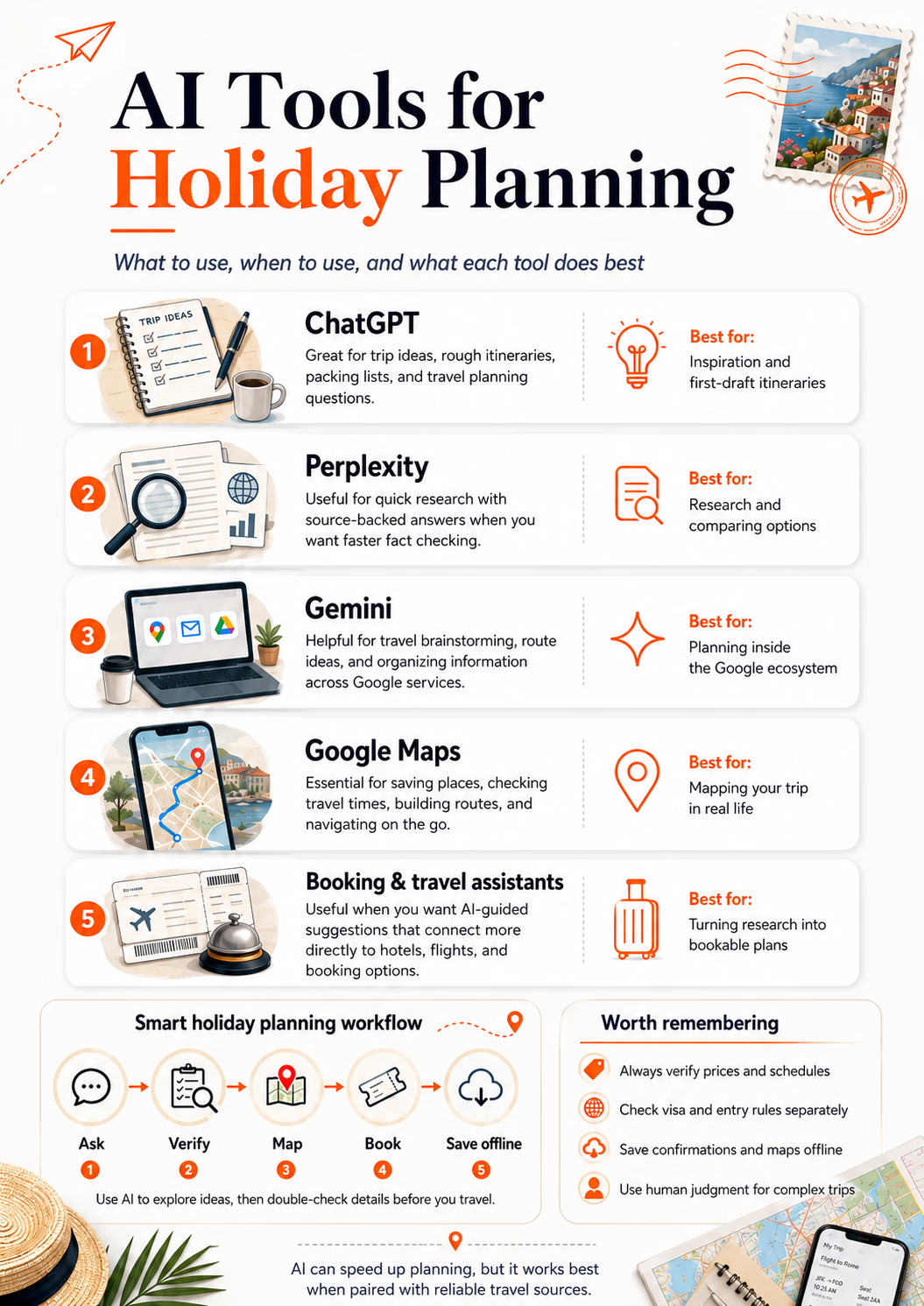
British travellers are now Europe’s quickest adopters of AI travel planning, and that matters because the UK is often an early signal for where digital travel habits are heading next. AI tools for holiday planning
According to the 2026 Portrait of European Travellers by MMGY Travel Intelligence, published on 11 June 2026, 52% of UK travellers now use AI tools to help plan holidays. That is up from 40% in 2025, giving Britain the fastest year-on-year growth among the five European markets tracked: the UK, France, Germany, Italy and Spain.
This is not just a novelty moment. A 12-point jump suggests AI has moved beyond the “let’s try it once” stage and into the practical part of trip planning, where people compare cities, ask for itineraries, check neighbourhoods and look for something less generic than a search results page.
MMGY says ChatGPT is the most widely used AI platform among UK travellers, with 35% usage. The main reason people use AI is still inspiration, cited by 47% of respondents. Travellers are not handing over the whole booking process to a chatbot. They are using it earlier, when the trip is still an idea.
The new discovery loop
The old planning journey was fairly linear: Google search, travel blog, booking site, maybe a review platform, then purchase. That journey now looks more like a loop.
A traveller might ask ChatGPT for a five-day itinerary in Lisbon, watch neighbourhood videos on YouTube, save hotel reels on Instagram, compare prices on Booking.com, then return to AI to narrow the plan. AI gives structure. Social media gives texture. Booking platforms bring inventory and price reality.
READ MORE: Google Maps Becomes a Smarter Travel Planning Tool
MMGY’s study shows how strong that social layer has become in the UK. Nearly half of British travellers, 46%, say social media influences their holiday decisions, while 32% use social platforms to research and follow destinations. YouTube and Instagram are the most influential platforms for travel inspiration.
That should make destination marketers slightly nervous. A polished campaign still matters, but it now competes with creator videos, hotel room tours, Reddit-style honesty and AI-generated shortcuts. The traveller is not waiting for a brochure. They are building their own brief.
Platforms are moving fast
The wider market is already adapting. Booking.com has expanded its AI Trip Planner and added AI-powered property Q&A, designed to answer practical accommodation questions faster. Expedia has introduced Romie, an AI assistant built around planning, group coordination and support when plans change. Google is pushing AI deeper into Search and Maps, with itinerary building, flight deal discovery and conversational place recommendations.
These are not identical products. Booking.com is closest to conversion. Expedia is trying to stay with the traveller across the journey. Google sits at the discovery layer, with a dangerous advantage: it already knows where people search, map and compare.
READ MORE: Ubigi and Tripsora Embed eSIMs Into AI Travel Planning
For hotels, tourism boards and travel brands, this creates both opportunity and pressure. AI does not magically make weak content visible. It rewards clear information, useful destination context, structured data, fresh reviews, strong imagery and answers to real traveller questions. The basics are becoming more important, not less.
Where AI still falls short
AI planning is not for every traveller or every trip. If someone is booking a complex family holiday, accessibility-sensitive travel, visa-heavy routes or a high-budget luxury itinerary, a human advisor can still offer judgment that a chatbot cannot reliably replace.
There is also a trust gap. AI can sound confident even when prices, opening hours or transport advice are outdated. The next improvement needs to be better source transparency, live availability, clearer booking handoffs and fewer vague recommendations that feel polished but thin.
For now, the smartest travellers will use AI as a planning partner, not a final authority. Social platforms, official destination sites, review platforms, booking apps and travel advisors still have a place, especially when details matter.
The real shift
The UK’s lead in AI travel planning is not really about British travellers loving technology more than everyone else. It is about convenience. Planning a trip is fragmented, and AI offers a shortcut through the noise.
But the winner will not be the platform that produces the prettiest itinerary. It will be the one that connects inspiration with reliable information, bookable options and real-time confidence. That is why the real race is not between AI and social media. It is between travel brands that understand the new discovery loop and those still treating AI as a gimmick.
Britons may be leading the shift, but the direction is European. Travel planning is becoming conversational, visual and platform-fluid. Brands that want to be chosen now need to be visible before the traveller knows exactly what they are looking for.