Roamless Backup Connectivity: Travel eSIM Safety Net
Most people still talk about travel eSIMs as a way to “Avoid roaming charges.” Fair enough. That is usually the hook. But the more interesting story around Roamless is not just cheaper data abroad. It is backup connectivity. Roamless Backup Connectivity solutions
That sounds less glamorous, but it is probably more useful.
Think about the way people actually travel now. You land late. Your hotel address is in WhatsApp. Your train ticket is in an app. Your card needs 3D Secure approval. Your taxi driver is messaging you. Your main roaming plan is either too expensive, not activated yet, throttled, or simply behaving strangely because the local partner network is having a bad day.
That is where a second connectivity layer starts to matter. Not as a replacement for everything, but as the thing you keep ready when your primary connection fails.
Roamless fits neatly into that behaviour because its core promise is built around a Single Global eSIM that works across 200+ destinations, installed once and reused without buying and installing a new eSIM every time you cross a border. Users can add Roamless Credits for pay-as-you-go data or buy prepaid destination plans inside the app. The company also positions the app around data, phone numbers, calls, SMS, and one shared balance.
Why Roamless feels different
The classic travel eSIM model is still very trip-based. You search for Italy. You buy 5GB for 15 days. You install the eSIM. You use it. Then it expires. It works well for many holidays, but it is not always elegant for people who travel often, cross borders regularly, or simply want something ready before the next trip.
Roamless leans more toward a persistent model. Install once, keep it on your phone, and use it again when needed. Its support pages describe the product as a flexible all-in-one global connectivity solution designed to reduce the need for multiple SIM cards, country-specific eSIM downloads, or expensive roaming plans.
That matters because backup connectivity is not only about price. It is about friction.
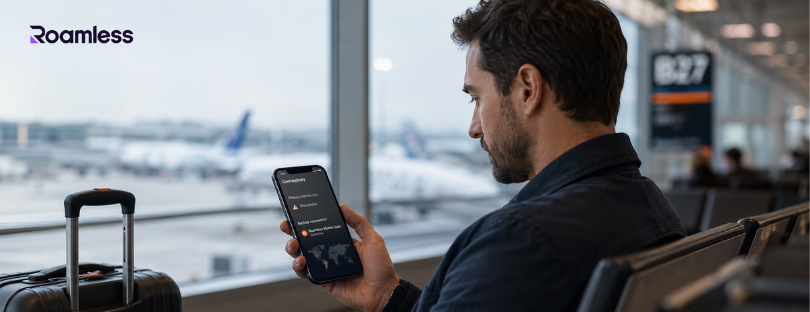
A backup solution should be ready before the problem happens. Nobody wants to compare eSIM plans while standing outside an airport terminal with one bar of signal and 3 percent battery. A good backup eSIM should already be installed, already funded, and boringly available.
READ MORE: Roamless Adds Calls, SMS and Phone Numbers — Is This the All-in-One Travel eSIM?
Roamless’ pay-as-you-go logic is useful here. You do not necessarily need to buy a big plan for every trip. You can keep credit in the app and use data when needed. Roamless also offers fixed data plans, called Roamless Fix, for users who prefer a defined package with a fixed amount of data and a set validity period.
That gives Roamless two personalities. One is the everyday travel data product. The other is the emergency layer sitting quietly in the background.
The airport test
Here is the practical test for any travel connectivity product: what happens in the first 30 minutes after landing?
This is when travel data becomes most valuable. You are not streaming Netflix. You are trying to function. You need maps, ride-hailing, hotel details, messaging, banking approval, passport app checks, maybe a translation tool. If your primary mobile plan fails at that moment, even a small amount of working data becomes disproportionately valuable.
That is why “backup connectivity” should be taken seriously. It is not a niche feature for paranoid travellers. It is becoming part of the modern travel stack.
For business travellers, the case is even stronger. A missed message from a client, a failed Teams login, or a dead connection before a meeting can cost more than the entire eSIM package. For digital nomads, it is similar. The backup eSIM is the insurance policy between the airport, apartment Wi-Fi, coworking space, and local SIM setup.
READ MORE: Roamless – Global Travel Connectivity Startup – Raises $12M to Fix Broken Roaming
Roamless is not alone in serving this behaviour, of course. Airalo has built enormous visibility with country, regional, and global eSIM packages in 200+ destinations. Holafly is well known for unlimited-style travel data plans. Nomad eSIM, Ubigi, GigSky, aloSIM, Saily, and Yesim all compete for the same broad traveller wallet in different ways. But many of these products are still perceived mainly as “buy a plan for a trip.” Roamless has a slightly different angle because the single reusable global eSIM and wallet-style balance make it easier to think of the app as always-on backup infrastructure, not just a one-off travel purchase.
Not all backup is equal
Still, travellers should be realistic. A backup eSIM is not magic. Performance depends on local network partners, routing, device settings, and country coverage. Two eSIMs can appear to use the same country but behave differently because of wholesale agreements, roaming routes, or network selection.
That is why the best backup solution is not automatically the cheapest one. It is the one that is easiest to activate when things go wrong.
Roamless has a good argument here because one installation reduces one of the biggest pain points in travel eSIM usage: managing too many profiles. Apple and Google have made eSIM installation much easier, but average travellers still get nervous when they see multiple SIM profiles, default data lines, roaming toggles, and APN settings. Less switching means fewer mistakes.
The market is clearly moving in this direction. Travel eSIM adoption is growing quickly, and recent industry coverage citing CCS Insight and Juniper Research points to strong growth through 2030, with operators increasingly pushed to respond to independent eSIM providers and connectivity-as-a-service platforms.
That bigger trend is important. Travel eSIMs are no longer just a cheap roaming workaround. They are becoming a second connectivity layer. Sometimes primary, sometimes backup, sometimes embedded into airlines, banks, booking platforms, and loyalty apps.


Where Roamless fits
Roamless is strongest for travellers who hate starting from zero every time they travel. The person who takes two city breaks, three work trips, and one long-haul holiday in a year does not want to repeat the same research cycle every month. They want a simple answer: is there data ready on my phone when I need it?
That is Roamless’ natural territory.
Airalo may still win for travellers who want a familiar marketplace with lots of destination-specific plans. Holafly appeals to users who want the psychological comfort of unlimited data. Yesim has strong potential for travellers who like persistent connectivity products such as pay-as-you-go and broader global packages. Ubigi is interesting for users who value the Transatel/MVNO backbone story, especially in connected devices and car-adjacent use cases. But Roamless has a very clean backup proposition: one eSIM, one app, one balance, and less drama when your main line lets you down.
Conclusion about Roamless backup connectivity solution
The smartest way to understand Roamless is not as “another travel eSIM app.” That category is already crowded, and frankly, many providers now sound almost identical: 200+ countries, instant activation, no roaming fees, easy setup. Useful, yes. Differentiated, not always.
Roamless becomes more interesting when framed as travel connectivity insurance.
Not insurance in the formal sense, of course. But in practical terms, it plays that role. It sits on the phone before the trip, waits quietly, and becomes valuable exactly when normal connectivity fails. That is a much sharper use case than simply promising cheaper roaming.
The next phase of travel eSIM competition will not be won only by who has the lowest price per gigabyte. It will be won by the providers that reduce anxiety: fewer installs, fewer confusing plans, fewer dead moments abroad. Roamless is not the only company moving in that direction, but its persistent global eSIM model gives it a believable place in the shift from “buy data for a trip” to “keep connectivity ready wherever life takes you.”