For most European travellers, “free roaming” feels like one of the EU’s cleanest success stories. You land in Spain, Italy, Germany or Croatia, your phone connects, WhatsApp works, Google Maps opens, and nobody is charging you €10 for checking your email at the airport.
That is a huge change from the old roaming era, when using mobile data abroad felt like playing financial roulette with your operator.
But here is the more interesting question: how free is free roaming (EU) in practice?
The honest answer is: free roaming is real, but it is not unlimited freedom. It is a regulated privilege built around occasional travel, fair use, wholesale caps, and a quiet balance between consumer protection and operator economics.
That balance matters more than most travellers realise.
The promise
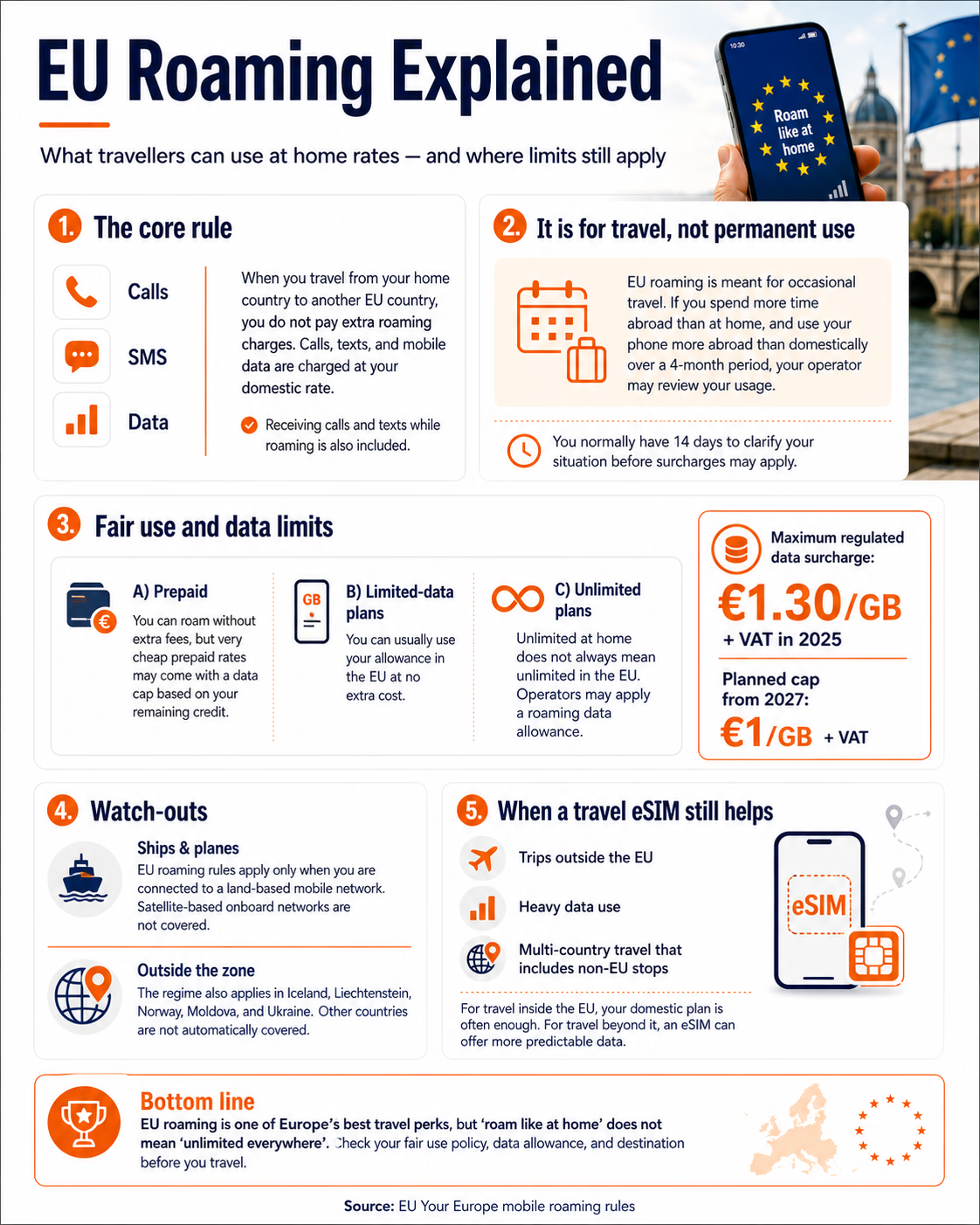
The EU’s “Roam Like at Home” rules mean that people travelling within the EU and the wider EEA can use calls, SMS and mobile data abroad under domestic conditions, without paying extra roaming charges for ordinary travel use. The policy has been in place since 2017 and has been extended until 2032, which makes it one of Europe’s most visible digital consumer protections.
In plain language, if you have a mobile plan in France and travel to Portugal, your plan should follow you. If you have minutes, texts and data at home, you can usually use them while travelling in another EU country.
That sounds simple. And for many people, it is.
A weekend in Rome? Fine. A business trip to Brussels? Fine. A summer holiday in Greece? Usually fine.
The problem starts when “free” is understood as “use anything, anywhere, forever, exactly like home.” That was never quite the deal.
The fair-use catch
EU roaming rules were designed for periodic travel, not permanent roaming. That distinction is the whole story.
Operators are allowed to apply a fair-use policy, especially around mobile data. The reason is practical: roaming still costs money behind the scenes. Your home operator has to pay the visited operator whose network you are using abroad. The EU regulates those wholesale prices, but it does not make them disappear.
The European Commission explains clearly that operators may apply limits to the amount of data you can use at domestic prices while roaming, especially in cases involving very cheap, unlimited or open data plans. In 2025, the EU-wide wholesale data cap is €1.30 per GB plus VAT, falling to €1 per GB plus VAT from 2027 onward.
That wholesale cap is important because it quietly shapes what “free roaming” means. It determines how much cost your operator can absorb before your roaming usage stops looking like normal travel and starts looking like a loss-making arrangement.
So yes, roaming can be free for you at the retail level. But the network economics underneath are not free.
Unlimited is not always unlimited
This is where travellers get caught.
Many users now have “unlimited” domestic data plans. At home, unlimited often means you can stream, hotspot, scroll and video-call without thinking too much. But when you travel, your operator may set a separate fair-use roaming allowance.
European consumer guidance makes this point directly: unlimited plans can still have roaming safeguards, particularly for mobile data. Operators must inform customers of the roaming limit in advance and notify them when the limit is reached.
So the word “unlimited” becomes a little more complicated.
At home, it may mean effectively unlimited. In the EU, it may mean “unlimited up to a fair-use roaming threshold.” After that, you may face a regulated surcharge.
This is not necessarily unfair. It is the compromise that keeps roaming included without forcing operators in lower-price markets to subsidise heavy international usage indefinitely.
But from a traveller’s point of view, it can feel strange. The phone says 5G. The app says unlimited. The marketing says free roaming. Then a fair-use SMS appears halfway through your trip.
That is the gap between the slogan and the system.
The four-month rule
There is also a behavioural side to fair use.
EU roaming rules are meant for people who live in one country and travel to another. They are not designed so that someone can buy a cheap mobile plan in one EU market and use it permanently in a more expensive one.
The Council of the EU explains that if, over a four-month period, a customer’s roaming usage and presence abroad exceed domestic usage and presence, the operator may ask for clarification and apply capped surcharges if the pattern continues.
This matters for remote workers, cross-border commuters, students, seasonal workers and digital nomads.
If you live in Croatia but buy a plan from another EU country because it is cheaper, then use it mainly in Croatia for months, that may not be treated as normal roaming. If you spend most of your time abroad and most of your usage happens abroad, your operator can challenge it.
Again, this is not the end of free roaming. It is the system protecting itself from arbitrage.
Why operators care
It is easy to frame roaming as a consumer win versus operator resistance. But the reality is more nuanced.
Large operators with pan-European footprints can often manage roaming economics more easily because they have group networks, wholesale agreements and internal traffic balancing. Smaller operators, MVNOs and challenger brands may face tougher margins, especially if they offer low domestic prices and generous data bundles.
That is why fair-use rules exist. They prevent the market from turning into a race where the cheapest domestic plan in one country becomes a roaming product for the entire continent.
BEREC, the Body of European Regulators for Electronic Communications, continues to monitor the roaming framework and is expected to work on updated guidance as the system evolves, including changes linked to the geographical enlargement of Roam Like at Home to Ukraine and Moldova.
That is a signal worth watching. Roaming is no longer just a travel convenience. It is becoming part of Europe’s wider connectivity policy, with consumer, geopolitical and operator-market implications.
Where eSIM fits in
This is where the eSIM market becomes interesting.
For EU residents travelling inside the EU, domestic free roaming often removes the need to buy a travel eSIM. If your plan gives you enough roaming data and your trip is short, an extra eSIM may be unnecessary.
But the picture changes quickly.
A travel eSIM can still make sense when your domestic plan has a low roaming fair-use limit, when you need more data for hotspot use, when you are travelling beyond the EU, or when you want a separate data line for work, streaming, navigation or backup connectivity.
This is why eSIM providers are not really competing with EU roaming in a simple “cheaper data” way. They are competing around flexibility, certainty and travel-specific usage. A traveller who trusts their domestic plan for a weekend in Vienna may still buy an eSIM for the United States, Turkey, Morocco, the UAE or a multi-country trip that moves outside the EU roaming zone.
And for business travellers, the equation is even more specific. Free roaming may cover the trip, but it does not always provide policy control, usage visibility, pooled data, employee management or predictable billing across teams. That is why enterprise eSIM, managed roaming and corporate mobility platforms are increasingly separate from consumer travel eSIMs.
The consumer asks: “Will my phone work?”
The business asks: “Can we control this at scale?”
Those are very different questions.
The traveller’s blind spot
Most travellers do not read roaming terms. Honestly, who does?
They land, connect and assume everything is fine. And most of the time, it is. That is the beauty of EU roaming.
But the blind spot is data intensity. Travel behaviour has changed dramatically since 2017. People now use mobile data for ride-hailing, TikTok, live translation, Google Maps, video calls, cloud backups, mobile payments, boarding passes, work chats and hotspotting laptops in hotel rooms.
A 10 GB fair-use allowance that felt generous a few years ago can disappear quickly if you are using your phone as your entire travel infrastructure.
This is why “free roaming” should not be understood as a magic shield. It is a consumer protection layer. A very good one. But still a layer.
What travellers should check
Before travelling inside the EU, the smartest thing is not to ask “do I have free roaming?” The smarter question is: “How much data can I actually use while roaming?”
Check your operator’s roaming fair-use allowance. Check whether your plan includes full domestic data abroad or a reduced roaming cap. Check what happens after you hit the limit. And if you are on an unlimited plan, pay extra attention, because unlimited domestic data and unlimited roaming data are often not the same thing.
For light users, this may not matter at all.
For heavy users, families, remote workers and business travellers, it matters a lot.
The real conclusion
Free roaming in the EU is still one of the best consumer connectivity policies in the world. It turned roaming from a luxury into a normal part of travel, and for that, it deserves credit.
But the next phase is less romantic.
The real question is no longer whether roaming charges have disappeared. For most ordinary EU travel, they have. The better question is whether the roaming model still matches how people actually use mobile data today.
A traveller in 2017 needed maps, messages and maybe a few photos. A traveller in 2026 may be working from a train, hotspotting a laptop, uploading video, managing bookings, using AI translation and relying on mobile connectivity as the backbone of the whole trip.
That puts pressure on the old idea of “occasional use.”
So, how free is free roaming?
Free enough to make Europe feel connected. Not free enough to ignore the small print. And definitely not simple enough for operators, eSIM providers or travel platforms to treat as a solved problem.
The next opportunity is not to scare travellers back into roaming anxiety. It is to explain connectivity more honestly: what is included, what is capped, what is protected, and when an extra travel eSIM or business mobility solution genuinely makes sense. That is where the market is heading. Not away from free roaming, but beyond the illusion that “free” means unlimited, borderless and consequence-free.
Driven by wanderlust and a passion for tech, Sandra is the creative force behind Alertify. Love for exploration and discovery is what sparked the idea for Alertify, a product that likely combines Sandra’s technological expertise with the desire to simplify or enhance travel experiences in some way.



 The fair-use catch