eSIM for international travel is unstoppable

The experience travelers are actually buying
Here’s the part that gets missed in most explanations.
Travelers are not buying data.
They’re buying predictability.
Think about how people actually use connectivity abroad:
- Google Maps in a new city
- Uber or Bolt late at night
- Boarding passes, bookings, banking apps
- WhatsApp, Slack, email
The moment connectivity fails, the entire travel experience breaks.
eSIM reduces that risk.
Not because networks are better, but because switching networks becomes easier. If one provider underperforms, you can change. Instantly.
That flexibility is more valuable than price.
And it’s reshaping what “good connectivity” means.
The market is no longer just about coverage
Most eSIM providers today offer similar things on the surface:
- Global coverage
- Regional plans
- App-based installation
- Data bundles
- Data & Voice bundles
But underneath, the market is splitting into very different strategies.
The three models emerging
Aggregators (Airalo, Nomad, etc.)
These players focus on distribution and pricing. Wide coverage, competitive plans, strong apps.
They win on accessibility.
Experience-driven providers (Holafly, Fairplay-type models)
They focus on simplicity or premium positioning. Unlimited data, subscription logic, or performance guarantees.
They win on user experience.
Infrastructure and enablement players (Airhub, 1GLOBAL, Yesim API layer)
These are not just selling eSIMs. They are enabling others to sell them.
They win on scale and distribution.
And this is where things get interesting.
Because in travel, the real competition is no longer just between providers.
It’s between distribution channels.
The real battle: who owns the traveler
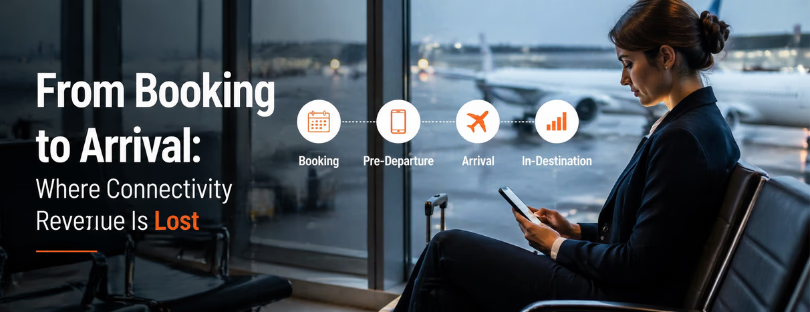
Airlines, banks, travel apps, and even insurance platforms are starting to embed eSIM directly into their user journeys.
You book a flight → you get connectivity
You open a fintech app → you activate data abroad
You check into a hotel → you receive a plan
This is not hypothetical. It’s already happening.
And it changes everything.
Because the traveler might not even know which eSIM provider they’re using.
At that point, branding becomes secondary.
Distribution becomes everything.
What most “best eSIM” lists don’t tell you
If you look at rankings and comparisons, you’ll see the usual names.
Providers offering coverage in 150–200+ countries
Apps that make installation easy
Plans ranging from 1GB to unlimited
All true.
But these lists miss the bigger dynamic.
The market is becoming less about who has the best plan, and more about:
- Who controls the relationship with the traveler
- Who owns the channel where the purchase happens
- Who can reduce acquisition cost
Because here’s the reality.
Selling a €10–€20 travel eSIM profitably is hard.
Customer acquisition costs are rising. Platforms like Google and Meta take a large share of that value.
So providers are being forced to rethink their model.
And that’s why you’re seeing:
- More partnerships
- More embedded distribution
- More subscription-style offers
- More bundled connectivity
Travel eSIM is no longer just a product. It’s becoming a layer inside other products.

The overlooked advantage: sustainability
There’s another angle that’s rarely discussed, but increasingly relevant.
eSIM eliminates physical SIM cards entirely.
No plastic
No packaging
No shipping
Some estimates suggest up to 87% reduction in emissions compared to traditional SIM distribution.
For a travel industry under pressure to become more sustainable, this matters.
And it’s likely to become part of the narrative, especially for airlines and travel brands.
What this means for you as a traveler
If you’re traveling internationally today, the practical takeaway is simple.
eSIM is no longer a “tech-savvy” option.
It’s becoming the default.
Not because it’s new, but because it removes friction.
You don’t think about SIM cards anymore.
You just expect your phone to work.
And increasingly, it does.
Where this is heading next
Looking ahead, a few trends are already clear:
eSIM-only devices will become standard
Global plans will replace country-based thinking
Subscriptions will replace one-off purchases
Connectivity will be bundled into travel services
And most importantly:
You won’t choose your eSIM provider.
It will be chosen for you, by the platform you’re already using.
Conclusion: this is no longer about SIM cards
The biggest mistake is still thinking about eSIM as a better SIM card.
It’s not.
It’s a shift in how connectivity is delivered, sold, and experienced.
Right now, players like Airalo or Holafly dominate the consumer conversation because they made eSIM accessible early. Others, like infrastructure-focused providers and API-driven platforms, are quietly building the next phase by embedding connectivity into other ecosystems.
And that’s the real story.
The market is moving from:
“Which SIM should I buy?”
to
“Why do I even need to think about this?”
That shift is subtle, but it’s decisive.
Because once connectivity becomes invisible, the winners won’t just be the providers with the best plans.
They’ll be the ones who control where, when, and how connectivity appears in your travel journey.
And if you zoom out, that’s the bigger picture.
eSIM isn’t just changing international travel.
It’s quietly redefining what it means to be connected anywhere.