Why Connectivity Belongs in Your Travel Risk Register
In most travel risk programs, connectivity still sits in a weird limbo.
It is not “security” like civil unrest. It is not “medical” like an illness abroad. It is not “logistics” like a missed connection. So it gets treated like a convenience item. Something travelers solve with a local SIM, a hotel WiFi password, or whatever app they downloaded at the gate.
But if you run travel risk management (TRM) properly, you already know the rule: if a dependency can fail in a way that blocks duty of care, incident response, or business continuity, it belongs in the risk register.
Connectivity is exactly that.
And standards-based TRM is moving in this direction anyway. ISO 31030 pushes travel risk to be integrated with enterprise risk management, meaning travel risks should sit alongside other business risks in the same governance system, not in a side spreadsheet.
Connectivity is not a perk. It is a control layer.
TRM has matured from “check the travel advisory and buy insurance” to a coordinated set of policies, responsibilities, assessments, and response capabilities. In plain language: you are building a system that keeps people safe, compliant, and reachable when things go off-script.
Now look at how your TRM controls actually work in real life:
You send alerts. You check in on people. You coordinate reroutes. You move someone to a safer location. You approve an exception. You confirm they got medical help. You collect facts. You escalate. You document.
Every one of those actions assumes one thing: the traveler can connect.
If the traveler cannot connect, your beautiful TRM playbook becomes a PDF.
That is why connectivity deserves the same framing as any other operational dependency. Not as “data for Instagram,” but as the thing that keeps your duty-of-care machine functioning.
The risk is not “no signal.” The risk is cascading failure.
Most companies only notice connectivity when it becomes a headline internally.
A team lands and cannot access the arrival instructions. An exec cannot receive the MFA code to log into a corporate app. A field team loses maps and dispatch updates. A traveler cannot open the assistance app because the login needs a one-time password. Someone cannot call an emergency number because VoIP needs data and they have none.
This is not a single-point failure. It cascades:
- Loss of contact makes risk assessment slower
- Slower assessment delays decisions
- Delayed decisions increase exposure
- Increased exposure becomes an incident
TRM vendors talk a lot about visibility and response. Travel management companies also frame technology as a way to enhance compliance and safety outcomes. But “visibility” is just a promise unless the traveler can reliably get online in the moment it matters.

Put connectivity into the register like a grown-up risk
If you want this to be TRM-native, stop asking “Should we give travelers eSIMs?” and start asking the risk register questions:
Risk statement
What is the risk scenario, in one sentence?
Example: “Travelers lose the ability to connect to corporate communications and emergency support due to roaming failure, coverage gaps, or SIM issues during business travel.”
Impact
What breaks when connectivity breaks?
Think duty of care (unable to check in), incident response (unable to coordinate), security (unable to receive instructions), and business operations (unable to access systems).
Likelihood
How often does this happen across your travel footprint?
This is where reality hits: coverage gaps exist, onboarding fails, travelers forget to activate plans, phones get reset, QR codes get lost, roaming gets blocked, and local networks behave differently than expected.
Controls
What controls “modify risk” in practice?
Risk controls are not just prevention. In ISO-aligned risk language, controls modify risk, sometimes by reducing likelihood, sometimes by reducing impact, sometimes both.
So your control should not be “hope travelers figure it out.” A TRM-grade control looks like redundancy, centralized deployment, and fast recovery.
What a TRM-grade connectivity control looks like
Here is the simple version: you want a backup connectivity layer that is easy to deploy, hard to mess up, and designed for the moments when primary connectivity fails.
In the market, a lot of travel eSIM solutions are optimized for consumer checkout flows and cost comparisons. Useful, but not TRM-native.
A TRM-native approach typically has five characteristics:
Multi-network behavior
A single-network plan can still fail locally. Multi-network capability reduces the single point of failure problem.
Backup logic, not “new primary”
In TRM terms, you are building resilience. A backup data connection that kicks in when needed is closer to how companies treat other operational dependencies.
Simple deployment
If rollout is complex, it will be inconsistent. In a risk program, inconsistency becomes risk.
Works across typical corporate devices
Smartphones, tablets, and increasingly laptops. This matters because the “traveler” is not always a single person with a single phone.
Visibility and support orientation
TRM is operational. Someone has to support this when it fails at 11:30pm in a different time zone.
This is exactly why the “enterprise eSIM + management” category is getting more attention: it reframes connectivity as something IT and risk teams can control, not something employees freestyle.
Where SureSIM fits naturally, without the hard sell
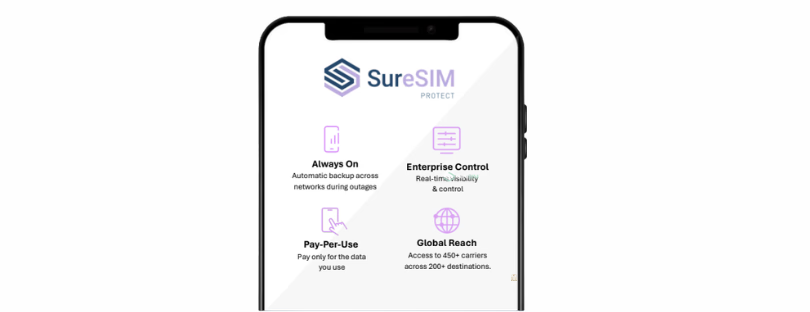
If you look specifically at SureSIM’s positioning, it is not trying to be a trendy travel add-on. It is built for corporate IT teams and managed service providers, which is already closer to TRM reality than consumer retail.
And its “Protect” concept is straightforward: a multi-network backup data connection designed to minimize the impact of coverage and connectivity issues, and built to deploy simply across common corporate devices.
That “backup connectivity” framing is the key. It lets risk teams treat connectivity like they treat other dependencies: not perfect, not glamorous, but designed to reduce the blast radius when something fails.
In other words, it behaves like a control.
The trend line: TRM is integrating, and connectivity is joining the stack
Zoom out and the direction is clear.
TRM is increasingly anchored in frameworks like ISO 31030 and tied into enterprise risk governance, including risk registers and continuity planning. At the same time, organizations are leaning harder on mobile-first workflows, MFA, and cloud tools while traveling, which quietly raises the operational cost of being offline.
In parallel, telecom itself is shifting toward more programmable, remotely managed connectivity standards and architectures. The GSMA’s published eSIM specifications, and the industry push toward more scalable remote provisioning, are part of a broader story: connectivity is becoming managed infrastructure, not a plastic SIM problem.
That matters because it makes “managed backup connectivity” more feasible. You no longer need to treat connectivity as a personal traveler choice. You can treat it as part of the control environment.
Conclusion: Treat connectivity like risk, and your TRM gets sharper
If you add connectivity to your travel risk register, something subtle but important happens: TRM becomes more honest.
You stop pretending that your duty-of-care process is purely policy-driven. You acknowledge it is operational, and operations rely on working infrastructure.
Comparing the market, most travel eSIM providers still sell connectivity as a traveler product: plan selection, price points, destination packs. That is fine for consumer convenience. But it does not fully match the TRM mindset, where the goal is resilience, standardization, and predictable response.
The TRM-native approach is different: choose a control that reduces single points of failure, deploy it consistently, and make it easy for people to recover fast when connectivity goes sideways.
That is the real shift. Not “everyone should have data.” But “connectivity is a dependency we manage, because it is the channel through which duty of care actually works.”