
SureSIM Shortlisted at Mobile News Awards 2026 — A Signal That Enterprise eSIM Is Maturing
Enterprise eSIM rarely makes headlines.
Consumer travel eSIM does. Roaming alternatives do. App launches do.
But enterprise-grade eSIM infrastructure? That space moves quietly — and when it gets recognised, it usually means something structural is happening beneath the surface.
This week, SureSIM was shortlisted as a finalist in the eSIM Innovation & Deployment category at the Mobile News Awards 2026. The nomination follows the company’s 2025 win for Enterprise IoT eSIM Service of the Year.
On paper, it’s an award update.
In reality, it’s a signal about where enterprise connectivity is heading.
Why This Category Matters
The “eSIM Innovation & Deployment” category isn’t about consumer adoption curves. It’s about infrastructure execution.
Judges assess measurable impact, depth of innovation, execution capability, commercial traction, and clarity of evidence. In other words, this is not a marketing award. It’s an operational one.
For companies operating in IoT and enterprise mobility, deployment is no longer defined by activation volume. It’s defined by reliability at scale.
That’s where SureSIM sits.
Enterprise eSIM Is Not Travel eSIM
There’s a tendency to treat all eSIM providers as variations of the same model. They are not.
SureSIM, developed by Utelize Mobile, operates exclusively in the enterprise and IoT segment.
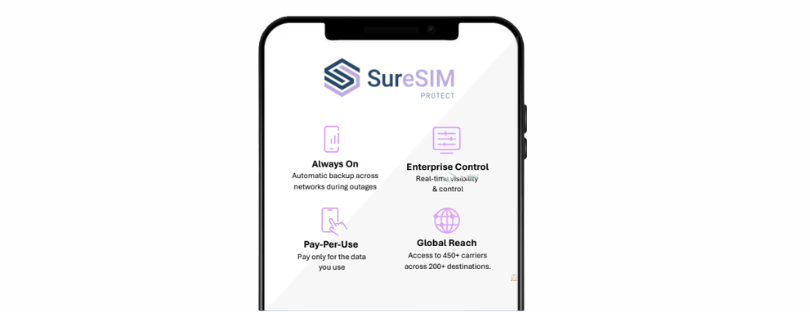
Its platform focuses on:
- Multi-network access
- Remote SIM provisioning
- Lifecycle management of SIM profiles
- Centralised control for IT teams
- Global deployment across 450+ networks in 200+ destinations
This is connectivity engineered for environments where downtime has operational consequences.
Fleet management.
Asset tracking.
Field engineering.
Industrial IoT.
Corporate mobility.
In these environments, connectivity failure is not an inconvenience. It is a business interruption.

Deployment Is the Real Differentiator
The industry conversation around eSIM often focuses on the technology itself. But in enterprise environments, the differentiator is deployment logic.
How quickly can thousands of profiles be provisioned?
How resilient is the network access layer?
How much visibility does IT retain over usage and risk exposure?
How easily can profiles be updated remotely?
These questions define enterprise maturity.
SureSIM’s nomination suggests its approach to multi-network architecture and centralised management is resonating within the UK mobile industry.
And that’s important.
Because enterprise eSIM is entering a new phase.
The Shift From Convenience to Control
The first wave of eSIM removed physical SIM cards.
The second wave simplified onboarding and distribution.
The current phase is about control and resilience.
Organisations increasingly expect:
- Redundancy across network partners
- Remote lifecycle governance
- Real-time visibility
- Scalability across jurisdictions
Enterprise connectivity is being reframed as infrastructure.
That shift is visible in award categories like this one.
It’s also visible in enterprise procurement behaviour, where connectivity is now embedded in risk frameworks and operational continuity planning.
SureSIM’s platform positioning aligns directly with that transition.
Back-to-Back Recognition
Winning in 2025 and being shortlisted again in 2026 is not a small detail.
In enterprise telecom, sustained recognition typically reflects commercial traction rather than hype cycles.
The Mobile News Awards are a long-standing fixture within the UK mobile industry calendar, with the 2026 ceremony set to take place at the London Hilton, Park Lane.
Being shortlisted in consecutive years places SureSIM within a narrow group of providers demonstrating both technical depth and execution capability.
For enterprise buyers watching the market, consistency matters.
The Broader IoT Context
According to industry research from GSMA and other telecom analysts, global IoT connections continue to scale rapidly, with increasing emphasis on remote provisioning and flexible network access.
As deployments grow geographically distributed, single-network dependency becomes a structural weakness.
Multi-network eSIM architecture — particularly when centrally managed — is increasingly viewed as a baseline requirement for serious enterprise rollouts.
SureSIM’s infrastructure footprint across 450+ networks positions it directly inside that macro trend.
This nomination reflects alignment with where the IoT market is going, not where it has been.
A Maturing Segment
Consumer eSIM growth tends to dominate headlines. Enterprise eSIM maturity, however, may ultimately have the larger economic footprint.
IoT deployments, asset intelligence systems, and global mobility frameworks require:
Reliability.
Visibility.
Governance.
Redundancy.
Awards recognising innovation in deployment signal that the industry is now evaluating providers not only on technology capability but on implementation discipline.
That’s a positive sign for the ecosystem.
What This Means for the Market
SureSIM’s shortlisting is less about celebration and more about validation.
It validates that enterprise connectivity is evolving from a commodity purchase to a managed infrastructure layer.
It validates that deployment architecture matters as much as pricing.
And it validates that resilience — not just activation — is becoming the benchmark.
Conclusion: Enterprise eSIM Is Growing Up
The shortlist announcement may look like routine industry news.
But in reality, it highlights something deeper.
Enterprise eSIM is no longer an emerging alternative. It is becoming a structural component of modern operations.
SureSIM’s consecutive recognition at the Mobile News Awards reflects a provider operating in alignment with that evolution — focused not on consumer growth metrics, but on enterprise deployment integrity. Enterprise eSIM deployment
As IoT fleets expand and global mobility frameworks grow more complex, the companies that win in the long term will not be those that activate fastest.
They will be those who deploy the smartest.
SureSIM’s 2026 nomination suggests it understands that distinction.