Why eSIM Aggregators Are the New Power Players in Telecom
For years, telecom power was easy to understand. The operators owned the networks. The roaming agreements sat behind closed doors. The SIM card came from your mobile provider. If you travelled, you either accepted roaming charges, bought a local SIM, or hunted for airport Wi-Fi like everyone else.
That world is not gone, but it is no longer the whole story.
The new power in telecom is not only sitting inside the mobile network operator. It is increasingly sitting in the layer between the network and the customer. That layer is where eSIM aggregators live.
And this is why they matter.
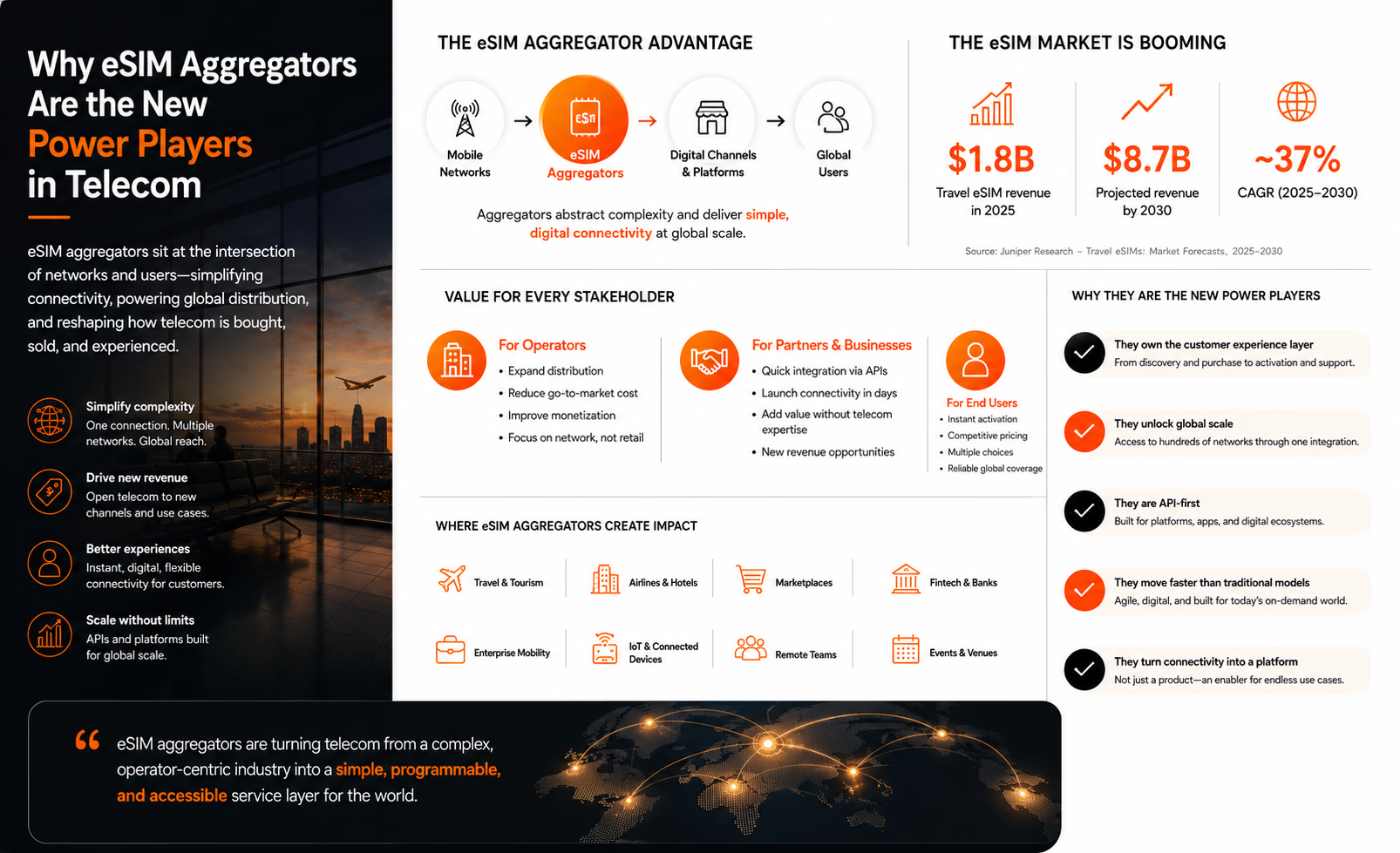
eSIM aggregators are not just reselling data. The best ones are becoming distribution engines, pricing translators, API providers, customer experience platforms, and connectivity brokers. They are taking something telecom has historically made complicated and turning it into something that travel brands, fintechs, airlines, hotels, marketplaces, and app companies can actually sell.
That changes the balance of power.
The old telecom model was built around ownership. The new eSIM model is being built around access.
The power moved closer to the customer
Traditional telecom companies still control the infrastructure. That is important, and nobody serious should pretend otherwise. Without network operators, there is no mobile connectivity to aggregate in the first place.
But owning the network is not the same as owning the customer experience.
That is where aggregators found their opening. They saw what travellers were experiencing: confusing roaming prices, poor visibility, surprise bills, local SIM friction, QR code problems, and endless plan comparison. Then they built a cleaner layer on top.
READ MORE: How eSIM Aggregators Are Reshaping Roaming
A traveller does not wake up thinking, “I want an IMSI profile attached to a remote provisioning system.” They think, “I need data in Japan before I land.” Or, “My team is flying to Dubai and I do not want another roaming invoice surprise.” Or, “Can we offer connectivity inside our travel app without becoming a telecom company?”
Aggregators understand language better than most operators.
They package connectivity around moments, not around telecom logic. A seven-day Europe plan. A 30-day global plan. An API for an airline. A white-label eSIM store for a travel agency. A business dashboard for employee data. A marketplace where multiple underlying networks are hidden behind one simple offer.
That is not just a product shift. It is a power shift.
Aggregators make telecom sellable
Telecom is one of the most valuable industries in the world, but it has never been especially easy to sell outside telecom channels.
Try explaining roaming bundles, wholesale rates, coverage rules, fair usage policies, throttling, provisioning, activation, device compatibility, refunds, and support flows to a hotel group or fintech team. Most of them do not want to become connectivity experts. They want a product that works, a margin they understand, and a customer journey they can control.
Aggregators solve that problem.
They take the messy backend of mobile connectivity and turn it into a commercial product. That might mean a direct consumer eSIM app. It might mean an API. It might mean a co-branded storefront. It might mean vouchers, wholesale dashboards, enterprise allocation, or embedded travel connectivity inside another company’s checkout.
READ MORE: What eSIM Providers Don’t Tell You About Throttling
This is why they are becoming so attractive to non-telecom brands.
An airline does not need to negotiate dozens of network relationships to offer travel data. A bank does not need to build telecom provisioning systems to give premium cardholders global connectivity. A travel platform does not need to become an MVNO to add eSIMs as an upsell.
The aggregator absorbs the complexity.
That is where the commercial power sits.
The API layer is the real story
Consumer travel eSIMs get most of the attention because they are visible. People see Airalo, Holafly, Ubigi, Yesim, Nomad eSIM, GigSky, and others competing for travellers online. That is the easy part to understand.
But the bigger strategic story is happening behind the scenes.
The real power move is the API layer.
APIs turn eSIMs from a product into infrastructure. Once connectivity can be embedded into another company’s app, booking flow, loyalty program, corporate travel platform, or device management system, the market becomes much larger than people searching “Best eSIM for Europe.”
This is where aggregators become telecom’s new middleware.
READ MORE: Why Some eSIMs Feel Premium and Others Feel Broken?
They sit between mobile operators and thousands of potential distributors. Some of those distributors are consumer brands. Some are enterprise platforms. Some are IoT companies. Some are travel sellers. Some are financial services brands that want to attach useful benefits to premium customers.
The aggregator becomes the shortcut.
Instead of every brand building one-off telecom partnerships, they connect once and sell many destinations. Instead of every operator building individual commercial relationships with hundreds of digital brands, they can route supply through platforms that already understand digital distribution.
That makes aggregators valuable to both sides.
To brands, they simplify telecom.
To operators, they expand distribution.
To customers, they reduce friction.
That is a strong position.
Operators are not losing, but they are being challenged
It would be too simple to say operators are being replaced. They are not. Operators still own the radio access networks, local licences, spectrum, core infrastructure, and much of the wholesale foundation that makes global mobile connectivity possible.
But they are being challenged in a very specific way: customer ownership.
For a long time, roaming was protected by inertia. Travellers stayed with their home operator because the alternative was inconvenient. Local SIM cards meant queues, passports, language barriers, and swapping plastic cards. Public Wi-Fi was free but risky and unreliable. Roaming was expensive, but easy.
eSIM changed that equation.
Now the alternative can be bought in two minutes. It can be installed before travel. It can be compared by price, destination, data volume, validity, hotspot rules, and user reviews. That makes roaming compete with digital retail.
READ MORE: Who Controls eSIM? The Entitlement Battle Begins
Operators can respond, and many already are. Some are launching travel eSIM products. Some are improving roaming bundles. Some are working with aggregators instead of fighting them. That is smart, because the market is not simply “operator versus aggregator.”
The more realistic future is mixed.
Operators will still provide the networks. Aggregators will often own the packaging, marketplace logic, and digital customer journey. Some operators will build their own eSIM retail experiences. Some aggregators will move closer to operator-like products. The lines will blur.
But the direction is clear: the companies that make connectivity easiest to buy, activate, manage, and embed will gain influence.
Trust will separate winners from noise
Of course, not every aggregator deserves the same level of confidence.
This market is growing fast, and fast-growing markets always attract noise. Some providers are transparent about coverage, hotspot rules, throttling, refunds, and support. Others are vague. Some build strong enterprise and API infrastructure. Others simply repackage plans with a nice landing page.
That is why trust will become the next battleground.
The best aggregators will not win only because they are cheap. They will win because they can answer serious questions.
Which networks are actually available in a destination?
What happens when one network performs badly?
Is hotspot allowed?
Is unlimited really unlimited?
What support exists when activation fails at the airport?
Can a business see usage in real time?
Can a partner manage refunds, vouchers, and customer care without chaos?
Can the platform scale without breaking?
These are not small details. They are the difference between a useful connectivity layer and a fragile reseller model.
For consumers, trust means the plan works when they land.
For businesses, trust means the service will not damage their own brand.
For operators, trust means their network quality is not being hidden behind poor customer experience.
Aggregators that understand this will become stronger. Aggregators that treat eSIM like a quick affiliate product will struggle.
Why this matters beyond travel
Travel eSIMs are the visible entry point, but aggregation is bigger than travel.
The same logic applies to enterprise mobility, IoT, connected devices, remote teams, temporary workforces, logistics, events, and even future AI-driven services that need trusted connectivity identities. As eSIM and remote provisioning mature, connectivity becomes more programmable. Once it becomes programmable, it becomes easier to distribute through software platforms.
That is why this market is so important.
eSIM aggregation is not only about avoiding roaming fees on holiday. It is about telecom becoming modular.
READ MORE: Why eSIM Adoption Is Stuck: Distribution Over Tech
Connectivity can be packaged, embedded, switched, monitored, assigned, paused, topped up, and sold through channels that did not exist in the old SIM card world. That opens telecom to companies that were previously too far away from the industry to participate.
A hotel can offer arrival connectivity.
An airline can bundle data with long-haul flights.
A fintech can add global data to premium accounts.
An employer can allocate travel data to staff.
A marketplace can compare plans across providers.
A device company can activate connectivity after shipping.
That is the real shift.
Telecom is moving from a closed operator relationship to a programmable service layer.
The new gatekeepers
The uncomfortable truth for traditional telecom is that aggregators are becoming new gatekeepers.
Not because they own more infrastructure, but because they increasingly control discovery, comparison, pricing perception, and customer experience.
They decide how plans are presented. They influence which networks or providers get visibility. They shape what customers expect from international connectivity. They are teaching travellers that mobile data should be flexible, instant, borderless, and easy to change.
Once customers learn that behaviour, they do not easily go back.
That is exactly what happened in other industries. Booking platforms changed hotels. OTAs changed flights. App stores changed software distribution. Payment processors changed online commerce. In each case, the infrastructure still mattered, but the distribution layer captured enormous power.
Telecom is now facing a similar moment.
The network is still essential. But the interface is becoming just as strategic.
Final thoughts
eSIM aggregators are powerful because they sit where telecom used to be weakest: usability, distribution, and speed.
They do not replace operators. They reorganize access to them. They turn mobile connectivity from a closed telecom product into something that can be bought, compared, embedded, and managed like software.
That is why the smartest operators will not simply see aggregators as a threat. They will see them as a new route to market. And the smartest travel, fintech, airline, hotel, and enterprise brands will not see eSIM as a small add-on. They will see it as a practical connectivity layer that can improve customer experience, create new revenue, and reduce friction at exactly the moment travellers need help most.
The next power players in telecom may not be the companies with the most towers.
They may be the companies that make those towers easier to access.