eSIM Aggregators Are Rewriting Travel Roaming
The telecommunications industry is undergoing one of its most significant shifts since the introduction of mobile roaming itself. At the center of this transformation is eSIM technology and a new class of companies known as eSIM aggregators.
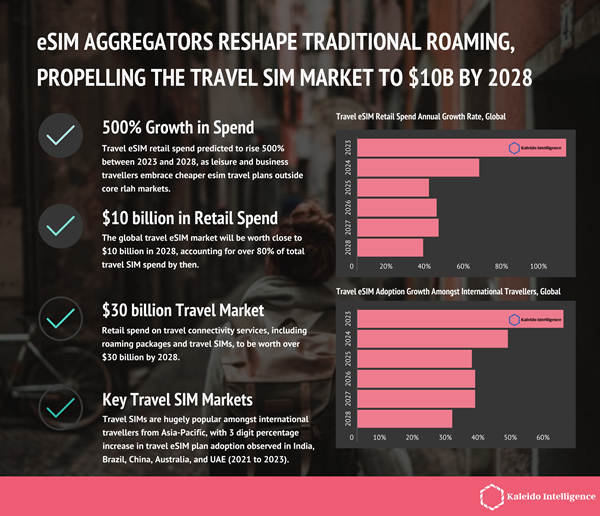
According to research from Kaleido Intelligence, global retail spending on travel eSIM services is expected to grow by more than 500% between 2023 and 2028. By the end of that period, the global travel SIM market could reach nearly $10 billion, with eSIM accounting for the vast majority of spending.
In other words, the humble travel SIM card is evolving from a niche convenience product into a major component of the global connectivity economy.
The Shift Toward Digital Connectivity
The rise of eSIM technology is fundamentally changing how travelers access mobile connectivity abroad.
Instead of purchasing a physical SIM card at airports or local shops, travelers can now activate a mobile data plan digitally within minutes. This shift removes one of the biggest friction points in international connectivity: the need to physically replace a SIM card.
READ MORE: Why eSIM Aggregators Are the New Power Players in Telecom
As smartphone manufacturers increasingly adopt eSIM-first architectures, the transition is accelerating. Apple’s decision to launch eSIM-only iPhones in the United States was a major milestone, and many analysts expect similar shifts globally in the coming years.
This hardware transition is enabling a more seamless customer journey. Travelers can now purchase connectivity before they even leave home, install the eSIM profile instantly, and activate it the moment they land.
For a market historically dominated by airport kiosks and prepaid plastic cards, this represents a dramatic change.
The Role of eSIM Aggregators
While mobile network operators remain the backbone of global connectivity, much of the innovation in the travel eSIM sector is being driven by aggregators and digital connectivity platforms.
These companies sit between mobile networks and end users, integrating connectivity from multiple operators into a single digital marketplace. Instead of relying on one national operator, travelers can choose plans covering dozens or even hundreds of countries.
READ MORE: Why eSIM Adoption Is Stuck: Distribution Over Tech
This model dramatically simplifies the travel connectivity experience.
Rather than navigating local telecom markets in every destination, users can purchase a global or regional data plan through an app or online platform. For many travelers, especially digital nomads and frequent flyers, this convenience is the key selling point.
Aggregators are also able to bundle connectivity in creative ways that traditional telecom operators rarely offered in the past.
Examples include:
This combination of convenience, flexibility, and pricing transparency is reshaping expectations around international connectivity.
Why Roaming Is Under Pressure
For decades, roaming charges were one of the most profitable services in telecom.
However, the economics of roaming have started to shift. Regulatory initiatives such as Roam Like At Home (RLAH) in the European Union significantly reduced roaming costs within Europe. At the same time, travelers outside these protected markets continue to face high roaming fees.
This gap has created an opportunity for travel eSIM providers.
When travelers realize they can access data abroad for a fraction of traditional roaming costs, switching becomes an easy decision. As awareness of eSIM technology increases, more consumers are exploring these alternatives.
Kaleido Intelligence’s research suggests that lower cost remains the primary driver for adopting travel SIM and eSIM services.
But cost is only part of the story.
Convenience and control also play major roles. With an eSIM installed on their device, travelers can maintain their home number while using a secondary data connection abroad. This dual-SIM capability is becoming one of the defining features of modern smartphones.

Changing Traveler Behavior
The shift toward eSIM is not just technological. It also reflects changing traveler behavior.
Kaleido’s survey of 20 global markets found that travelers increasingly combine multiple connectivity methods while abroad.
Leisure travelers often mix roaming packages with travel SIMs or eSIM plans, switching depending on cost and convenience. Business travelers, on the other hand, still rely heavily on roaming through their corporate mobile plans, although eSIM adoption is growing in this segment as well.
Regional differences are also notable.
Respondents in markets such as China, India, and the United Arab Emirates showed particularly strong interest in using travel SIM or eSIM solutions in the future. These markets represent massive potential growth areas for digital connectivity services.
Another factor that could accelerate adoption is the future ratification of GSMA eSIM specifications for smartphones in China. If Chinese device manufacturers fully embrace global eSIM standards, the number of compatible devices could increase dramatically.
A Market Expanding Beyond SIM Cards
The rapid growth of travel eSIM spending is part of a broader expansion in travel connectivity services.
Kaleido estimates that total retail spending on travel connectivity including roaming packages, travel SIMs, and related services could exceed $30 billion globally by 2028.
In this ecosystem, eSIM is emerging as the dominant delivery mechanism.
Physical SIM cards will likely remain in certain markets and segments, but their role is gradually shrinking as digital provisioning becomes the default.
For telecom operators, this presents both a challenge and an opportunity.
On one hand, aggregators and digital connectivity providers are capturing parts of the travel connectivity value chain that operators historically controlled. On the other hand, operators can partner with these platforms to reach new global customer segments.
Some operators are already launching their own travel eSIM offerings or partnering with aggregators to distribute connectivity internationally.
What This Means for the Telecom Industry
The rise of eSIM aggregators signals a broader shift in telecom from network ownership toward connectivity platforms.
Historically, telecom operators controlled both infrastructure and customer relationships. Today, digital platforms are increasingly mediating that relationship by packaging connectivity from multiple networks into a single service layer.
This mirrors transformations seen in other industries where platforms aggregate supply and simplify access for users.
In travel connectivity, this platform model is accelerating innovation and competition.
Consumers benefit from lower prices and more choice. Telecom operators gain access to global distribution channels they previously lacked. Meanwhile, aggregators build value by simplifying the complexity of international connectivity.
Conclusion
The growth of the travel eSIM market is not simply about replacing plastic SIM cards with digital profiles. It represents a deeper restructuring of how global connectivity is delivered, purchased, and managed.
Research from Kaleido Intelligence highlights the scale of this transition. With retail spending expected to approach $10 billion by 2028, travel eSIM services are becoming a major segment of the telecommunications industry.
But the real story lies in the emergence of connectivity platforms powered by aggregators, APIs, and digital distribution models.
Companies such as Airalo, Nomad, Holafly, and others have already demonstrated how powerful this model can be. At the same time, telecom operators are experimenting with their own digital travel services in response.
In many ways, the travel eSIM market is becoming a preview of telecom’s broader future.
Connectivity is gradually evolving from a locally sold telecom product into a globally distributed digital service layer. And as smartphones, networks, and platforms continue to converge, the line between telecom provider, technology platform, and travel service may become increasingly blurred.
For travelers, the result is simple: faster access to affordable connectivity wherever they go.
For the telecom industry, the implications are much bigger.