eSIM Explained: What an Electronic SIM Card Really Is
If you’ve traveled recently, switched phones, or even just scrolled through your settings, you’ve probably seen the term “eSIM” or “electronic SIM card.” It sounds technical. Maybe even a bit abstract.
But once you understand it, it’s actually one of the simplest shifts happening in mobile connectivity right now.
And honestly, it changes more than people realize.
So, what is an electronic SIM card?
An electronic SIM card, better known as an eSIM, is a digital version of the traditional SIM card.
Instead of inserting a small plastic chip into your phone, the SIM is already built into the device. It’s embedded directly into the hardware. That’s where the “e” comes from.
Everything else stays conceptually the same. You still connect to a mobile network. You still get data, calls, and texts. You still have a mobile identity.
The difference is this: instead of physically swapping cards, you download a mobile plan.
That’s it.
But that small shift unlocks a lot.
Why SIM cards existed in the first place
To understand eSIM, it helps to quickly look at what SIM cards actually do.
A traditional SIM card stores your subscriber identity. It tells the network who you are, what plan you have, and what services you’re allowed to use.
For years, the only way to manage that identity was through a physical card. That’s why switching carriers meant swapping SIMs. Traveling meant buying a local SIM. Losing your SIM meant losing access.
It worked. But it was never elegant.
And more importantly, it wasn’t built for a digital world.
What changes with eSIM
With an electronic SIM card, that identity becomes software-based.
Instead of a piece of plastic, your phone stores a programmable profile. That profile can be added, removed, or switched through software.
So instead of this:
- Go to a store
- Buy a SIM
- Insert it
- Restart your phone
You now do this:
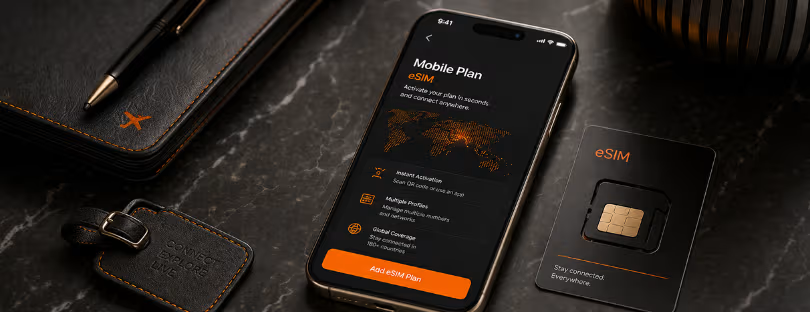
- Scan a QR code or download a plan
- Activate
- You’re connected
No store. No waiting. No physical anything.
That’s why eSIM often feels less like a telecom feature and more like a software feature.

The real advantage isn’t convenience
Most people stop at convenience. No SIM swapping, no tiny trays, no losing cards.
But the bigger shift is flexibility.
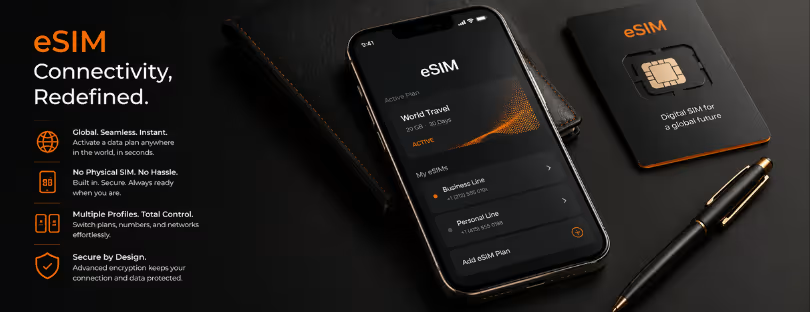
With eSIM, your device can hold multiple profiles at once. That means you can:
- Keep your home number active
- Add a travel data plan instantly
- Switch between networks without removing anything
It’s not just easier. It’s fundamentally more adaptable.
And this is where things get interesting, especially for travel.
Travel is where eSIM makes the most sense
Think about what usually happens when you land in another country.
You turn your phone on. It connects. And then you hesitate.
Do you use roaming? Is it expensive? Should you find Wi-Fi? Should you buy a local SIM?
That moment of uncertainty is still very real.
eSIM removes it completely.
You can install a data plan before you even get on the plane. The moment you land, you’re connected. No queues at the airport. No language barriers. No guessing.
And that’s why eSIM adoption has been fastest among travelers, digital nomads, and business users.
They feel the problem the most.
But it’s not just about travelers
There’s a bigger shift happening behind the scenes.
Connectivity is slowly becoming part of other products.
Airlines are starting to bundle eSIM with tickets. Banks are exploring it inside their apps. Travel platforms are looking at it as an add-on, just like insurance or baggage.
Because once connectivity becomes digital, it becomes something you can distribute.
And that’s a completely different business model compared to physical SIM cards.
How eSIM actually works (without the technical overload)
At a high level, eSIM relies on something called remote SIM provisioning.
That just means your mobile operator can send your SIM profile over the internet instead of handing it to you physically.
When you scan a QR code or download a plan, your device securely installs that profile. From that point on, your phone behaves exactly as if you inserted a physical SIM.
You connect to networks. You use data. You make calls if the plan supports it.
There’s no visible difference in usage.
The only difference is how you got there.
Are there downsides?
Yes, and it’s worth being honest about them.
Not every device supports eSIM yet, although most newer smartphones do. Think recent iPhones, Samsung Galaxy models, and Google Pixel devices.
Also, not every operator globally has fully embraced eSIM. Some markets are still catching up.
And for some users, the lack of a physical card feels unfamiliar. There’s a psychological comfort in something you can hold and swap.
But these are temporary limitations.
The direction is clear.

Why the industry is moving this way
For telecom operators, eSIM reduces logistics. No manufacturing, no shipping, no retail distribution in the same way.
For businesses, it opens up new revenue streams. Connectivity can be embedded into their existing products.
For users, it removes friction.
And in tech, anything that removes friction usually wins.
It’s the same pattern we’ve seen with streaming replacing DVDs, cloud replacing local storage, and digital payments replacing cash in many situations.
The physical layer disappears. The experience becomes instant.
The subtle shift most people miss
Here’s the part that doesn’t get talked about enough.
eSIM is not just about replacing SIM cards.
It’s about turning connectivity into something programmable.
When connectivity becomes software, it can be integrated, automated, bundled, optimized.
It stops being a standalone product and becomes part of an experience.
That’s why you’re starting to see it appear in places you wouldn’t expect. Travel apps. Fintech platforms. Even IoT devices and cars.
It’s no longer just telecom.
So, what is an electronic SIM card really?
On the surface, it’s simple.
An electronic SIM card is a built-in, digital version of a SIM that lets you activate mobile plans without using a physical card.
But if you zoom out a bit, it’s more than that.
It’s the moment connectivity stopped being tied to hardware and started behaving like software.
And once that happens, everything around it starts to change.
How do you travel? How do you switch networks? How companies distribute mobile services? How products are designed?
It’s one of those shifts that feels small when you first encounter it.
Until you realize how many things depend on it.
And then it starts to look much bigger.