Electronic SIM Card Explained: What You Need to Know
Here’s the thing about connectivity: for years, it felt unnecessarily complicated. You land in a new country, hunt for a SIM card, deal with language barriers, swap tiny plastic chips, and hope everything works. Then came something that quietly started changing all of that. The electronic SIM card, better known as the eSIM.
It didn’t arrive with a bang. No big “this changes everything” moment. But if you look closely, it’s doing exactly that.
What is an electronic SIM card, really?
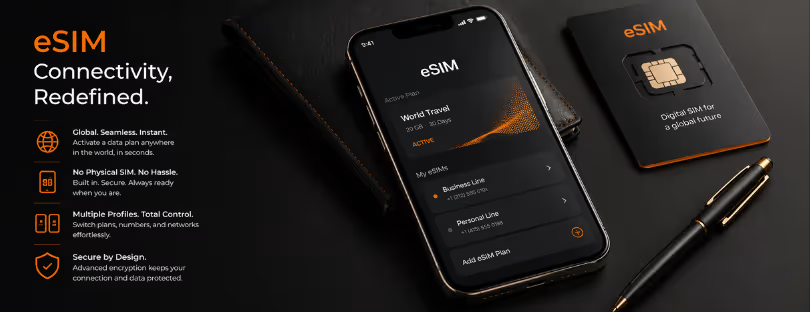
An electronic SIM card is exactly what it sounds like. A SIM card that isn’t physical.
Instead of inserting a plastic card into your phone, the SIM functionality is built directly into the device. It’s a small chip soldered inside your phone, tablet, smartwatch, or even a laptop. You don’t touch it. You don’t remove it. You don’t lose it.
What you do instead is download a mobile plan digitally.
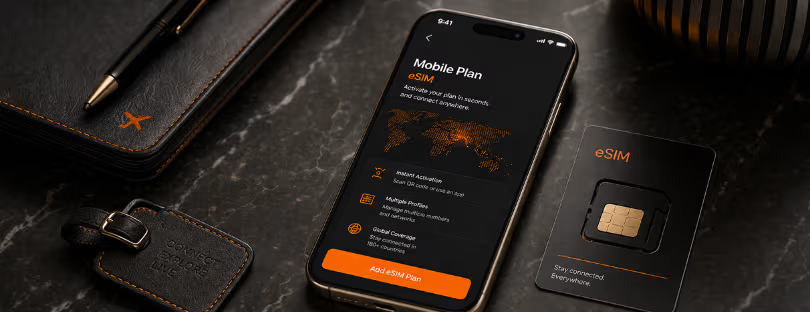
Usually, that means scanning a QR code or installing a plan through an app. Within minutes, your device connects to a network, just like a traditional SIM would. No shops. No waiting. No awkward airport purchases.
And once you’ve used it once, going back to physical SIM cards starts to feel… outdated.
Why is it gaining so much traction now
For years, telecom tried to push eSIM as a “nice feature.” Something optional. Something futuristic.
That phase is over.
The shift is now happening because of three very real forces.
First, device manufacturers are fully on board. Some smartphones are already removing SIM trays entirely. That’s not a design choice. It’s a direction.
Second, travel behavior has changed. People move more, work remotely, and expect connectivity to follow them instantly. Waiting to get connected is no longer acceptable.
Third, the ecosystem finally matured. Providers, platforms, and apps now make it easy to discover, buy, and activate plans in seconds.
This combination is what turned eSIM from a concept into infrastructure.
The real benefit isn’t what you think
Most people think the main benefit of an electronic SIM card is convenience.
And yes, it’s convenient. But that’s not the real story.
The real shift is control.
With a traditional SIM, you’re locked into a single operator unless you physically change cards. With an eSIM, your phone can hold multiple profiles at once. You can switch between them in seconds.
Traveling to France? Activate a local data plan. Landing in Singapore next week? Add another one. Need a backup network because your primary is slow? Done.
You’re no longer tied to one provider. You’re choosing the best option in real time.
That’s a completely different relationship with connectivity.
Travel is where it really shines
If you want to understand why eSIM is exploding, look at travel.
Roaming has always been a pain point. Expensive, unpredictable, and often confusing. Even today, many travelers still turn off mobile data completely to avoid bill shock.
eSIM changes that behavior.
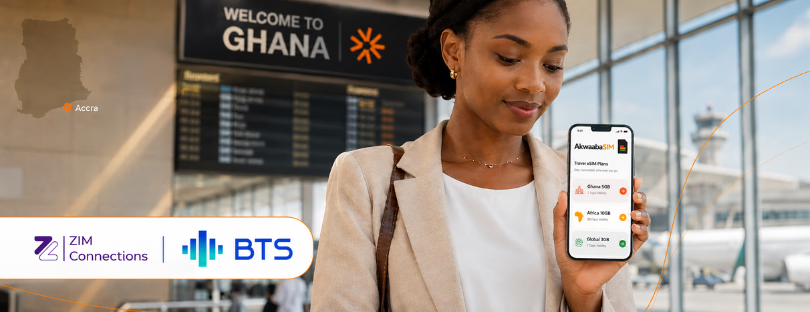
Instead of relying on your home operator’s roaming rates, you can install a local or regional plan before you even leave. The moment you land, you’re connected.
No searching for WiFi. No taxi rides without internet. No stress.
And here’s the important part: this isn’t just about saving money. It’s about removing friction from the entire travel experience.
Connectivity becomes invisible. And that’s exactly how it should be.
It’s not just for travelers anymore
For a long time, eSIM was positioned as a “travel thing.”
That’s changing quickly.
More and more people are using eSIM in their daily lives. Not because they travel, but because they want flexibility.
Think about it:
You can separate work and personal numbers on one device. You can test different operators without commitment. You can have a backup data plan in case your main network fails.
For businesses, it goes even further.
Companies can manage connectivity across teams without dealing with physical SIM distribution. Devices can be provisioned remotely. Plans can be updated instantly.
This is where eSIM starts moving from consumer convenience to business infrastructure.
The hidden layer: what’s happening behind the scenes
What most users don’t see is the ecosystem powering all of this.
Behind every eSIM download is a provisioning platform. Systems that securely deliver and manage profiles. Standards defined by industry bodies. APIs connecting providers to apps and devices.
This is where things get interesting.
Because the real innovation isn’t just the chip in your phone. It’s the infrastructure that allows connectivity to be distributed digitally.
That’s why you’re seeing new types of companies entering the space. Not just traditional telecom operators, but tech platforms, travel companies, fintech apps, and even airlines.
Connectivity is becoming something you embed into experiences, not something you buy separately.
Device compatibility is still a barrier. Not every phone supports eSIM, especially in lower price segments. Even when it does, users often don’t realize it or don’t know how to activate it.
Then there’s the fragmentation problem. The experience varies a lot depending on the provider. Some make activation seamless. Others still rely on clunky processes that feel anything but digital.
And let’s be honest, telecom hasn’t exactly built a reputation for simplicity.
There’s also a trust gap. Many users still feel more comfortable “holding” a SIM card. It feels tangible. Reliable. An eSIM, by comparison, is invisible. And invisible products require confidence in the system behind them.
That confidence is growing, but it’s not universal yet.
Where is this all heading
What’s happening with the electronic SIM card is part of a much bigger shift.
Connectivity is becoming software.
Not something you insert. Not something you manually configure. Something that exists in the background, activated when needed, optimized automatically, and tied directly to the service you’re using.
Think about how cloud computing replaced physical servers. Or how streaming replaced DVDs.
eSIM is doing something similar to telecom.
You won’t “buy a SIM card” in the future. You’ll get connectivity as part of a product, a service, or an experience.
Book a flight, and your data plan is already there. Open a banking app, and you can activate connectivity for your trip in seconds. Check into a hotel, and your phone connects instantly without asking.
That’s where this is going.
And it’s already starting to happen.
Why companies are paying attention
This is where things get interesting from a business perspective.
Because eSIM isn’t just a better SIM card. It’s a new revenue layer.
Travel platforms can monetize connectivity at the exact moment users need it. Airlines can sell data plans during check-in. Banks can bundle connectivity with premium accounts. Fintech apps can offer global data alongside payments.
The opportunity isn’t theoretical. It’s already being tested across the market.
And the companies that move early have a clear advantage.
They don’t just generate additional revenue. They improve user experience in a way that feels natural, not forced.
That’s a rare combination.
So what does this mean for you?
If you’re a traveler, it means less friction, more control, and often lower costs.
If you’re a business, it means something bigger.
It means connectivity is no longer someone else’s problem.
It’s part of your product.
And the question is no longer whether your users need it. They do.
The question is whether they’ll get it from you… or from someone else.
Final thought
Electronic SIM cards didn’t arrive as a revolution. They arrived quietly, almost unnoticed.
But if you step back, the impact is hard to ignore.
We’re moving from a world where connectivity is tied to operators and physical hardware… to one where it’s flexible, digital, and embedded into everything.
That changes how people travel. It changes how products are built. And it changes who owns the customer relationship.
Most companies are still treating connectivity as an add-on.
The smarter ones are starting to treat it as infrastructure.
And once you see it that way, it’s very hard to unsee.
Driven by wanderlust and a passion for tech, Sandra is the creative force behind Alertify. Love for exploration and discovery is what sparked the idea for Alertify, a product that likely combines Sandra’s technological expertise with the desire to simplify or enhance travel experiences in some way.