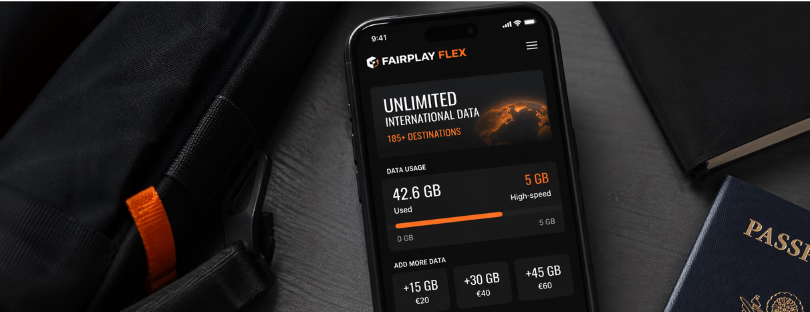
The Truth About Unlimited International Data
“Unlimited international data” sounds like one of those phrases the telecom industry loves to overuse. It’s up there with “premium quality” and “best coverage” — technically true in some contexts, but often stretched to the point where it stops meaning anything.
But here’s the thing. In 2026, unlimited data is no longer just a marketing hook. It’s becoming a real battleground in the travel connectivity space.
If you’ve traveled recently, you’ve probably noticed the shift. The old model was simple: buy a fixed data bundle, track every megabyte, panic when you hit 80 percent. Now, the expectation is different. You open your laptop in Lisbon, jump on a call in Bangkok, stream something in São Paulo — and you don’t think about your data.
That expectation is what’s driving the rise of “unlimited international data.” The problem is that not all unlimited is created equal.
What “unlimited” actually means now
Let’s be honest. In most cases, unlimited still comes with a ceiling. It’s just hidden better.
The typical structure across major eSIM providers looks something like this:
Common industry approach
- High-speed data capped at 1–5 GB per day
- After that, speeds drop dramatically (sometimes below usable levels)
- Fair usage policies buried in fine print
This is where providers like Holafly built their reputation. Strong marketing, simple proposition, but behind the scenes, performance often depends heavily on local network conditions and soft caps.
Then you have Airalo, which largely avoids the “unlimited” claim altogether, sticking to prepaid data bundles. It’s more transparent, but it doesn’t solve the core problem for heavy users: running out of data mid-trip.
And that’s exactly where a different model is starting to emerge.
A different take: usage-based unlimited
Instead of pretending limits don’t exist, some newer players are reframing the concept entirely.
Take Fairplay’s approach. It doesn’t start with “unlimited” as a promise. It builds toward it.
READ MORE: No Throttle eSIM vs Unlimited Plans: The Truth
Their Flex subscription is designed for a very specific type of traveler. Not tourists checking maps and emails. Think people who genuinely burn through tens of gigabytes without noticing. Remote workers, content creators, teams on the move.
The structure is unusual at first glance:
Fairplay Flex structure
- Monthly subscription starting from €25 to €35 depending on commitment length
- Includes an initial 5 GB at full speed
- Usage expands in 15 GB increments for €20
- After multiple expansions, a cost cap kicks in between €85 and €95
- Beyond that point, usage effectively becomes unlimited for the month
It’s not cheap upfront. That’s intentional. This isn’t built for light users.
What’s interesting is the logic behind it. Instead of selling “unlimited” cheaply and throttling aggressively, it assumes heavy usage and builds a ceiling that prevents runaway costs.
In other words, you don’t start unlimited. You earn your way into it through usage.
That’s a very different psychological model.
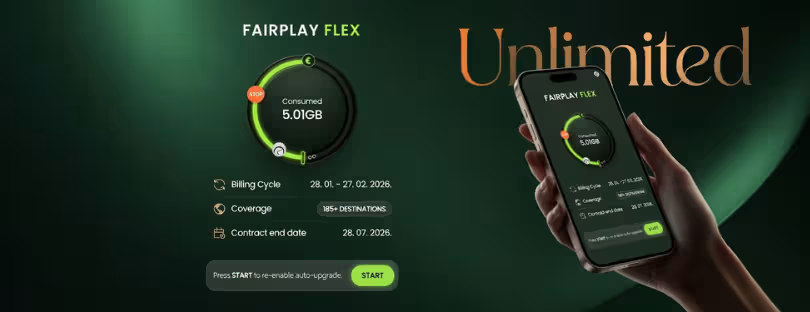
Day passes: unlimited without commitment
For shorter trips, the industry is moving in another direction entirely. Daily unlimited plans.
This is where things get more intuitive. You don’t think in gigabytes. You think in time.
Fairplay’s Day Passes are a clean example:
Fairplay Day Passes
- 3 days for €25
- 5 days for €40
- 7 days for €50
- 14 days for €75
- Works across 185+ destinations with one eSIM
No tracking usage. No worrying about hitting a cap mid-Zoom call. You’re effectively renting unlimited connectivity by the day.
This model is also where we’re seeing overlap with players like Yesim, which has been pushing a similar “pay-per-day” concept. The key difference is in execution. Some providers still apply soft throttling thresholds, while others aim to keep speeds consistent for longer.
That distinction matters more than most marketing pages admit.
Why is this shift happening now?
There’s a reason unlimited is suddenly everywhere.
First, network economics have changed. Wholesale data pricing has dropped, especially with multi-network agreements and eSIM infrastructure players like 1GLOBAL enabling more flexible routing.
Second, user behavior has changed even faster. A traveler in 2026 isn’t just checking Google Maps. They’re:
- Running video calls on mobile data
- Uploading large files
- Streaming constantly
- Using cloud-based tools in real time
The old 3 GB or 5 GB travel plan simply doesn’t match that reality anymore.
And third, competition has intensified. The eSIM market is crowded. “Unlimited” is the easiest way to stand out, even if the definition varies wildly.
The hidden trade-offs
Here’s where things get nuanced.
Unlimited international data sounds like freedom. But it always comes with trade-offs, just not always obvious ones.
Speed stability is one of them. Many providers prioritize coverage over performance, meaning you might be connected almost everywhere, but not always at usable speeds.
READ MORE: Unlimited Phone Plans Are Changing — Here’s Why
Network priority is another. Some eSIMs operate as secondary traffic on local networks, which means performance can drop significantly during peak times.
And then there’s pricing psychology. Cheap unlimited plans often rely on aggressive throttling to stay profitable. More expensive ones, like Fairplay’s Flex, are built for consistency but require a higher upfront commitment.
So the real question isn’t “is it unlimited?”
It’s “how usable is it when you actually need it?”
Where the market is heading
If you step back and look at the bigger picture, the direction is clear.
Unlimited is evolving into three distinct models:
- Marketing unlimited: cheap, heavily capped in practice
- Time-based unlimited: daily passes with predictable usage
- Usage-based unlimited: cost caps for heavy users
Each serves a different audience. And that’s probably where the industry stabilizes.
The interesting part is that we’re moving away from pretending one model fits everyone. The market is segmenting properly for the first time.
Conclusion
The phrase “unlimited international data” is finally starting to mean something again. But not in the way most people expect.
The real shift isn’t about removing limits entirely. It’s about redefining how those limits work and making them predictable.
Compared to providers like Airalo, which focus on transparency through fixed bundles, and Holafly, which leans heavily on simple unlimited messaging, Fairplay’s model sits somewhere in between. More complex, but arguably more honest for heavy users.
Industry data from sources like GSMA Intelligence and telecom infrastructure providers suggests this trend will continue. As networks improve and pricing models mature, unlimited won’t disappear. It will just become more structured.
And that’s probably a good thing.
Because the real goal isn’t unlimited data.
It’s not having to think about your data at all.