There Are Two Types of eSIM Providers — And They Don’t Compete on the Same Level
The travel eSIM market likes to present itself as one big category. telecom-backed eSIM providers
Open any app store, affiliate page, airport advertisement, or comparison site, and the message is usually the same:
cheap data, instant activation, global coverage, scan a QR code, travel stress-free.
Simple.
Too simple, actually.
Because behind the polished apps and aggressive marketing campaigns, the industry is quietly splitting into two very different worlds. And most travellers still do not realize the difference until they experience it themselves.
The uncomfortable truth is this: not all eSIM providers are competing on the same level anymore.
Some are essentially digital storefronts selling connectivity access. Others are deeply integrated telecom infrastructure players with operational control over large parts of the mobile experience.
On the surface, the products may look similar.
Underneath, they are completely different businesses.
The first wave changed travel forever
To understand why the market evolved this way, it helps to look at how fast travel eSIM adoption happened.
The first major wave of providers focused on solving one obvious frustration: roaming.
And they solved it brilliantly.
Companies like Airalo, Nomad eSIM, Holafly, aloSIM, and others removed enormous friction from international travel. Instead of buying local SIM cards at airports or paying ridiculous operator roaming fees, travellers suddenly had:
- app-based activation
- instant data access
- prepaid flexibility
- broad destination coverage
The timing was perfect. Smartphone support improved, Apple accelerated eSIM adoption, and travellers became more comfortable managing connectivity digitally.
For consumers, it felt revolutionary.
But most of these companies were built primarily around distribution and user experience, not telecom infrastructure itself.
That distinction matters more today than it did two years ago.
The rise of the app-first providers
The first category of eSIM companies is what could be called the app-first model.
Their biggest strengths are:
- onboarding simplicity
- strong UX
- aggressive pricing
- broad accessibility
- fast international scaling
These providers are excellent at packaging connectivity into something travellers can buy in under two minutes.
And honestly, the market needed that.
Telecom operators spent years overcomplicating international mobile services. The app-first eSIM players forced the industry to modernize.
But there is a tradeoff.
Many of these platforms rely heavily on third-party roaming aggregation, wholesale connectivity agreements, and external carrier partnerships. In other words, they control the storefront and customer acquisition layer far more than the underlying infrastructure itself.
For many travellers, that works perfectly fine.
Until connectivity becomes complicated.
The telecom-backed players
The second category operates very differently.
These are providers connected directly to telecom infrastructure, operator ecosystems, or deep carrier-level partnerships.
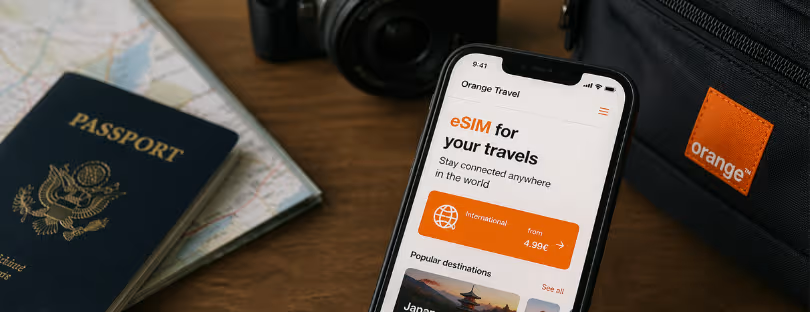
Orange Travel is a good example of this model. Because it sits within the Orange Group ecosystem, the product benefits from existing telecom infrastructure, roaming relationships, operational experience, and network management capabilities developed over decades.
That changes the priorities.
Instead of competing purely on:
- cheapest gigabyte
- biggest destination count
- flash discounts
telecom-backed players increasingly compete around:
- consistency
- reliability
- traffic management
- network orchestration
- voice and SMS integration
- support quality
- multi-country performance
This distinction becomes especially important in Europe, where travellers move rapidly across borders and expect connectivity to behave seamlessly between different network environments.
That is much harder to deliver than most consumers realize.
Same product category, different engineering problem
This is where the market gets interesting.
Two providers can both advertise:
- “200+ destinations”
- “5G coverage”
- “unlimited plans”
- “instant activation”
while solving completely different technical problems behind the scenes.
One may primarily optimize:
- onboarding
- growth
- low-cost acquisition
- fast scalability
The other may optimize:
- roaming stability
- carrier integration
- latency
- handover performance
- long-term reliability
Neither approach is inherently wrong.
But they are not competing on the same level.
One is fundamentally a digital travel product.
The other is increasingly becoming a telecom-grade connectivity platform.
Travellers are starting to notice
The reason this distinction matters now is simple: users are becoming more experienced.
A few years ago, consumers were impressed just because eSIMs existed.
Now they compare experiences.
And the market is becoming less forgiving when things fail:
- unstable hotspot performance
- inconsistent speeds between countries
- delayed activation
- missing SMS support
- weak customer support during issues
- throttled “unlimited” plans
This is especially true among:
- business travellers
- remote workers
- frequent flyers
- digital nomads
- event professionals
- creators working on the move
For these users, connectivity is no longer just convenience. It is an operational infrastructure.
That changes buying behavior significantly.

Europe became the stress test
Europe quietly became one of the hardest regions for eSIM providers to handle consistently.
Not because infrastructure is weak, but because movement is constant.
A traveller might move:
Paris → Brussels → Amsterdam → Berlin in four days.
Every border crossing introduces:
- different partner networks
- different roaming behavior
- different congestion patterns
- different carrier priorities
The providers performing best in this environment usually have stronger infrastructure orchestration and deeper telecom relationships.
And this is where telecom-backed players are beginning to gain strategic advantages again after initially appearing slower than app-first competitors.
The market is maturing fast
One of the biggest misconceptions in the industry is that eSIM competition is mainly about pricing.
It is not anymore.
Pricing helped drive adoption. Reliability will shape retention.
The companies likely to dominate the next phase are probably not the ones with the loudest affiliate campaigns or biggest discount banners. They will be the ones delivering the most stable and invisible connectivity experience across increasingly complex digital travel environments.
And “invisible” is the key word here.
The best connectivity experience is the one travellers never think about.
Conclusion about the importance of telecom-backed eSIM providers
The travel eSIM industry is no longer a single category moving in one direction.
It is splitting into distinct layers:
- app-first distribution platforms
- telecom-backed connectivity ecosystems
- orchestration-heavy enterprise providers
- infrastructure-focused operator models
eSIM providers transformed global travel connectivity by making eSIMs mainstream and easy to buy. Without them, the category would not have scaled this quickly. But the next stage of competition looks increasingly infrastructure-driven rather than purely marketing-driven.
That creates opportunities for telecom-backed eSIM providers like Orange Travel, as well as infrastructure-heavy providers capable of controlling more of the connectivity stack itself.
GSMA forecasts, Juniper Research analyses, and operator discussions across Europe and Asia all point toward the same long-term direction: connectivity is moving closer to being an integrated digital service layer rather than just a roaming product.
And when that happens, the companies owning stronger infrastructure foundations usually become much harder to compete against over time.
The irony is that the eSIM market spent years trying to make everything look identical. Now the infrastructure underneath is becoming the thing that matters most.