Why Data-Only eSIMs Still Create Problems for Travelers
Travel eSIMs solved a major problem for travellers. Nobody misses hunting for plastic SIM cards at airport kiosks, dealing with language barriers in local telecom stores, or paying ridiculous roaming fees just to open Google Maps.
But in the rush to make travel connectivity simple, the eSIM industry quietly removed something many travellers still end up needing: an actual phone number.
For a lot of users, this does not seem important at first. Most travel eSIM marketing focuses entirely on data. Bigger packages. Unlimited plans. Faster speeds. More countries. The assumption is simple: if travellers have data, they can do everything through apps anyway.
Until reality interferes.
Because somewhere between landing at the airport, ordering a taxi, confirming a bank transaction, calling a hotel, or trying to receive an authentication code abroad, travellers suddenly realize that “data-only” and “fully connected” are not exactly the same thing.
And the more people rely on digital services while travelling, the more obvious this gap becomes.
Data-only became the default
Most travel eSIM providers today operate on a data-only model.
It makes sense commercially. Data-only plans are simpler to scale internationally, easier to integrate across roaming partnerships, and avoid many of the regulatory and operational complications associated with voice and SMS services.
For many providers, especially app-first eSIM brands, the goal was speed and simplicity:
- instant activation
- quick installation
- low pricing
- massive destination coverage
And to be fair, that model worked. It helped push eSIM adoption into the mainstream much faster than traditional telecom operators expected.
But it also created a strange disconnect between how people think they travel and how they actually travel.
The moment data-only stops being enough
The problem usually appears in small moments.
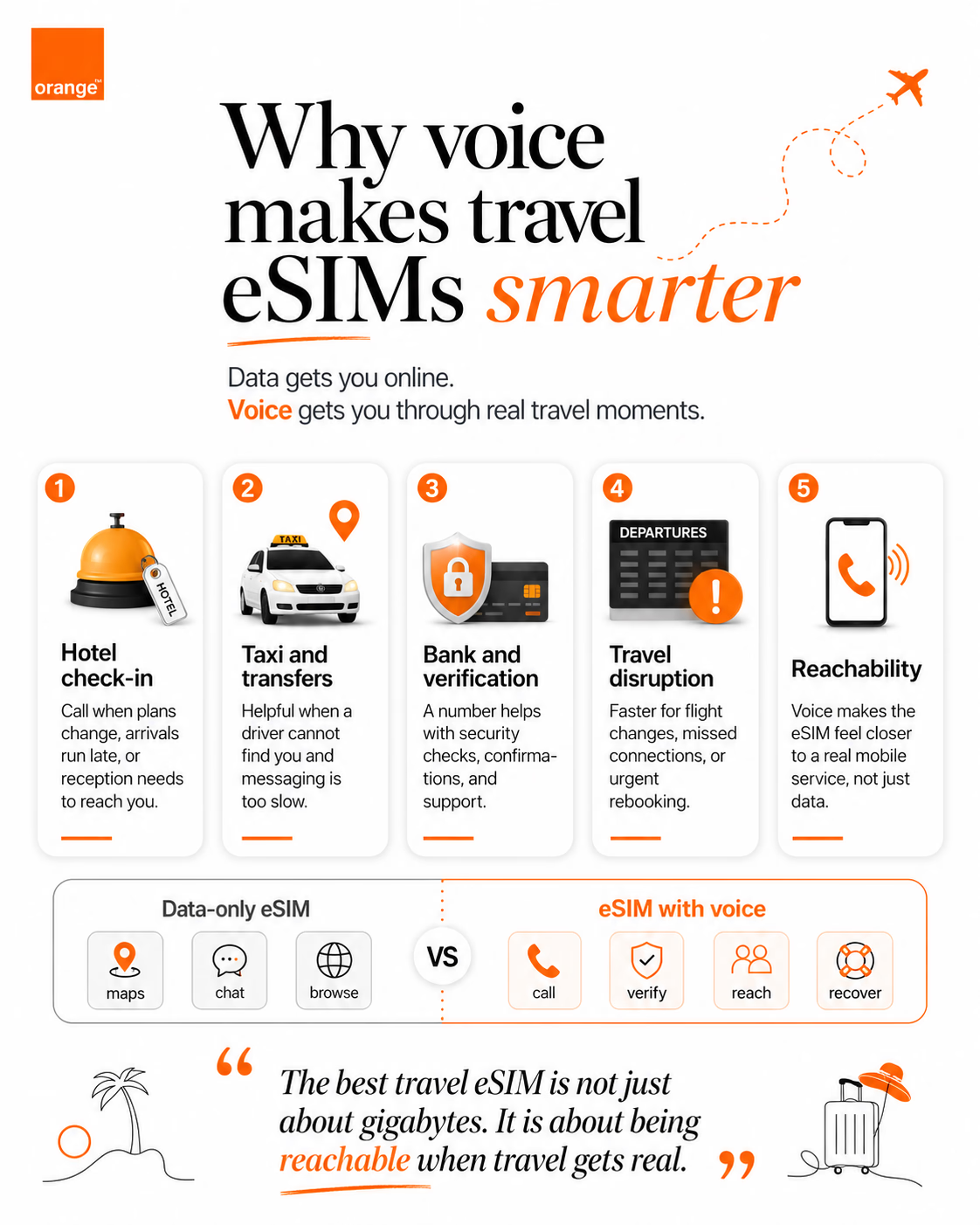
A traveller lands in Italy and needs a verification SMS from the bank before making a payment.
A hotel in Spain calls to confirm a late check-in.
An Uber driver in Paris cannot find the passenger and tries calling instead of messaging.
A business traveller in London suddenly realizes their two-factor authentication depends on receiving a code through SMS.
None of these situations sounds dramatic individually. But together, they expose something the travel eSIM market has quietly overlooked: mobile connectivity is still not purely about data.
Voice and SMS remain deeply integrated into how digital systems work globally.
Especially in travel.
Europe exposes this faster than most regions
Interestingly, Europe has become one of the places where this issue appears most often.
Partly because cross-border movement is constant. Travellers move between countries quickly and interact with a wide mix of local services, transportation systems, hospitality platforms, banks, and apps.
But also because Europe’s telecom environment is unusually mature.
People expect seamlessness.
They expect their device to simply work across borders without friction. And when a missing phone number suddenly interrupts that experience, it feels surprisingly outdated.
This is one reason why some providers are beginning to rethink the purely data-first model.
READ MORE: Europe Is the Hardest Test for eSIMs — Most Quietly Fail It
Orange Travel, for example, continues offering plans that include calls and SMS alongside data, which increasingly feels less like a legacy telecom feature and more like a practical advantage for real-world travel.
That distinction matters.
Because the industry conversation around eSIMs has spent years focused on installation and pricing, while actual traveller pain points increasingly revolve around reliability, recovery, authentication, and usability during unpredictable situations.
The industry may have oversimplified connectivity
One of the most interesting things about the eSIM market right now is how aggressively it has simplified telecom.
In many ways, that simplification was necessary. Traditional roaming models were confusing, expensive, and full of friction.
But some parts of telecom complexity existed for a reason.
Phone numbers still act as identity layers across enormous parts of the digital economy:
- banking systems
- ride-hailing apps
- travel services
- government portals
- business communication
- authentication flows
And while messaging apps replaced many personal calls years ago, SMS quietly remained critical infrastructure in the background.
The irony is that travellers often notice this only when something goes wrong.
Not when everything works.
There are now two very different eSIM philosophies
The market is slowly dividing into two approaches.
|
Data-first model
App-first global eSIM platformsThese players optimize heavily around speed, simplicity and data access. ● Simplicity
● Fast onboarding
● Large destination lists
● Low pricing
● Data-centric usage
Works best for
Short trips and casual users who mainly need navigation, social media and light browsing. |
Full-service model
Telecom-backed connectivity modelsThese providers focus on reliability, stronger telecom functionality and a more complete travel experience. ● Stability
● Stronger network integration
● Voice and SMS support
● Broader telecom functionality
● Premium travel use cases
Works best for
Travellers who want something closer to a full mobile experience, not just a temporary data workaround. |
And that distinction is becoming more important as travellers become more dependent on digital services while abroad.
Why this matters more in 2026 than it did before
The eSIM industry is entering a different phase now.
The first phase was about adoption:
“Can people install an eSIM?”
The second phase became distribution:
“Can airlines, banks, and apps sell eSIMs easily?”
READ MORE: Why Orange Travel eSIM Feels Different Abroad
The next phase is clearly about experience quality.
And experience quality is not just network speed anymore.
It is:
- how quickly recovery works
- whether authentication succeeds
- whether hotspot behaves properly
- whether calls work when needed
- whether travellers feel fully connected or partially connected
That is a much more demanding standard.
And increasingly, it favors providers with deeper telecom infrastructure and broader service capabilities.
Conclusion about eSIM with phone number
The interesting shift happening in the travel eSIM market is that consumers are slowly rediscovering the difference between internet access and actual mobile connectivity.
For years, the industry treated those as interchangeable. They are not.
eSIM platforms succeeded because they made global data access incredibly accessible and easy to buy. That changed the travel connectivity industry permanently. But as adoption matures, the conversation is moving beyond “does it work?” and toward “does it fully replace my mobile experience?”
That is where voice and SMS quietly become relevant again.
Not because travellers suddenly want to make traditional phone calls all day, but because phone numbers remain deeply connected to identity, security, payments, and trust across digital systems worldwide.
Research from GSMA, Juniper Research, and telecom market analysts increasingly points toward a broader convergence between travel eSIM services and full-service mobile experiences. The providers likely to stand out long-term may not be the ones offering the cheapest gigabyte, but the ones reducing friction during the moments travellers least expect.
And surprisingly often, that friction begins with something as simple as not having a number when you suddenly need one.