
Why I Stopped Buying a New eSIM Every Trip?
For a long time, buying an eSIM before every trip felt like part of the travel routine. persistent eSIM
Book a flight. Check the hotel. Download the boarding pass. Search for “best eSIM for Spain,” “best eSIM for Turkey,” “best eSIM for Japan.” Compare three plans. Wonder if 5GB is enough. Buy one. Install it. Hope it activates when I land.
Then, a few weeks later, do the exact same thing again for another country.
It worked, mostly. And that is the strange part. The problem was not that travel eSIMs failed. The problem was that I was treating every trip like a completely new connectivity problem.
Different country. Different plan. Different QR code. Different expiry date. Different app. Same small anxiety.
At some point, I realized I was not really buying mobile data anymore. I was buying peace of mind, over and over again.
The airport moment
The shift happened at an airport, as these things often do.
I had just landed, switched off airplane mode, and watched my phone search for a network. Around me, people were doing the usual arrival dance: looking for airport Wi-Fi, opening WhatsApp, checking transfer messages, refreshing maps, trying to remember whether roaming was safe to turn on.
I opened my eSIM app and bought another short-term plan.
It was quick. It was simple. But it also felt oddly repetitive. I already had an eSIM installed. My phone already supported multiple digital profiles. The technology was built for remote provisioning and flexible mobile access. Yet I was still behaving like a traveler in the plastic SIM era, just with better packaging.
That was when the idea of a persistent eSIM started to make sense.
Not as a fancy telecom term. As a better travel habit.
What persistent really means
A persistent eSIM is not necessarily one plan that covers every possible travel scenario forever. That would be too neat, and travel is rarely neat.
It means keeping a reusable eSIM profile on your phone and adding data when needed, instead of deleting everything after each trip and starting from zero.
The difference sounds small, but it changes the behavior.
You stop thinking: “Which eSIM should I buy for this trip?”
You start thinking: “Which data layer do I need on the eSIM I already use?”
That matters for frequent travelers, business travelers, digital nomads, conference visitors, and anyone who crosses borders more than once or twice a year.
READ MORE: The Future Is Not Roaming vs eSIM. It Is Friction vs Frictionless
For occasional holidaymakers, a single country eSIM still makes sense. If you take one summer trip to Greece and do not travel again for months, there is nothing wrong with buying a simple prepaid package and forgetting about it.
But if you travel often, the old one-trip-one-eSIM model becomes messy. Not impossible. Just inefficient.
The real value is less friction
Most travelers compare eSIMs on price first. That is understandable. Nobody wants to overpay for data.
But after using travel eSIMs repeatedly, I think the more important comparison is friction.
How fast can I reconnect?
Can I top up without reinstalling?
Do I trust the app?
Can I see usage clearly?
Does the eSIM profile stay useful after the first trip?
Can I keep a familiar setup across countries?
This is where the market is quietly changing.
Providers such as Airalo, Ubigi, Nomad eSIM, Yesim, GigSky, Saily, and others are no longer just selling “a data plan for Italy” or “5GB for Europe.” They are trying to become the traveler’s ongoing connectivity layer.
Some do this through regional and global plans. Some through top-ups. Some through annual or recurring options. Some through business portals, APIs, or multi-user management. The direction is clear: travel connectivity is moving from a one-off purchase to a relationship.
That is a big shift.
Because when a user keeps the same eSIM app installed and returns to it before every trip, the provider is no longer just a vendor. It becomes infrastructure.
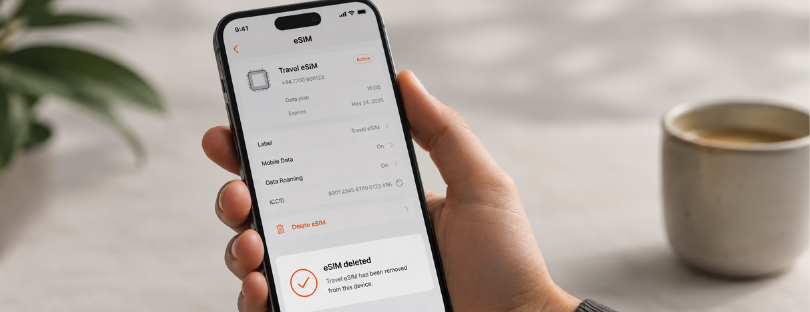
Why I stopped deleting eSIMs
The old way made my phone feel cluttered. I had expired plans, forgotten labels, and profiles I was not sure I could safely remove.
Now I keep fewer eSIM profiles and treat them more deliberately.
One can be my go-to travel data option. Another might be for a specific region I visit often. A third may be useful for work trips where reliability matters more than the lowest price per GB.
It is not about collecting eSIMs. It is about reducing decisions.
That is where persistent eSIMs become especially powerful. The best travel technology does not make you feel like you are using technology. It removes one boring decision at the right moment.
And connectivity is full of boring decisions.
Should I buy 3GB or 10GB?
Will the plan start when I install it or when I connect?
Is tethering allowed?
Does this country block certain apps?
Will my banking app send SMS verification to my main number?
Can I keep my home SIM active for calls while using travel data?
A persistent eSIM does not solve all of this. But it gives you a more stable base.
Who should still buy trip-by-trip
There are still good reasons to buy a new eSIM for a specific trip.
If you are going to one country and need the cheapest local data, a destination-specific plan may beat a broader reusable setup. If you need huge data for a short time, an unlimited day pass can be smarter than topping up a smaller persistent plan. If you travel to countries with unusual network rules, local restrictions, or patchy provider coverage, it is still worth comparing options before buying.
READ MORE: Operators Wake Up as Travel eSIMs Change Roaming
The persistent eSIM idea is strongest when convenience, trust, and repeat use matter more than squeezing out the lowest possible price.
That is why it fits business travelers so well. It also fits people who travel spontaneously, visit multiple countries, or simply hate repeating the same setup process every time they fly.
What providers need to improve
The market is not perfect yet.
Too many providers still make it difficult to understand when validity starts. Some apps still bury important details such as hotspot support, throttling rules, network partners, and whether top-ups are available for the same installed profile. Some plans look reusable but are really just one-time packages with nicer branding.
This is where the next competition will happen.
READ MORE: eSIM-Only Phones Put Operators Under Pressure
Not just “who has the cheapest 10GB in Europe,” but who offers the clearest, most reliable, most reusable travel connectivity experience.
The winners will not be the brands with the longest country lists. They will be the brands that make travelers feel they do not have to think about connectivity every time they move.
The bigger shift
Stopping the habit of buying a new eSIM every trip changed how I think about travel connectivity.
The future is not simply eSIM versus roaming, or global plan versus local plan. It is disposable connectivity versus persistent connectivity.
Traditional roaming still has one advantage: it follows you automatically. Travel eSIMs won because they made data cheaper and more flexible. The next step is obvious. They need to become just as effortless as roaming, without bringing back roaming’s bill shock.
That is why persistent eSIMs matter.
They turn the eSIM from a trip accessory into a travel layer. Something you keep. Something you understand. Something you return to because it works.
And once travelers get used to that, buying a new eSIM every trip may start to feel a bit like printing boarding passes.
Still possible. Sometimes useful. But no longer the smartest default.