Nomad eSIM China: Smart Travel Data Guide
China is one of those destinations where mobile data is not a nice extra. It is the trip.
You need it for maps, translation, ride-hailing, train bookings, QR payments, restaurant menus, hotel addresses, WeChat messages, flight changes, and the small daily emergencies that only happen when you cannot load anything. That is why the search for Nomad eSIM China has become more than a simple “which plan is cheapest?” question. For many travelers, it is really a question of landing in China with less digital friction.
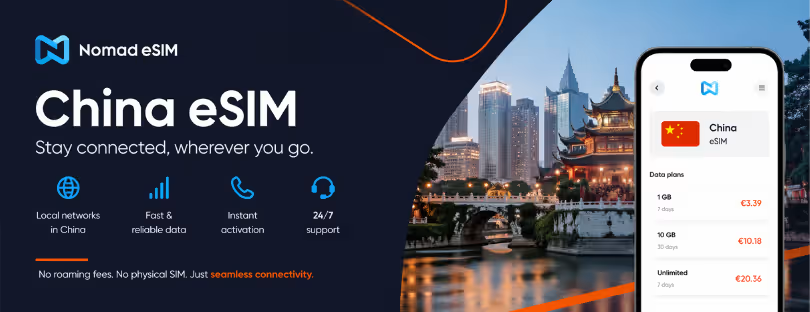
Nomad’s China eSIM offer sits right in that practical zone. It is prepaid, data-only, available before travel, and designed for tourists who do not want to queue for a physical SIM or gamble with expensive home-network roaming. On its China page, Nomad lists fixed data options from small 1 GB and 3 GB plans up to larger 20 GB and 50 GB packages, plus unlimited day-based options for short stays. The page also states that its China eSIM supports hotspot and tethering, which matters if you are using a laptop, tablet, or a second phone while moving between hotels, airports, and trains.
What Nomad gets right
The strongest part of Nomad’s China offer is not that it “has an eSIM.” Everyone says that now. The stronger point is the plan range.
China trips are not all the same. A three-day Shanghai business visit is not the same as a two-week Beijing, Xi’an, Chengdu, and Guangzhou route. A backpacker using maps and messages has different needs from someone working from hotel lobbies and uploading files. Nomad’s mix of fixed data and short unlimited plans gives travelers a few realistic choices instead of forcing everyone into one oversized package.
The pricing also looks competitive at the time of writing. Nomad’s China page shows examples such as 3 GB for 30 days, 10 GB for 30 days, 20 GB for 30 days, and 50 GB for 45 days, with some plans marked on sale. The exact prices may change, so travelers should check the live page before buying. But the structure is clear enough: light users can avoid overbuying, while heavier users can choose more generous data without turning the trip into a roaming-bill experiment.
READ MORE: Nomad eSIM Promo Code: What’s Actually Worth Using in 2026?
Another useful detail is network access. Nomad lists China Unicom and China Telecom as networks for its China eSIM, and says some China plans may connect to more than one local network. That matters because coverage quality in China can vary by city, indoor environment, train route, and even district. One network might be stronger in a hotel, another better on the move. It is not magic, but it gives the product a little more practical resilience.
The China factor
China is a special case in travel connectivity because access is not just about signal strength. It is also about app access, routing, and expectations.
Nomad includes user reviews on its China page mentioning successful use of apps such as WhatsApp, Google, Yahoo, Instagram, maps, and general internet access while in China. Those reviews are useful signals, not guarantees. Travelers should still be careful with expectations because service behavior can vary by plan, routing, device, location, and policy changes. But this is exactly why China eSIMs attract attention: travelers are not only buying data, they are buying a more workable travel internet experience.
There is also a wider market shift behind this. GSMA Intelligence noted in March 2026 that travel eSIM has become one of the successful consumer use cases for eSIM adoption, with 12% of international travelers across 11 surveyed countries using eSIM while abroad. It also pointed out that not all travel eSIM services are the same, which is probably the most important sentence in the whole debate. Price matters, yes. But routing, network partners, support, hotspot rules, throttling, and activation logic often matter more once you are already abroad.
What to check before buying
Do not buy a China eSIM only because the headline price looks good.
First, check whether your phone supports eSIM and is unlocked. This sounds obvious, but it is still where many failed installations start. Nomad’s FAQ also reminds users that the eSIM needs to be installed with an internet connection and that data roaming must be turned on for the eSIM line.
Second, look at validity. A cheap 1 GB plan may be fine for a layover or a cautious backup, but it will disappear quickly if you use translation, maps, social apps, and photo uploads all day. Nomad’s own user example on the page mentions using around 1 GB per day without heavy video streaming, which feels realistic for an active traveler in China.
Third, check the unlimited plan details. “Unlimited” in travel eSIM usually does not mean endless full-speed data forever. Nomad notes that some daily high-speed data plans continue at a throttled speed of 512 kbps after the daily high-speed allowance is used, with the high-speed allowance resetting every 24 hours. That is not necessarily bad, but it should be understood before buying.
Nomad eSIM China Plans
Standard data plans for predictable use, unlimited plans for heavier travel days.
Standard Plans
|
Unlimited Plans
Prices may change. Check the live Nomad page before purchase. |
How Nomad compares
Nomad is not alone in China. Airalo, Holafly, Saily, Ubigi, GigSky, and several regional Asia-focused providers all compete for the same traveler. The difference is in how they package the problem.
Airalo is often strong on simple fixed-data plans and global brand recognition. Holafly tends to appeal to travelers who want unlimited-style simplicity, although fair usage conditions still need attention. Saily leans into a privacy and security-friendly positioning, helped by its NordVPN connection. Ubigi often performs well where Transatel’s network and automotive/enterprise roots give it a more infrastructure-heavy feel. GigSky is another long-running travel connectivity player, especially visible among frequent travelers.
READ MORE: Nomad eSIM App Explained: Plans, Setup and Travel Use
Nomad’s advantage in China is that it feels balanced. Not the loudest “unlimited” promise. Not the most complicated enterprise-style product. Not the cheapest-looking plan at every data tier. But it gives a clean middle ground: prepaid, flexible plan sizes, hotspot support, regional options including APAC and China-Japan-Korea plans, and enough data range for both tourists and business travelers.
China’s domestic eSIM landscape is also changing. Reuters reported in October 2025 that China’s three major telecom operators had been cleared to provide trial eSIM services for iPhone Air, a sign that eSIM is becoming more visible inside China itself. For inbound travelers, however, travel eSIMs still solve a different problem: quick, short-term connectivity without needing a local mobile contract or physical SIM process.
Final take
Nomad’s China eSIM is a strong option for travelers who want a practical, low-friction way to arrive connected. It is especially sensible for people visiting major cities, moving between several stops, or needing hotspot support without relying on hotel Wi-Fi.
But the bigger story is not Nomad alone. China shows where the travel eSIM market is going. The winner is no longer simply the provider with the lowest price per gigabyte. The real winner is the one that reduces uncertainty: clear activation, realistic data rules, reliable routing, usable apps, support when something breaks, and plans that match how people actually travel.
Nomad does not need to shout to be relevant here. For China, that may be exactly the point.