Kazakhstan to use own international calling code 997
Kazakhstan’s plan to move away from the shared +7 international calling code was never just a technical numbering update. It was a small telecom story with a much bigger signal behind it: national digital identity, numbering independence, and the quiet politics of how countries are seen in global communications.
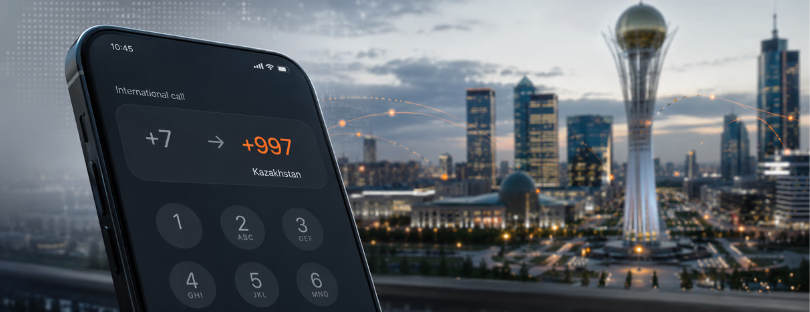
Back in 2021, Kazakhstan announced that it had reserved +997 with the ITU Telecommunication Standardization Sector, the body responsible for international numbering coordination under the E.164 system. The plan was simple on paper: Kazakhstan would begin shifting from +7, the code it shares with Russia, to its own dedicated international country calling code from January 2023. The old and new codes would then work in parallel for two years, with a full transition expected by 2025.
For anyone outside telecom, that may sound like a minor administrative change. It is not. Country codes sit at the very front of international identity. They affect routing, billing, numbering plans, operator coordination, business systems, fraud controls, databases, and the way a country appears on phones, platforms, and enterprise communication tools.
More than a number
At the time, Bagdat Mussin, then Kazakhstan’s Minister of Digital Development, Innovations and Aerospace Industry, framed the move as both practical and symbolic.
“It’s symbolic that by the 30th anniversary of Kazakhstan’s Independence, the Ministry has reserved a new calling code. Before we shared the same code with Russia, but now if you call abroad, ‘Kazakhstan’ will be written on the screen. A complete shift to +997 will allow us to independently allocate the national numbering resource and expand the national system by number of subscribers and services,” Mussin wrote on Facebook.
That sentence captures why the story mattered. A country calling code is not only about making calls. It is part of the national telecom architecture. It helps define who controls numbering resources, how future services are allocated, and how clearly a country is represented in global communications infrastructure.
Kazakhstan currently operates within the +7 numbering zone, historically shared with Russia after the breakup of the Soviet Union. Under that arrangement, Kazakhstan uses specific number ranges within the +7 structure, including mobile and fixed-line numbering blocks. ITU documentation from 2022 still listed Kazakhstan’s country code as +7, with an 11-digit international number format.

The switch that did not happen
The original timetable suggested a transition beginning in 2023 and finishing in 2025. But the shift proved more complicated than the announcement made it sound.
By 2024, Kazakhstan had decided to continue using +7, with local reports noting that the move to +997 had been abandoned or delayed because of technical and financial complications. Kazakhstan’s reserved +997 code has not disappeared, but it has not replaced +7 in daily use.
This matters because telecom numbering transitions are rarely clean. Changing a country code touches mobile operators, fixed networks, emergency systems, banks, government services, roaming partners, international carriers, contact databases, call-routing systems, and customer behaviour. Even when the national case is strong, the operational burden can be heavy.
There is also a coordination layer. Since +7 is shared, Kazakhstan’s withdrawal from that numbering zone required discussion with Russian communications authorities and alignment with ITU procedures. That makes this more complex than simply “choosing” a new number.
Why Alertify readers should care
For travel and telecom markets, Kazakhstan’s calling code story is a useful reminder: connectivity identity is becoming more strategic.
We usually talk about eSIMs, roaming, mobile data, and digital travel tools from the user side. Can I connect when I land? How much will it cost? Will my phone work? But underneath that experience sits a stack of numbering plans, roaming agreements, operator databases, routing tables, and international standards.
Kazakhstan’s +997 plan shows how national telecom systems are being rethought in the same era that eSIM adoption, satellite connectivity, digital identity, and cross-border mobile services are accelerating. Countries want more control over their digital infrastructure. Operators want smoother numbering and routing frameworks. Travellers and businesses simply want everything to work without thinking about it.
Other markets have made similar identity-driven telecom moves over time, particularly after political changes, independence, or regional restructuring. But Kazakhstan’s case is especially interesting because the country already had a functioning system under +7. The question was not whether phones worked. The question was whether the numbering identity still fit the country’s long-term digital ambitions.
The real signal
Kazakhstan’s move toward +997 was a statement of independence in telecom form. The decision to remain on +7, at least for now, is a reminder that telecom sovereignty has to survive contact with real infrastructure.
That is the bigger lesson. In connectivity, symbols matter, but systems matter more. A country code can carry national identity, political meaning, and digital ambition, but it also has to work across every operator, platform, database, and device that touches international calling.
For now, Kazakhstan remains reachable through +7. The reserved +997 code still tells us where the country once wanted to go, and perhaps where it may go again. But the story is no longer just “Kazakhstan gets a new code.” It is more interesting than that: Kazakhstan tested the cost of telecom independence and chose continuity, at least until the infrastructure case becomes stronger.