What International Direct Dialing Really Is (and Why It Still Matters)
If you’ve ever typed a number starting with “+” and hit call while abroad, you’ve used international direct dialing. You probably didn’t think about it. And that’s exactly the point.
International Direct Dialing, or IDD, is one of those invisible layers of telecom that quietly shaped global communication long before eSIMs, WhatsApp, or cloud APIs entered the picture. It’s still there. Still working. Just… no longer in the spotlight.
Let’s unpack it properly, because understanding IDD actually explains a lot about where connectivity is heading next.
The Original Global Connector
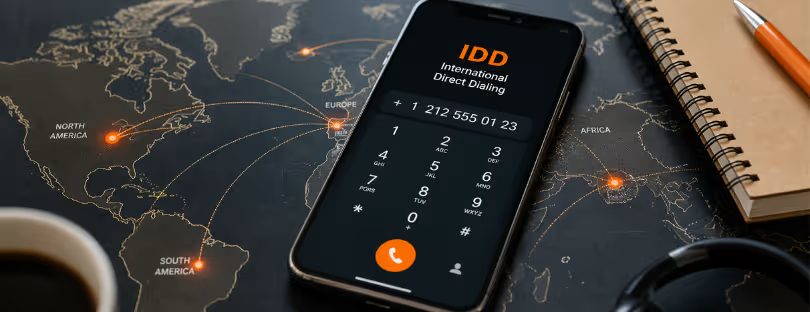
International direct dialing is exactly what it sounds like. It allows you to call a number in another country without going through an operator, by dialing a specific sequence: international prefix, country code, and the number itself.
That structure hasn’t changed much since the system was standardized by the International Telecommunication Union. The ITU created a global numbering framework so calls could be routed across borders consistently, introducing country codes and the now-familiar “+” format.
In practice, it looks like this:
+385 → Croatia
+44 → UK
+1 → US
Behind that simple input sits a surprisingly complex routing system. Your call travels through international gateways, switches networks, and lands in another country’s telecom infrastructure within seconds.
At the time, this was revolutionary.
Before IDD, international calls required operator assistance. You literally had to ask someone to connect you. IDD removed that friction and made global communication scalable.
For businesses, it was transformative. For consumers, it felt like magic.
The Cost Problem Nobody Liked
But IDD came with one big issue. Pricing.
Traditional international calls were built on a per-minute cost model, tied to infrastructure, routing agreements, and termination fees between telecom operators. That made them expensive. Often unpredictably expensive.
If you’ve ever seen a €3-per-minute roaming charge, you’ve experienced the legacy of this model.
Operators justified it with network complexity and infrastructure costs. And to be fair, routing a call from Zagreb to Sydney in the 1990s wasn’t trivial.
Still, from a user perspective, it created a simple behavior:
People avoided calling internationally unless they had to.
That behavior still shapes how we use connectivity today.
Enter VoIP, OTT, and the Quiet Collapse of IDD
IDD didn’t disappear. It got outcompeted.
The real shift started with Voice over IP. Instead of routing calls through traditional telecom networks, VoIP sends voice data over the internet. That changes everything about cost and scalability.
Suddenly:
International calls could be bundled or free
Infrastructure became software-driven
Marginal cost dropped close to zero
This is where apps like WhatsApp, Skype, and FaceTime took over. They didn’t “replace” IDD technically, but they replaced it behaviorally.
And the numbers reflect it.
Global IDD traffic has been steadily declining as users shift to internet-based communication.
But here’s where it gets interesting.
IDD Didn’t Die. It Moved Down the Stack
Despite all the noise around OTT apps, IDD is still deeply embedded in telecom infrastructure.
It’s just no longer a consumer-facing product.
Today, IDD is used in:
Enterprise voice systems
Call centers
Carrier-to-carrier routing
Backup communication layers
Even many VoIP services still rely on traditional networks at some point, especially when connecting to standard phone numbers.
So while you might not consciously “use IDD,” your call probably touches it somewhere along the way.
It became infrastructure.
Invisible, but essential.
The eSIM Layer Changes the Game Again
Now we’re seeing another shift, and this is where it gets relevant for Alertify readers.
Those principles still underpin everything we’re building today, from eSIM ecosystems to embedded connectivity in fintech and travel platforms.
The difference is how it’s packaged.
Conclusion
International direct dialing didn’t disappear. It got absorbed into a bigger system.
Compared to modern alternatives like VoIP apps or eSIM-based calling, IDD looks rigid and expensive. And in many consumer scenarios, it is. OTT players and data-first models clearly dominate everyday communication, supported by research from telecom analysts and organizations like the ITU showing the long-term shift toward IP-based traffic.
But IDD still wins on one thing no newer solution has fully replaced: universal reliability.
You can land in almost any country, dial a number, and it works. No app. No login. No ecosystem lock-in.
That matters more than we admit.
What’s changing now is not the existence of IDD, but its role. It’s becoming the fallback layer, the infrastructure safety net beneath more flexible, software-driven communication models.
And this is where the market is quietly heading.
The winners won’t be the ones replacing IDD outright. They’ll be the ones who know when to use it, when to bypass it, and how to combine it with data, identity, and APIs into something users don’t have to think about at all.
Because in the end, the best connectivity layer is the one you don’t notice.
Driven by wanderlust and a passion for tech, Sandra is the creative force behind Alertify. Love for exploration and discovery is what sparked the idea for Alertify, a product that likely combines Sandra’s technological expertise with the desire to simplify or enhance travel experiences in some way.