From Stadium to Tour: eSIM’s Role in Global Sports
There’s a quiet shift happening in sport that doesn’t get broadcast, doesn’t have sponsors on jerseys, and yet shapes almost everything behind the scenes.
Connectivity.
Not just Wi-Fi in stadiums. Not just broadcast rights. I’m talking about the invisible infrastructure that keeps athletes, teams, media crews, and fans online across borders. And increasingly, that layer is being rewritten by eSIM.
If you follow how modern sport actually operates, not just how it’s consumed, you start to see it everywhere.
Athletes don’t stay in one country anymore
Professional sport today is hyper-mobile. A tennis player might be in Madrid this week, Rome next, Paris after that. A footballer goes from domestic league to international duty. Even mid-tier athletes now travel more than most executives.
The old model—buy a SIM card at the airport, deal with roaming, or just suffer through bad connectivity—doesn’t scale anymore.
That’s why eSIM quietly became a tool athletes rely on. Not because it’s trendy, but because it solves a very real operational problem.
Training apps, recovery tracking, video analysis, team communication… all of it runs on data. And that data needs to work instantly, wherever the athlete lands.
You don’t get a second chance to upload footage, join a call, or sync performance data before a match. Connectivity is now part of preparation.
And this is where the model matters. Most eSIM providers still sell “destination-based” packages. One country, one plan, one expiry.
That’s fine for a tourist.
It’s not fine for someone moving across four countries in ten days.

The fan is now part of the live experience
Now flip the perspective.
Fans used to watch. Now they participate.
They stream matches on the move. Post reactions in real time. Check stats mid-game. Upload content from the stadium. Coordinate travel across cities.
Sport is no longer just a live event. It’s a continuous digital layer.
And that layer breaks the moment connectivity fails.
That’s why eSIM adoption among traveling fans is growing. It removes the friction: no SIM swapping, no hunting for local operators, no bill shock from roaming.
But more interestingly, it changes behavior.
Fans now travel more spontaneously. Follow tournaments across borders. Stay connected to communities globally. What used to be a localized experience becomes a distributed one.
You’re not just at the match. You’re in a global conversation around it.
Esports makes this even more obvious
If traditional sport hinted at the importance of connectivity, esports made it brutally clear.
There is no offline version of esports.
Players compete, stream, and communicate in real time. Teams operate across regions. Bootcamps, tournaments, scrims—everything depends on stable, high-speed connections.
Even small disruptions matter.
Latency, packet loss, unstable routing… these aren’t inconveniences. They directly impact performance.
That’s why eSIM is becoming part of the toolkit here, too. It allows players and teams to switch networks, optimize connectivity, and avoid expensive or unreliable roaming setups.
And again, the pattern repeats: mobility + data dependency = demand for flexible connectivity.
Events are becoming connectivity ecosystems
Look at how major sports events are evolving.
It’s no longer just the match. It’s content creators, influencers, media teams, sponsors, and fans all producing and consuming content simultaneously.
At events like international football tournaments or niche events like Footvolley Curaçao, connectivity isn’t a utility anymore. It’s part of the experience itself.
Players share moments instantly. Creators upload content on the spot. Fans navigate, book, and engage in real time.
What used to happen after the game now happens during it.
And that creates a new expectation: seamless, borderless connectivity.
Not “good enough Wi-Fi.” Not “maybe roaming works.”
Just… it works.

Where Fairplay fits into this
This is where things get more interesting.
Because most eSIM providers are still stuck in a travel mindset.
Buy a plan. Use it. Expire. Repeat.
That logic doesn’t match how sport actually works today.
Fairplay’s model is trying to align more closely with that reality.
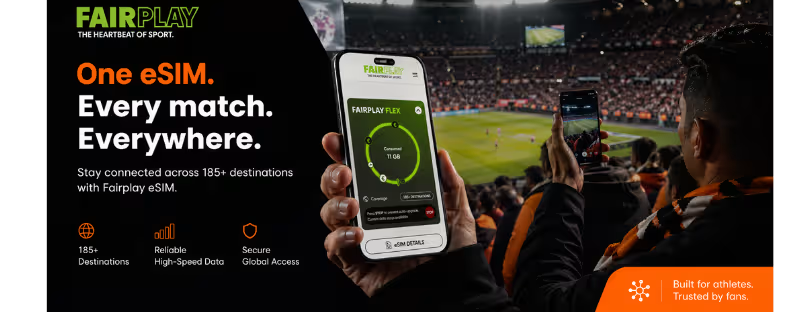
One eSIM. 185+ destinations. A single balance. A subscription structure that doesn’t reset every time you cross a border.
And most importantly, a predictable cost ceiling.
For someone moving between tournaments, or a fan doing a multi-city sports trip, that changes the equation.
Instead of constantly optimizing for the cheapest country plan, you optimize for continuity.
It’s a subtle shift, but it matters.
Especially when you consider how fragmented the current market still is.
The market is starting to move, but slowly
If you zoom out, you’ll see the industry beginning to react.
Operators and providers are pushing into sports partnerships. Vodafone, for example, has already explored travel eSIM integrations with football ecosystems to enhance fan connectivity.
At the same time, major players are expanding global plans, subscriptions, and enterprise offerings. Even newer models are experimenting with balance-based usage instead of fixed bundles.
But here’s the thing.
Most of these are still variations of the same idea: connectivity as a product.
What sport actually needs is connectivity as infrastructure.
Always-on. Borderless. Predictable.
Where is this going next?
If you follow the logic, sport is just the beginning.
It’s one of the most extreme use cases for mobility and connectivity. High movement, high data usage, high stakes.
That makes it a perfect testing ground.
What works for athletes and traveling fans will eventually become standard for everyone else.
And we’re already seeing early signs of that shift:
- Subscription-based connectivity replacing one-off purchases
- Single eSIM profiles replacing multiple country installs
- Balance-based or capped models replacing unpredictable roaming
- Integration into platforms (teams, events, partners) rather than standalone apps
Sport just exposes the gaps faster.
Conclusion
The relationship between eSIM and sport isn’t accidental. It’s structural.
Modern sport is global, mobile, and data-heavy. eSIM is one of the first connectivity models that actually matches that reality.
But the market is still in transition.
Some players built scale through simplicity and distribution; others leaned into “unlimited” messaging; third ones, eSIM providers expanded into enterprise and global coverage… All of them are pushing the category forward.
Yet most are still optimized for short-term travel behavior.
Fairplay is part of a smaller group trying something different: aligning pricing and structure with how people actually move across borders, especially heavy users like athletes, media teams, and dedicated fans.
And that distinction matters.
Because the next phase of this market won’t be about who sells the cheapest gigabyte.
It will be about who understands movement.
Sport just happens to be where that truth is hardest to ignore.