eSIM Claims vs Reality: What You Should Check First
There is a certain confidence that defines the eSIM market today.
Spend a few minutes reviewing different providers, and you will notice it immediately. The language is polished, the promises are clean, and the positioning is remarkably consistent. Global coverage, seamless connectivity, no restrictions, better value.
At first glance, it feels like a competitive market. In reality, it often feels like the same product described in slightly different ways.
That is not accidental.
It reflects a deeper truth about how most global eSIM products are built, and why understanding the difference between them requires looking well beyond the surface.
Most Products Are Assembled, Not Engineered End-to-End
What rarely gets discussed openly is that many eSIM providers do not control the full connectivity stack.
Instead, they operate within an ecosystem of wholesale agreements, multi-network partnerships, and infrastructure layers that are shared across the industry. Access is purchased, bundled, and redistributed under different brands, each adding its own pricing model, user experience, and positioning.
This does not make the product inferior. It simply means that differentiation is rarely happens at the network level.
It happens in how the product is structured, how traffic is managed, and how transparently those decisions are communicated.
That distinction is critical, because two providers can appear nearly identical while delivering meaningfully different real-world performance.
The Language of “Unlimited” and “Unrestricted” Deserves Scrutiny
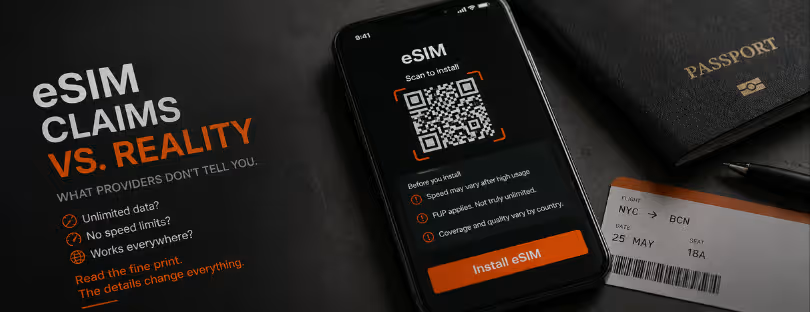
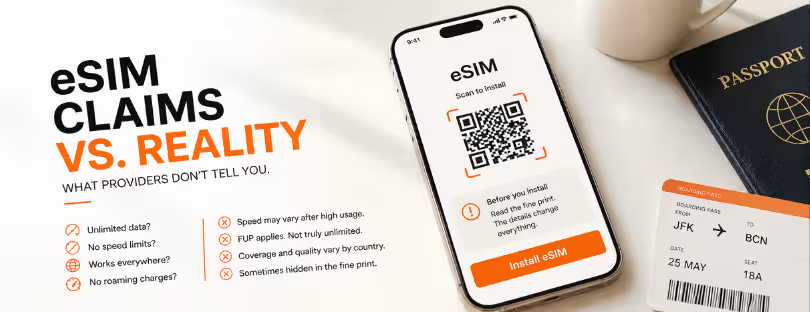
Few terms are used more confidently, or more loosely, than “unlimited.”
From a technical perspective, mobile networks are never truly unlimited. Capacity is finite, prioritization exists, and usage patterns are constantly managed to maintain stability across the network.
What changes is how those constraints are applied and communicated.
In some cases, limits are explicit. In others, they are embedded in fair usage policies, network prioritization rules, or dynamic speed adjustments that only become visible under sustained usage.
As a result, the absence of a visible cap does not necessarily mean the absence of limitations. It often means the limitations are handled differently.
Understanding that distinction is far more useful than relying on the label itself.
Global Coverage Solves One Problem While Introducing Another
The promise of a single eSIM that works across 190 or more countries is undeniably compelling. It removes friction, simplifies travel, and eliminates the need to manage multiple local solutions.
However, this convenience is achieved through aggregation.
Multiple operators, multiple agreements, and multiple routing strategies are brought together into a single product experience. While this enables broad coverage, it also introduces variability that cannot be fully standardized.
Network quality differs by country.
Routing decisions impact latency and speed.
Local conditions influence performance in ways that no global provider can fully control.
Coverage, in this context, is a measure of availability. It is not a guarantee of consistency.
Speed Is an Outcome, Not a Feature
Claims around speed are often presented as if they are a fixed attribute of the product. In practice, speed is the result of several interdependent factors.
The local network you connect to, the agreements behind that connection, the routing path your data takes, and the level of congestion at any given moment all play a role in determining performance.
Even within the same country, the experience can vary depending on location and network conditions.
This does not invalidate claims of fast connectivity, but it does place them in the proper context. Speed is not something a provider can universally guarantee. It is something they can influence to varying degrees.
Pricing Models Often Reveal More Than Marketing Does
One of the clearest indicators of how a product actually works is its pricing structure.
Pay-as-you-go wallets, per-gigabyte billing, regional bundles, and so-called unlimited plans all reflect different assumptions about usage and cost control. When these models are combined with broad claims such as “no limits” or “unrestricted data,” it is worth examining how those ideas align.
If usage is metered, then cost scales with consumption.
If cost is capped, then some form of control is applied to usage.
These are not contradictions. They are design choices. But they should be understood as such, rather than interpreted purely through marketing language.

The Real Differentiation Lives Below the Interface
At a certain level, most eSIM products begin to look similar. Installation is straightforward, activation is fast, and the user interface is designed to reduce friction.
What differentiates them is not what is visible during setup, but what happens afterward.
How traffic is routed.
How networks are selected and switched.
How performance is maintained under load.
How transparently limitations are communicated.
These are not features that can be easily summarized in a headline, but they are the factors that shape the actual experience.
Why Confident Claims Dominate the Market
In a space where underlying structures are often similar, positioning becomes a primary tool for differentiation.
Highlighting the limitations of others while presenting a simplified alternative is an effective strategy. It creates contrast, builds confidence, and reduces the perceived complexity of the decision.
However, without supporting detail, it remains a narrative.
And in a technical product category, narrative alone is not a reliable indicator of quality.
What You Should Actually Evaluate
A more reliable approach is to shift focus away from claims and toward behavior.
How does the product perform under sustained usage?
How predictable are costs across different regions?
How clearly are network relationships and limitations explained?
How does the provider handle variability rather than avoid discussing it?
These questions are less convenient than reading a feature list, but they lead to a much clearer understanding of what you are actually using.
Where the Market Is Heading
Connectivity is increasingly being integrated into broader digital experiences. It is no longer a standalone product purchased in isolation, but a component embedded within travel platforms, financial services, and digital ecosystems.
As that shift continues, expectations will change.
Consistency will matter more than coverage.
Transparency will matter more than simplicity.
And infrastructure decisions will become more visible through the experiences they shape.
What to look for in an eSIM provider – Final Thoughts
In a market where every provider claims to offer the same outcome, the most meaningful differences are found in the details that are least prominently displayed.
Understanding those details does not require deep technical expertise, but it does require a willingness to look beyond the headline.
Because in connectivity, what is explained clearly is often more valuable than what is promised confidently.