Hotels Risk Losing Bookings in the Age of AI Search
There’s a quiet shift happening in how travelers discover hotels. It’s not loud, and it’s not yet fully visible in booking numbers. But it’s already changing who gets considered and who gets ignored. AI hotel search visibility
According to Access Hospitality, hotels are at real risk of losing visibility as search behavior moves away from traditional engines and into AI-driven platforms.
This isn’t about the future. It’s already happening.
Data from Deloitte’s 2026 Travel Industry Outlook shows that nearly a quarter of travelers used generative AI tools for trip planning in late 2025. That’s a threefold jump from just a few years earlier. Not incremental growth. A structural shift.
And importantly, this behavior is concentrated where it matters most: the beginning of the journey.
Where Discovery Is Now Happening
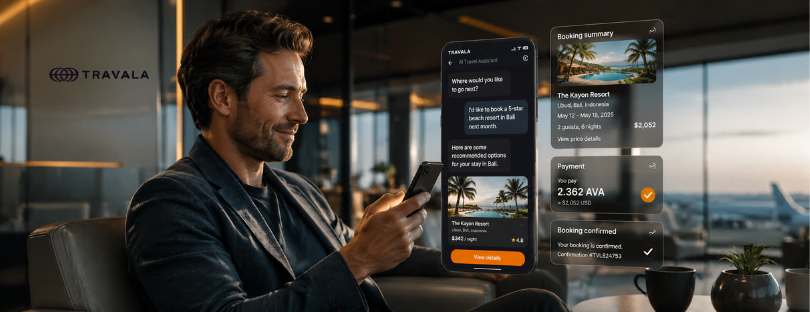
Travel used to start with Google. Now, it increasingly starts with a prompt.
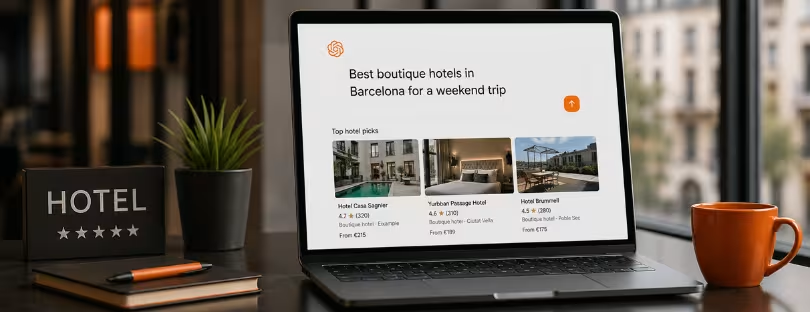
“Best boutique hotels in Lisbon with rooftop views.”
“What’s a good hotel near central Tokyo for remote work?”
That shift sounds small, but it changes everything.
Data from SimilarWeb’s Gen AI Brand Visibility Index makes this clear. Around 35% of consumers now find AI tools most useful for discovering and generating ideas. Traditional search engines? Just 13.6%.
Even during evaluation, AI is catching up fast. About 32.9% of users rely on AI tools compared to 15% for search engines.
That means by the time a traveler opens a booking site, they often already have a shortlist. And if your hotel wasn’t surfaced by AI, you were never in the running.
The Visibility Gap Most Hotels Don’t See
Access Hospitality’s research, conducted across 1,000 hospitality businesses and 8,000 consumers, points to a growing disconnect.
On one side, 57% of consumers say technology has improved their travel experience. On the other hand, only 34% of businesses expect AI to meaningfully improve decision-making.
That gap matters.
Because visibility is no longer just about ranking. It’s about being included in the answer.
“Hotels that focus only on traditional search risk becoming invisible during key discovery moments. To stay competitive, hospitality brands need to ensure they are visible wherever travelers are searching for inspiration and recommendations. Search has the power to shape and create demand. To truly lead in hospitality, hotels need to create content that influences the way people frame their queries, whilst also responding to how travelers now search.”
said Nicola Longfield, Chief Commercial Officer, Global Accommodation & Payments at Access Hospitality.
This is the core issue. Most hotels are still optimizing for clicks. AI platforms are optimizing for answers.

Why SEO Alone Isn’t Enough Anymore
Traditional SEO still matters. But it’s no longer sufficient.
AI platforms don’t rank pages the same way search engines do. They prioritize clarity, structure, and contextual relevance. They synthesize information rather than just list it.
That creates a different kind of competition.
Hotels are no longer just competing with other hotels. They’re competing with how clearly their offering can be understood and surfaced by AI.
If your property description is vague, inconsistent, or buried across different platforms, AI won’t piece it together for you. It will simply move on to another option that is easier to interpret.
And that’s the uncomfortable reality. Visibility is no longer just earned. It’s structured.
What Actually Needs to Change
The response from Access Hospitality is pragmatic, but it points in the right direction.
Hotels need to move beyond a single-channel mindset and treat visibility as an ecosystem.
That starts with the basics, but executed properly:
- Complete and consistent listings across platforms
- Clear articulation of amenities, experiences, and differentiators
- Alignment across OTAs, directories, and official tourism sites
- Structured data that AI systems can easily interpret
- Reviews that go beyond generic praise and mention specific features
This might sound operational. But it’s strategic.
Because AI doesn’t “discover” your hotel. It assembles an answer based on what it understands about you.
If that understanding is fragmented, you lose.

The Bigger Industry Pattern
What’s happening in hospitality isn’t unique.
We’re seeing the same shift across travel, fintech, and retail. Discovery is moving upstream, into AI-driven environments where decisions are shaped before platforms even come into play.
Look at how companies like Booking.com and Expedia Group are investing in AI-driven trip planning. Or how Google is integrating generative AI directly into search experiences.
The direction is clear. The interface is changing.
And when the interface changes, distribution changes with it.
What This Means for Hotels Right Now
The risk isn’t that hotels will disappear from search.
The risk is that they’ll disappear from consideration.
If travelers rely on AI to generate options, and your hotel isn’t part of that output, you’re effectively invisible. No matter how strong your SEO is. No matter how competitive your pricing is.
That’s a different kind of problem. And it requires a different kind of response.
Hotels need to think less about ranking and more about representation. Less about keywords and more about how their property is understood across the digital ecosystem.
Because in an AI-first discovery model, clarity wins.
Conclusion: Visibility Is Becoming a System, Not a Channel
The hospitality industry has seen shifts before. OTAs changed distribution. Mobile changed booking behavior. Metasearch reshaped pricing competition.
AI is different.
It doesn’t just add another channel. It changes how decisions are formed.
What Access Hospitality is pointing to is not just a marketing adjustment. It’s a structural change in how demand is created.
And the brands that will win are not necessarily the ones with the biggest budgets or the best locations. They’re the ones who understand how to position themselves inside this new discovery layer.
Compare this with what we’re seeing in broader travel tech. Platforms are moving upstream. Decision-making is happening earlier. And the companies that control that early influence capture disproportionate value.
Reliable indicators from Deloitte and SimilarWeb confirm the direction. AI is not replacing search entirely. But it is redefining the moments that matter most.
For hotels, the implication is simple but uncomfortable.
If you’re not visible when the traveler is asking the first question, you won’t be part of the final decision.
And by then, it’s already too late.