Airlines Are Sitting on a Telecom Goldmine — Most Don’t Know It
Airlines have become exceptionally good at selling everything around the seat.
They’ve turned luggage into revenue. Seat selection into strategy. Even the boarding order is a monetized decision.
But there’s one layer of the travel experience they still treat as an afterthought. And it’s arguably more valuable than all of those combined.
Connectivity after landing.
Not the in-flight Wi-Fi headline. Not the roaming email buried somewhere post-booking.
Real, usable, immediate mobile data the moment a traveler steps off the plane.
That’s where the telecom goldmine sits. And most airlines are barely touching it.
The invisible gap that airlines still ignore
Here’s a simple observation that keeps repeating itself.
You board a plane with Wi-Fi access. You land in a new country. And within minutes, you’re disconnected again.
You’re looking for a signal, checking roaming settings, hunting for Wi-Fi, or hoping your phone bill won’t surprise you later.
From a user experience perspective, it’s broken.
From a business perspective, it’s a missed opportunity happening millions of times a day.
Airlines solved connectivity in the air, but left a gap on the ground. And that gap is exactly where the highest intent sits.
Because landing is when connectivity becomes urgent, not optional.
The demand is already there. Just not captured
This is not about creating demand. Travelers have already solved the problem on their own.
They buy local SIMs. They activate roaming. Increasingly, they download eSIMs.
The shift is happening fast. eSIM adoption is accelerating globally, driven by convenience, pricing transparency, and device compatibility. At the same time, roaming dissatisfaction hasn’t disappeared. If anything, it has become more visible as pricing inconsistencies continue across regions.
So the behavior is clear.
People are willing to pay for connectivity. They just don’t associate that purchase with airlines.
That’s the disconnect.
Airlines have something others don’t
The real advantage airlines have is not product. It’s timing and context.
They know where you’re going before you even think about connectivity.
They know:
- Your destination
- Your travel dates
- Your trip duration
- Your travel pattern
That level of insight is extremely rare.
Most eSIM providers operate reactively. Travelers search, compare, and buy when the need becomes obvious.
Airlines operate proactively. They sit at the moment before the need becomes urgent.
That difference alone should translate into higher conversion rates.
But only if used correctly.
The problem with how airlines think about ancillaries
Most airlines still treat ancillaries as static add-ons.
You get the same baggage option whether you’re flying for 24 hours or three weeks. The same meal upsell regardless of context. The same interface for completely different types of travelers.
That logic does not work for connectivity.
Connectivity is situational.
A business traveler landing in Singapore has completely different expectations from a tourist arriving in Barcelona. A digital nomad behaves differently from a weekend traveler.
Selling “an eSIM” as a generic add-on misses the point entirely.
The opportunity is not the product.
It’s the segmentation.

Vertical targeting changes the economics
This is where airlines are leaving serious money on the table.
Instead of offering one generic connectivity product, they could be offering:
- Short-trip data passes for weekend travelers
- Multi-country plans for long-haul routes
- High-speed data bundles for business travelers
- Always-on plans for frequent flyers
The difference might seem subtle, but commercially it’s not.
Targeted offers convert better. They feel relevant. They reduce decision friction.
And most importantly, they align with actual traveler behavior.
This is already standard in other verticals. Fintech apps personalize offers. Streaming platforms tailor subscriptions. Even airlines themselves segment seat pricing dynamically.
Connectivity should follow the same logic.
Why hasn’t this scaled yet
If the opportunity is so clear, why aren’t airlines already leading this space?
There are a few structural reasons.
First, telecom has historically been complicated. Integrating connectivity meant dealing with infrastructure, regulations, and support layers that most airlines were not equipped for.
That has changed.
Today, API-driven platforms allow companies to launch branded eSIM products without owning telecom infrastructure. The complexity is abstracted. The barrier is no longer technical.
Second, ownership inside airlines is unclear.
Connectivity doesn’t sit cleanly within one department. It touches digital, partnerships, ancillary revenue, and customer experience. Without a clear owner, it tends to get delayed.
Third, and more importantly, it’s a mindset issue.
Airlines are used to monetizing the flight.
eSIM monetizes the trip.
That shift requires thinking beyond traditional revenue windows.
Nobody is maximizing the loyalty play
There’s another angle here that most airlines haven’t fully explored.
eSIM is not just a revenue product. It’s a retention tool.
Loyalty programs have been struggling to stay relevant. Points are harder to redeem. Benefits feel distant. Engagement drops between trips.
Connectivity changes that.
It’s immediate. It’s useful. It’s used daily during travel.
Offering eSIM as part of a loyalty ecosystem does something most rewards don’t. It stays visible throughout the entire journey.
Instead of a one-time benefit, it becomes a continuous experience.
That has long-term implications for retention.
Your customers will buy connectivity. The question is: from you, or from someone else?
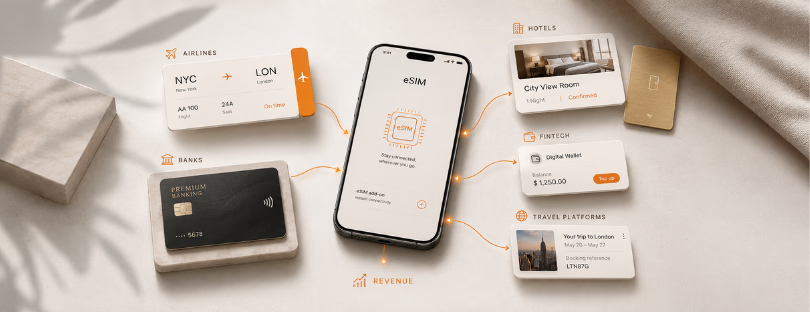
We help airlines, banks, and travel platforms turn that demand into a built-in product — not a missed opportunity.
What early movers are already doing differently
We’re starting to see signals from other industries.
Fintech apps are embedding connectivity into travel features. Travel platforms are experimenting with bundled services. eSIM providers are building distribution through partnerships instead of relying only on direct acquisition.
They all understand one thing.
Connectivity is not a standalone product anymore. It’s part of the broader experience layer.
Airlines, in theory, are in the best position to own that layer.
They already control the booking journey. They already have customer trust. They already operate at a global scale.
What they lack is execution.
The real shift is happening now
The market is moving away from reactive connectivity.
It’s moving toward embedded connectivity.
That means the decision happens earlier. The experience is integrated. The friction disappears.
And when that happens, the company that owns the journey usually captures the revenue.
Right now, that company is not the airline.
Conclusion: this is not an add-on, it’s infrastructure
Most airlines are still evaluating eSIM as just another ancillary.
That’s the mistake.
Because compared to traditional ancillaries, connectivity behaves differently in three critical ways:
It scales globally without operational overhead.
It extends beyond the flight into the traveler’s entire trip.
It becomes more valuable when personalized and targeted.
That combination is rare.
Other players in the market have already positioned themselves accordingly. Dedicated eSIM providers focus on direct acquisition. B2B platforms enable white-label distribution. Telecom enablers are building the infrastructure layer behind it all.
They are not treating connectivity as a feature. They are treating it as a system.
Airlines still have the strongest advantage of all: intent at scale.
But that advantage is time-sensitive.
Because the moment connectivity becomes fully embedded into travel platforms, fintech apps, or even device ecosystems, the airline’s role shrinks.
This is not about selling more add-ons.
It’s about deciding who owns connectivity in the travel experience.
Right now, that question is still open.
It won’t stay that way for long.