What Actually Separates eSIM Providers?
eSIM providers are no longer just a niche travel hack. They’ve quietly become one of the most competitive and strategically interesting layers in global connectivity.
What started as a workaround for roaming has turned into a full-blown market with its own economics, power dynamics, and emerging winners.
This is where things get interesting.
The eSIM provider landscape is getting crowded — fast
If you look at the market today, it’s no longer just a handful of apps. It’s an ecosystem.
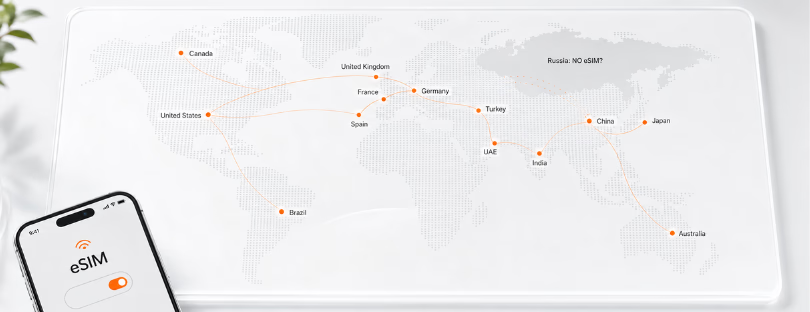
You have digital-first travel players like Airalo, Holafly, Nomad, and others offering app-based data plans across 200+ destinations.
Then you have telecom-backed or infrastructure-driven players like Vodafone, Orange, and Ubigi entering with their own versions of global connectivity.
And in between, a growing layer of platforms, APIs, and white-label providers enabling everyone else to sell eSIMs.
This fragmentation is not accidental.
It’s a signal.
Because the market itself is expanding at a pace that invites everyone in. The global eSIM market is expected to grow from $2.12 billion in 2026 to $7.62 billion by 2034.
Travel eSIM specifically is accelerating even faster, with projections reaching up to $1.85 billion by 2032 and growing at nearly 18% CAGR.
That kind of growth doesn’t just create competition.
It creates confusion.
Not all eSIM providers are playing the same game
On the surface, most providers look similar.
You download an app, buy a plan, and get connected.
But underneath, they are operating on very different models.
Consumer-first players
These are the names most travelers recognize.
Airalo
Built early distribution and brand awareness. Often, the first eSIM many users try has a strong global footprint and loyalty ecosystem.
Holafly
Focused heavily on unlimited plans. Simple positioning. Clear use case. But often comes with fair usage policies and pricing trade-offs.
Nomad and others
Somewhere in between. Offering both fixed and “unlimited” plans, often with speed caps or usage limits behind the scenes.
These players are optimized for:
- quick acquisition
- app-based onboarding
- short-term travel usage
But they are also the most exposed to price competition.

Infrastructure and platform players
This is where the real shift is happening.
Instead of just selling data to travelers, some providers are building:
- APIs
- white-label solutions
- enterprise connectivity layers
These companies don’t just want users.
They want distribution.
Because in this market, distribution is leverage.
Reports already highlight that eSIM providers are increasingly integrating with airlines, fintech apps, and travel platforms to reach users before they even think about connectivity.
That changes the entire game.
The real competition isn’t provider vs provider
Here’s the part most people still miss.
eSIM providers are not really competing with each other in the traditional sense.
They are competing for:
- where the user first encounters connectivity
- who controls the relationship
- who owns the margin
Because the product itself is becoming commoditized.
Unlimited data is no longer a differentiator. Pricing differences are shrinking. Coverage is broadly similar across major providers.
Even market reports point out increasing concentration and standardization, with a few key players dominating while others struggle to differentiate.
Which leads to a very specific pressure:
If you don’t control distribution, you compete on price.
And that’s not a good place to be.
 Growth is real, but so are the cracks

The numbers look strong.
Retail spending on travel eSIM is expected to reach $3.3 billion by 2025.
Device adoption is accelerating, with hundreds of millions of eSIM-enabled devices entering the market.
And usage is shifting from occasional travel to something closer to default behavior.
But underneath that growth, there are clear friction points:
- Many users still don’t fully understand how eSIM works
- Device compatibility is not universal
- “Unlimited” plans often come with hidden limitations
- The number of providers creates decision fatigue
These aren’t small issues.
They’re structural.
And they open the door for the next phase of the market.
eSIM is moving beyond travel — and that changes everything
One of the most overlooked shifts is where eSIM is going next.
It’s no longer just about tourists.
We’re seeing expansion into:
- enterprise mobility
- IoT and connected devices
- automotive (connected cars as mobile offices)
- embedded connectivity in apps and services
This matters because it changes who the “real” eSIM providers are.
In-car connectivity, for example, is already becoming a serious use case, with connected vehicles expected to dominate the market by 2030.
At that point, the idea of “buying an eSIM” disappears.
Connectivity becomes invisible.
And whoever controls that layer controls the value.
Why traditional telecom is still not winning
You would expect telecom operators to dominate this space.
They have the networks, the infrastructure, the customer base.
But they’re not leading.
Instead, digital-first eSIM providers are capturing demand by offering:
- simpler onboarding
- clearer pricing
- better UX
Meanwhile, telcos are reacting.
Some are launching their own travel eSIM products.
Others are partnering or enabling.
But the dynamic is clear.
eSIM is shifting power away from traditional operators toward:
- platforms
- aggregators
- and distribution partners
Even industry analysts suggest that operators risk being reduced to infrastructure providers if they don’t adapt.
That’s a big shift.
The bigger picture: eSIM providers are becoming connectivity platforms
If you zoom out, something more fundamental is happening.
eSIM providers are evolving from:
selling data → to managing connectivity
That includes:
- multi-country access
- seamless switching between networks
- integration with other travel services
- predictive and personalized plans
In other words, they are becoming platforms.
Not products.
And that’s where the real long-term value sits.
Conclusion
The eSIM provider market is entering its second phase, and it’s already splitting into two very different paths.
On one side, you have consumer-facing providers like Airalo, Holafly, and Nomad. They built the category, educated users, and scaled fast. But they are increasingly competing on price, packaging, and marketing.
On the other side, you have infrastructure and platform-driven players building APIs, enterprise layers, and embedded distribution. They are not fighting for the same customer in the same way. They are positioning themselves deeper in the stack, where margins and control are stronger.
This is exactly what we’ve seen in other industries.
First comes product differentiation.
Then comes commoditization.
Then comes platform control.
Right now, travel eSIM is moving from stage one to stage two.
And the early signs of stage three are already visible.
Market data supports this shift. Growth is strong across both consumer and enterprise segments, with projections showing sustained double-digit expansion and increasing integration into broader digital ecosystems.
At the same time, reports warn about saturation, consolidation, and the growing importance of distribution over pure product innovation.
So what does this mean in practice?
It means the winners won’t be the providers with the cheapest plans.
They’ll be the ones who:
- control where connectivity is discovered
- embed themselves into travel and digital platforms
- and turn eSIM from a purchase into a default layer
The real question is no longer:
“Which eSIM provider is best?”
It’s:
“Who owns the moment when connectivity becomes invisible?”
And that answer is still being written.