Why eSIM Providers Push You to Keep Their App
If you’ve used a travel eSIM lately, you’ve probably noticed something. travel esim apps
The provider really wants you to keep their app. Not just for activation. Not for troubleshooting. They want it on your phone long after the trip is over.
You buy a plan, land, connect, come home — and the nudges start.
“Your data plan expired.” “Top up for your next trip.” “Special offer for your destination.”
On the surface, standard product design. But behind it is something more revealing: the actual economics of the travel eSIM business. Once you understand those, the behavior makes complete sense.
The real product isn’t the first sale. It’s retention.
The First Sale Rarely Tells the Full Story
There’s a persistent assumption that selling mobile data is a high-margin business. It isn’t — at least not at the point of acquisition.
A typical plan sells for $10 to $20. But getting that customer to convert costs real money. Providers compete across:
- Paid search (Google, App Store), social, and influencer channels
- Affiliate networks, comparison sites, and travel content partnerships
- Brand campaigns and SEO programs that take months to pay off
By the time someone downloads an app and buys their first package, the provider may have spent at or above the transaction value to get them there. How far beyond depends on channel mix, market, and brand maturity — but the math frequently doesn’t favor the first purchase.
This isn’t unique to eSIM. Telecom has always been a high-CAC, high-churn industry. The playbook — acquire expensively, recoup through retention — has been standard for decades. Travel eSIM companies are running the same model, often without the infrastructure advantages of legacy operators.
The Installed App Is the Real Asset
Once the app is on the device, the economics shift.
Every subsequent purchase doesn’t require going back to Google Ads or paying another affiliate. The provider already has the channel — they just need to use it.
Push notifications carry near-zero marginal cost. In-app offers surface at zero marginal cost. Destination-aware prompts can trigger right when a user starts planning a trip. The cost of re-engaging an existing user is a fraction of acquiring a new one.
That gap is why the installed app matters so much. It’s not a UI decision — it’s a distribution asset. In a market where paid acquisition is expensive and competitive, owned reach is genuinely valuable.
Retention Is the Hidden Battleground
Walk down the product list of any major travel eSIM provider and you’ll find near-identical offerings: regional plans, QR activation, prepaid packages, and broad country coverage. The core product is increasingly commoditized.
What hasn’t commoditized is the relationship.
Telecom churn is notorious. Switching providers costs the user almost nothing, which is why operators have historically spent heavily on loyalty mechanics, customer experience, and engagement to hold their base. Travel eSIM providers face a more acute version of this problem: their users don’t subscribe continuously. They buy occasionally — sometimes twice a year, sometimes less.
During the gap between trips, if the app goes dormant or gets deleted, that user is up for grabs again. The next purchase goes to whoever ranks first on Google, or whoever a travel blog recommends, or whatever the airport kiosk is selling.
Retention, in this context, means staying installed long enough to catch the next intent moment.

The Second Purchase Is Where the Economics Turn
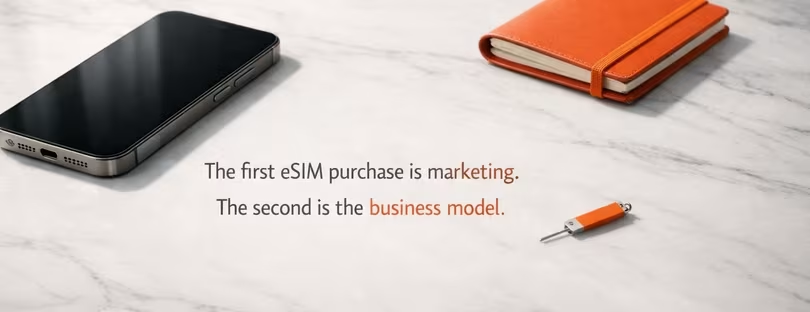
The second purchase is when the business model starts making sense.
Once the acquisition cost is spread across multiple transactions, each additional one contributes progressively more to the margin. This is the logic behind every feature designed to keep users engaged between trips:
- Data wallets / stored credit — unused balance creates a reason to return
- Travel-timed notifications — prompts aligned with peak booking seasons
- Loyalty incentives — small discounts for returning customers reduce the switching impulse
- Multi-region bundles — breadth of coverage becomes a stickiness mechanism
None of this is incidental. It’s CLV optimization, built into product design.
Existing Ecosystems Have a Structural Advantage
Here’s where distribution logic gets interesting.
Companies that already have millions of engaged users — travel booking platforms, fintech apps, airlines, super apps — don’t have the same acquisition problem. If they add eSIM as a feature, the hard part is already done. They promote it to users who already trust them, already open the app regularly, and already have payment details stored.
They significantly reduce the most expensive step in the entire model.
This is why traditional telecom is no longer the only industry worth watching in the eSIM space. The players with the best distribution aren’t necessarily the ones building eSIM-first products. They’re the ones who already own the customer relationship and are adding connectivity as a layer.
 A Growing Market, But a Crowded One
 A Growing Market, But a Crowded One
The macro picture is favorable. International travel is recovering, eSIM-compatible devices are now the default in most new flagship handsets, and awareness is rising fast. Juniper Research projects travel eSIM users growing from around 40 million in 2024 to over 215 million by 2028 — a signal of structural demand, not just hype.
But supply-side dynamics are working in the opposite direction. Connectivity-as-a-Service platforms have lowered the technical barriers to launching a travel eSIM brand dramatically. The result is a market where dozens of providers offer nearly identical products, competing primarily on price, coverage, and marketing spend.
When the product is undifferentiated, retention becomes the actual competitive advantage. And right now, many providers are still optimizing for acquisition, not retention.
The Psychology of the Home Screen
There’s a behavioral reality underlying all of this.
Most people regularly use a narrow set of apps. Everything else is passive inventory — installed but forgotten. For a travel eSIM provider, the difference between being in the active set and being in the passive set is the difference between a retained customer and a lost one.
If the app gets deleted, the relationship resets entirely. The next trip is a new acquisition battle.
That’s why the best eSIM apps are increasingly positioning themselves as travel companions rather than connectivity utilities — usage dashboards, destination context, travel timing prompts. The goal isn’t feature richness for its own sake. It’s staying relevant enough that the user doesn’t reach for the delete button during a nine-month gap between trips.
The Industry Is Already Splitting
The shift is already visible. Providers aren’t betting everything on one-time prepaid sales. The experiments underway include annual subscriptions, global always-on plans, business traveler packages, and embedded integrations inside larger travel platforms.
The direction is clear: move from transactional to recurring. From prepaid to relationship. From acquisition-dependent to retention-led.
What Comes Next
The travel eSIM boom is real — but the competitive dynamics underneath it are more complex than the growth numbers suggest.
Providers like Airalo, Holafly, Ubigi, and Yesim built scale by making eSIM simple and accessible. That was the right move for the early market. The next phase looks different: it’s about keeping users, not just converting them.
The industry is likely heading toward two distinct models. Pure-play eSIM brands that compete on product experience, community, and loyalty — and platform-embedded players that treat connectivity as one feature among many inside a broader travel or fintech ecosystem. The second group starts with a structural advantage: they don’t need to solve retention, because they already have it.
In that environment, the most valuable thing a standalone eSIM provider can own isn’t coverage or pricing. It’s the icon that survives on your home screen until the next trip.